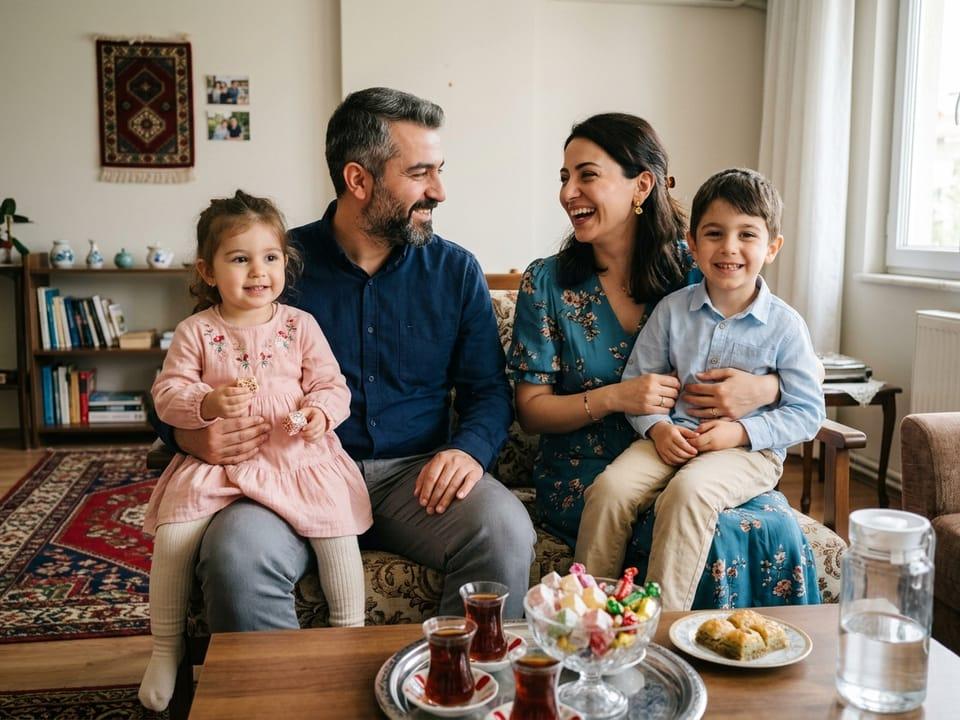
When the Ramadan (Ramazan) fast ends, families in Türkiye celebrate Ramazan Bayramı, also known as Şeker Bayramı, the "Sugar Feast." In 2027 the public holiday runs from the afternoon of 8 March through 11 March. The two moments worth planning for are the children kissing their elders' hands and touching them to their foreheads, and the morning in new clothes before everyone heads out. Both happen at home or at the grandparents', and a little forethought makes a real difference to what you end up with.
2027: from the afternoon of 8 March to 11 March
Ramazan Bayramı lasts three days, the 1st to the 3rd of Şevval in the Islamic calendar. Türkiye's public holidays are set by Act 2429 of 1981, and on top of the three bayram days, the afternoon of the eve (arife) is also a holiday, which makes three and a half days off in all.
Because the Islamic year is about 11 days shorter than the solar year, the holiday moves earlier every year. In Türkiye, the Presidency of Religious Affairs (Diyanet) publishes its calendar in advance, and the 2027 calendar was announced in August 2026. According to it, the fasting month starts on Monday 8 February 2027, the arife falls on Monday 8 March, and the bayram runs from Tuesday 9 to Thursday 11 March. Dates vary from year to year, so check Diyanet's calendar for later years.
The holiday-clothes photo happens on the morning of the first day. Have outfits and shoes ready by the arife afternoon and that morning will be a lot calmer.
Three days of cologne, sweets and visitors
There are two explanations for the name Şeker Bayramı. One starts with fitre, the charity given at the end of the fast, which is also known as the "charity of thanks." The word for thanks, şükür, is said to have turned into şeker, "sugar," over time. The other traces the name to the custom of starting the holiday by eating dates and sweets. The two names have become a matter of debate in Türkiye, and some people prefer Ramazan Bayramı because it keeps the religious meaning in front.
On the first morning, the bayram prayer is held at mosques, attended mostly by men. Many families buy the children new clothes (bayramlık) for the occasion, and the adults wear their best too.
Then come the visits: relatives, neighbors, friends. Hosts sprinkle kolonya (cologne) on guests' hands and offer sweets, Turkish delight and baklava. Pistachio baklava is the specialty of Gaziantep in the southeast.
Children greet their elders by kissing their hand and then touching it to their own forehead. It's something younger people do for older ones, mostly close family: parents, grandparents, aunts and uncles. Some elders give the children who kiss their hands a small gift or pocket money (harçlık). Little groups of kids going door to door to collect sweets is a classic bayram scene. Some families also visit the graves of loved ones.
At home in the morning: take the holiday-clothes photo before you leave
Photograph the children in their new clothes at home, before you head out, while nothing is creased and the shoes are still spotless.
Good spots are the front door, the balcony or a window. Indoors, window light through lace curtains is beautifully soft on faces. Don't stand your child with their back to the window or their face goes dark; put the window to one side instead. One full-length shot, one from the waist up, and one of siblings together. Five minutes is plenty.
When dad or grandpa gets back from the prayer, you can follow up with a family photo around the breakfast table. With a Turkish breakfast (kahvaltı) of small plates of cheese and olives and a pile of simit, take one shot of the whole table from slightly above before anyone starts eating.
Shoot the hand-kiss from the side, at child height
The photo that says bayram most clearly is a child kissing a grandparent's hand. Shoot it head-on and all you get is the back of the child's head, so move to the side and crouch down to the child's eye level. The kiss and the touch to the forehead take a few seconds, so use burst mode. If the grandparents are sitting on the sofa, the child will come up and lean in, so position yourself on the side where window light falls across both profiles and you'll get both faces bright.
If you miss it, try not to make the child do it over and over. Ask for one retake at most, and get yourself in position for the next child instead. A grandparent handing over the pocket money and a child holding out their hands for kolonya are just as much a part of bayram.
When the children go around the neighborhood, follow a little way behind and catch them peeking into their bags or skipping along. If neighbors or their doorways will be in the frame, ask first, or choose an angle that leaves them out.
Group photos: grandparents in the middle, no ultra-wide
With all the relatives in one place, this is the day for a group photo. The basic layout: grandparents in the middle of the sofa, other adults on either side, children on the floor or cushions in front, taller people standing at the back.
Your phone's ultra-wide (0.5x) lens distorts people at the edges, so stick to the standard lens and step back instead. Hold the camera at the eye level of the standing adults, or slightly above. Turn on every light in the room so that, together with the window light, even the corners are bright and nobody ends up with a shadowed face.
Prop the phone on a shelf or chair, set the self-timer to 10 seconds, and the photographer gets to be in the picture too. Take several, and you'll find one where everyone's eyes are open. If your family has a boy's sünnet (circumcision celebration) coming up in the summer, use bayram to try out how the relatives will line up, and the day of the feast will go more smoothly.
Put the camera away for prayers and the cemetery
Don't photograph people praying at the mosque. A visit to the cemetery is a time to put the phone away. And some relatives would rather not appear on social media, so it's only polite to check with the people in a photo before you post it.
Photograph inside the house and on the doorstep; leave the prayers and the cemetery alone. Agree on that line as a family at the start, and you won't have to think twice each time the phone comes out over the three days.
Some years relatives living in Germany or elsewhere abroad can't make it home for bayram. In that case, pokesta can create an AI family photo in holiday clothes in a bayram sitting room from each person's own phone photos. Your first photo is free after signing up, and after that it's $1 per photo.
Related articles:
References