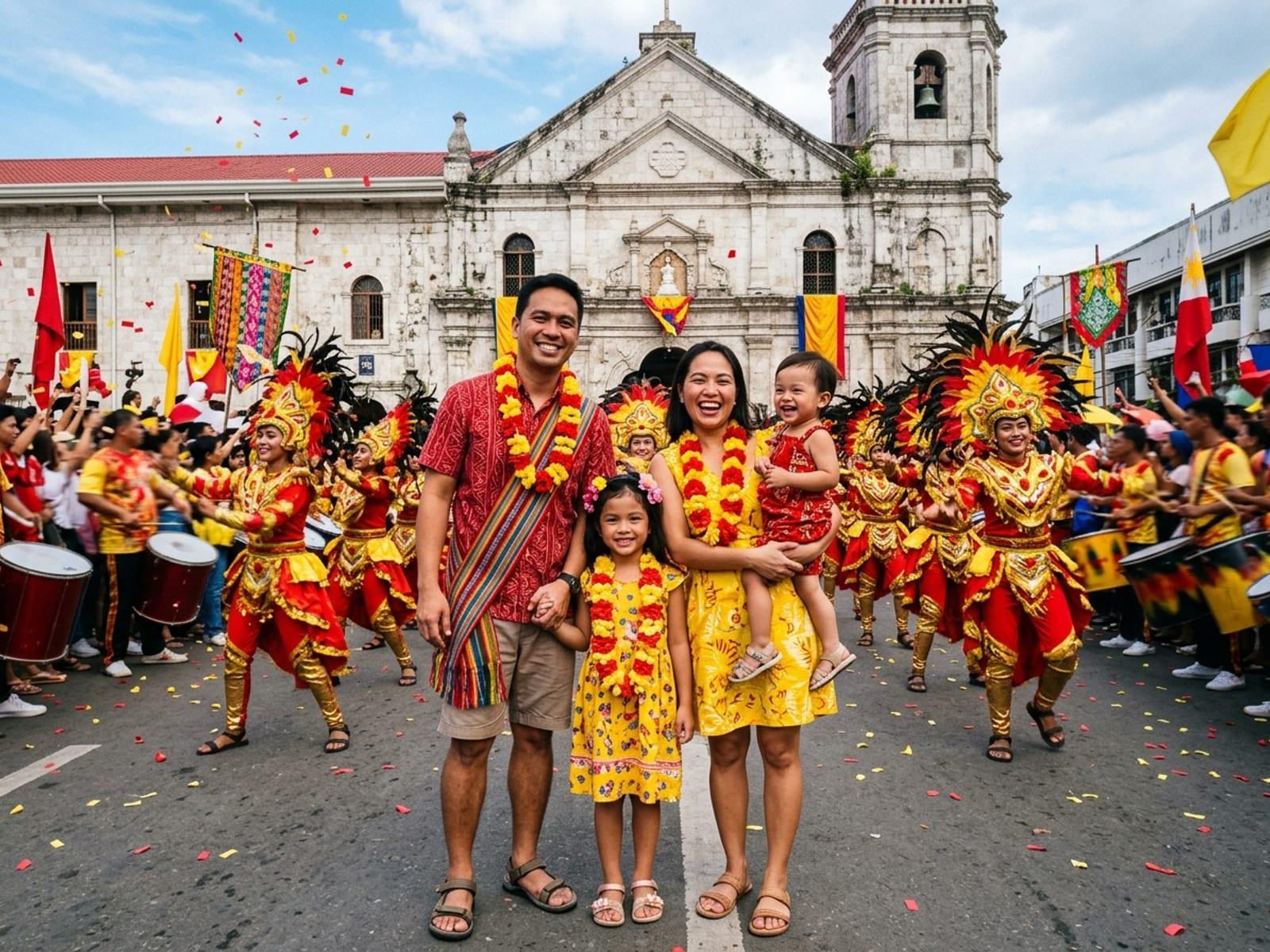
Sinulog is the festival held in Cebu City, in the central Philippines, in honor of the Santo Niño, an image of the Child Jesus, with its main day on the third Sunday of January (January 17 in 2027). The highlight is the Grand Parade, where dancers in vivid costumes move through the streets to drums, and in recent years crowds have reached into the millions. With children, choose one spot and a set time for the parade and keep it short, and visit the Basilica del Santo Niño on a quieter day before or after the festival.
A festival that began with an image of the Child Jesus 500 years ago
Sinulog's origins go back to 1521. When Ferdinand Magellan's expedition reached Cebu and Hara Amihan, wife of the local ruler Rajah Humabon, was baptized, Magellan presented her with an image of the Child Jesus. She is said to have taken the baptismal name Juana.
Some 40-odd years later, when the Spanish expedition led by Legazpi burned Cebu, a soldier found the image in the ashes. In 1565 a church was built on that spot, the beginning of today's Basilica del Santo Niño, considered the oldest church in the Philippines. Right next to it stands the chapel housing Magellan's Cross, said to have been planted by Magellan. It's a fixture of any visit to Cebu.
The name "Sinulog" comes from the Cebuano word sulog, meaning the flow of water. The dance step, two steps forward and one step back to the beat of drums, was likened to the current of a river. The festival in its present form began with the first parade, organized by Cebu City on January 20, 1980. The idea came from David Odilao, then regional director of the Ministry of Youth and Sports Development, who wanted a truly Cebuano festival, and the city's historical committee under Mayor Florentino Solon carried it out.
The main day is the third Sunday of January, with masses and processions all week before
The main day of Sinulog is the third Sunday of January every year, which falls on January 17 in 2027. The basilica celebrates it as Fiesta Señor, the feast of the Santo Niño, and holds nine days of masses (the novena) in the lead-up. Crowds of pilgrims visit the church throughout.
The basilica's published program for 2026 (main day January 18) shows how the week unfolds. It opened before dawn on Thursday, January 8, with the penitential "Walk with Jesus," which assembled at Fuente Osmeña in the city, followed by the opening mass. On Thursday the 15th came the Traslacion, when the Santo Niño image is carried from the basilica to neighboring Mandaue City and on to Lapu-Lapu City on Mactan Island. At 6 a.m. on Saturday the 17th, the fluvial procession set out: the image rides a decorated boat across the Mactan Channel for about two hours to Pier 1 in Cebu City, then returns to the basilica in a short procession. At 1 p.m. the same day, the solemn procession of the Santo Niño image leaves the basilica. Times and order change from year to year, so check the basilica's official website.
On Sunday, the Grand Parade begins after the early-morning mass. Dance groups from around the region move through the city streets, performing to drums in elaborate costumes. There's also Sinulog sa Kabataan, a dance competition for young people, so you'll see children dancing too. Sinulog weaves worship and dance together, which gives it a very different feel from a festival like Davao's Kadayawan in August, which celebrates the region's peoples and harvest.
The ritual showdown, where the dance groups are judged, was long held at the Cebu City Sports Center (CCSC). In 2023 and 2024 it moved to the South Road Properties (SRP), reclaimed land in the south of the city, but after complaints about the heat and the lack of water, shade and restrooms, it returned to the CCSC for the 2025 festival. The announcement at the time placed the street dancing on central city streets such as P. del Rosario, General Maxilom Avenue and Osmeña Boulevard. Attendance keeps climbing, and the 2026 festival was reported to have drawn more than 5.2 million people. Venues, routes and grandstand seating can change from year to year, so check the announcements from Cebu City and the Sinulog Foundation for the year you go.
Visit the Basilica del Santo Niño before or after the festival
On the main day the area around the basilica is packed, and on the Saturday before, the compound closes for part of the day ahead of the afternoon procession (from 11 a.m. in 2026). For a calmer family visit, go on a weekday during the novena or after the festival. The church became a basilica in 1965, and Pope Paul VI called it a symbol of the birth and growth of Christianity in the Philippines.
The 2013 earthquake badly damaged the bell tower and facade, but restoration was completed in 2016. The grounds include facilities for pilgrims and a museum where you can learn about the history of the Santo Niño image. Add Magellan's Cross next door, and one walk takes in the beginnings of Cebu's history.
Outside the basilica, candle vendors dance the Sinulog as a prayer. During the fiesta, every mass at the basilica ends with the traditional Sinulog dance. The cry you'll hear everywhere, "Pit Señor," is short for "Sangpit sa Señor," meaning to call on the Señor Santo Niño.
Keep your voices down during mass, out of respect for the people worshipping. Before going in, remind children that people are praying inside and that small voices are the rule.
Red and yellow for the parade, covered shoulders for church
Spectators have no dress code, but a family dressed in bright red and yellow fits right into the festive scene in photos and holds its own next to the dancers' costumes.
Even in January, Cebu has tropical sunshine. Wear breathable cotton or linen, and bring hats, sunscreen and drinks. You'll be standing along the parade route for a long time, so choose comfortable sandals or sneakers.
For the church itself, skip tank tops and very short shorts, and bring a light layer to cover your shoulders. Take photos discreetly so you don't disturb anyone at prayer.
Handling crowds of millions with small children
With millions of people attending, the parade route and the area around the basilica sometimes get so packed you can hardly move. So you don't lose each other, put a note with your contact details in small children's pockets and a brightly colored hat on their heads. A baby carrier is more practical than a stroller.
Watch out for pickpockets in crowded areas. Split up your valuables and keep your phone in front of you.
Hours of standing on a route with no shade wear children out fast. Pick the part you most want to see, keep your time on the route short, and find shade or somewhere to rest before you settle in.
Don't count on watching the fluvial procession from a boat with kids. In 2025, children aged 12 and under were barred from the outrigger boats joining the procession, and firecrackers and balloons were banned as well. With children, watch from land, or visit the image on another day once it's back at the basilica.
Book accommodation early. One family-friendly setup is to stay at a resort on Mactan Island, a little outside the city, and go into town only on festival day. Expect road closures and traffic jams on the main day, though, and leave plenty of time to get around.
Flying into Cebu and registering for eTravel
The gateway is Mactan–Cebu International Airport (CEB) in Lapu-Lapu City on Mactan Island. Three road links cross to mainland Cebu: the Mactan–Mandaue Bridge, the Marcelo Fernan Bridge, and the Cebu–Cordova Link Expressway (CCLEX), an 8.9-kilometer toll expressway opened in 2022 that runs from Cordova to the SRP in Cebu City. Traffic is often heavy even on ordinary days, so allow extra time during the festival. For a festival-day feast, sit down to Cebu lechon, the herb-stuffed roast pig. If your schedule has room, you can also cross to neighboring Bohol before or after the festival to see the Chocolate Hills and the tiny tarsiers.
Whether you can enter visa-free, and for how long, depends on your nationality. Before arrival you must register online with eTravel, the electronic travel declaration (registration opens 72 hours before departure).
eTravel itself is free, but paid agency services also turn up in searches, so register only on the Philippine government's official website. Confirm visa requirements before you leave, either in your own government's travel information or with the Philippine embassy.
References