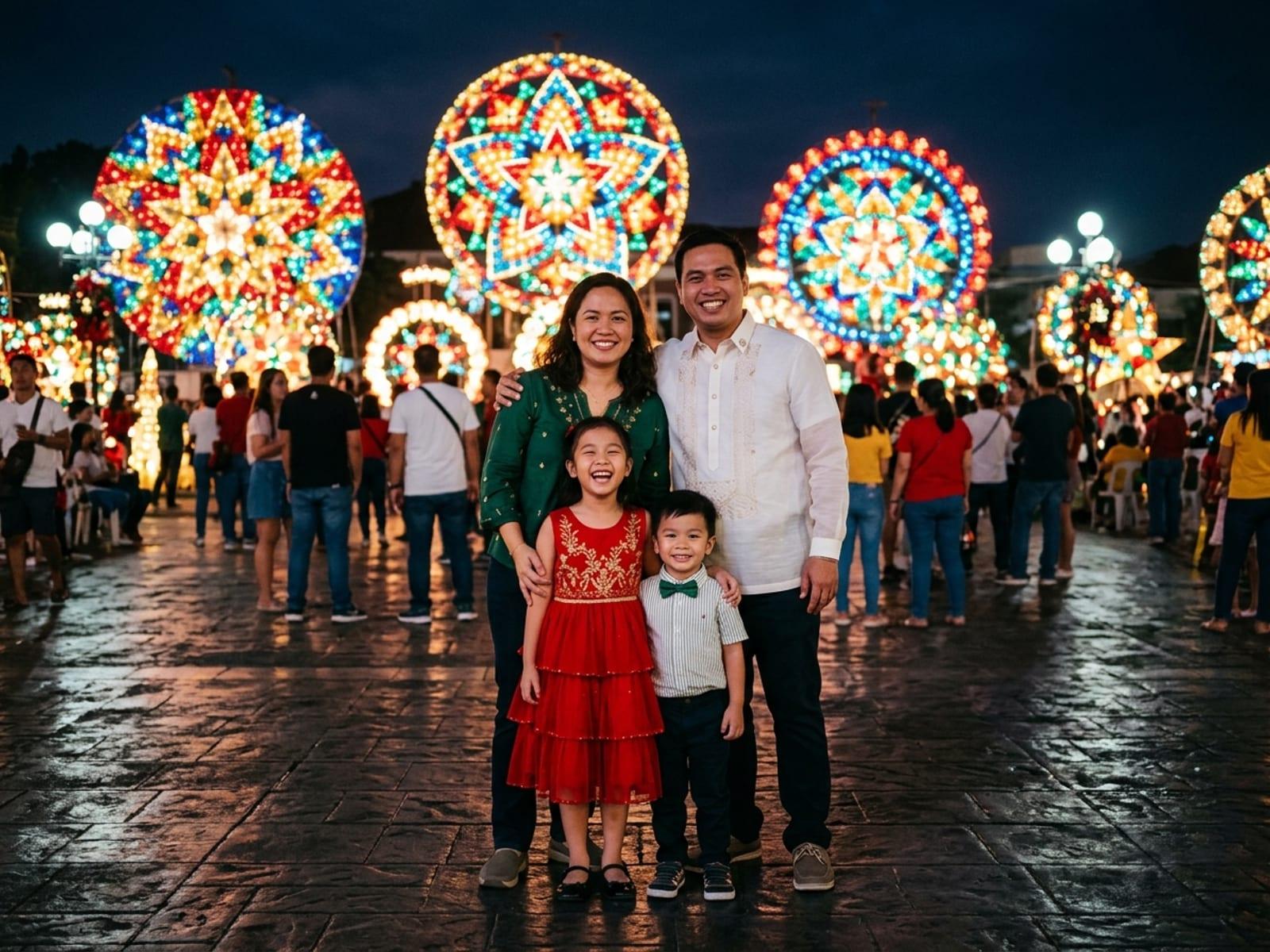
The Giant Lantern Festival, known locally as Ligligan Parul (the lantern contest), is held every December in San Fernando, Pampanga, northwest of Manila: star-shaped parol lanterns about 6 meters tall, wired with thousands of bulbs, compete in flashing patterns of light. The contest itself is a single night in mid-December, but the lanterns stay on display into the new year, which is why San Fernando is called the "Christmas Capital of the Philippines." With children, pick a quieter display night, arrive for the 6 p.m. lighting and plan to leave after about an hour.
From lights carried in night processions
The festival traces back to a religious tradition called lubenas in the neighboring town of Bacolor. During the novena, the nine days of prayer before Christmas, people walked in night processions carrying lanterns about 60 cm across. After the provincial capital moved from Bacolor to San Fernando in 1904, the lantern tradition carried on in San Fernando, and the Ligligan Parul lantern contest began. Accounts differ on whether the first year was 1904 or 1908.
Electric lights first went into the lanterns in 1931. From then on they kept getting bigger, and apart from cancellations in 1978 and 1979 under martial law and a display-only year during the COVID-19 pandemic in 2020, the festival has continued for more than 100 years. The 2025 festival was the 117th. The materials changed, too: colored plastic replaced the thin papel de hapon paper, and in 2010 lanterns of fiberglass and handmade paper appeared. Since 2024 the rules have required that at least 30 percent of the lights be LEDs.
The parol represents the Star of Bethlehem that announced the birth of Jesus. The lantern-making skills that grew out of this festival became a local industry, and parols large and small made by San Fernando artisans decorate homes, streetlights and offices across the Philippines.
The future of the craftsmen who can build the giant lanterns, though, is far from certain. A 2025 news report described how fewer young people are learning the craft, with the makers themselves saying they may be the last generation. Knowing that the patterns of light in front of you come from months of handwork each year changes, a little, how you see them.
Hand-turned "rotors" make the lights dance
The giant lanterns aren't impressive for size alone. What draws people is the way their patterns of light shift one after another in time with music. According to 2025 reports, a single lantern can weigh up to about a ton. It has 12,000 bulbs of 50 watts each and as much as 15 km of cable, and a team of about 20 people spends three months building it. The cost can reach a million pesos per lantern.
The lights are controlled by a "rotor," a large metal drum. In the old days the bulbs were switched on and off with hand switches; now people turn this drum by hand to switch the bulbs on and off. As it turns, the patterns open and close like a kaleidoscope. It's a light show run by human hands, not electronics.
The 2025 contest took place on Saturday, December 13, with 10 of the city's barangays (districts) competing with lanterns about 6 meters tall. The venue was the Robinsons Starmills shopping mall, where the event has been held since 2008.
Contest night, or a display night?
Contest night draws thousands of spectators and gets extremely crowded. It's the most dramatic option, but with small children, going to the displays after the contest is a perfectly good choice. In 2025, the winning lanterns and others were shown at Starmills every night from 6 p.m., from December 14 to 23 and from December 25 to 30. On Christmas Eve, the 24th, there was a lighting at 9 p.m. around city hall and the Metropolitan Cathedral, and the season wrapped up with a finale at 6 p.m. on January 1. Dates and venues change from year to year, so check the city's announcements.
Since this is a night outing, it's important to work around bedtime. Arrive in time for the 6 p.m. lighting, watch for about an hour, then head home. A short plan like that gets you out before the kids get sleepy and cranky. Sparks sometimes fly from the turning rotors, and firefighters patrolled the grounds at the 2025 event. Don't get too close to the lanterns, and keep hold of your children's hands.
San Fernando's craftsmen also make small parols for the home. One sized to hang in a window makes a souvenir you can bring out every Christmas. Carry it in your hand luggage so the frame doesn't get crushed. If the kids help pick the colors and shape, every year when you put it up you'll have the night you stood under the giant lanterns to talk about.
For photos, use the lanterns as a backdrop and watch the exposure
In the Philippines, the Christmas season is an important time when families go to church together and relatives gather. There's no dress code, but working in one Christmas color, like red, green or gold, makes a photo in front of the glowing lanterns feel like a proper seasonal keepsake. In some families the father wears a barong, the embroidered formal shirt, and a white barong catches the night light beautifully. December nights are cooler than the days, so bring a light layer for the kids.
When you photograph people with a lantern behind them, the lantern is so bright that faces tend to come out dark. On a phone, tap the face to set the exposure, then shoot in bursts to catch the moment the lights form a pattern. Using the flash makes the background light patterns look weaker, so try to avoid it.
A shot of the family lined up in front of a glowing parol can also be made with pokesta's AI photos ($1 per photo, and your first one is free). You can see Christmas photos from the Philippines taken by other families on the community posts page.
Fly into Clark; it's also a day trip from Manila
The nearest international airport is Clark International Airport (CRK) in Pampanga. It has international flights to and from cities in Asia and the Middle East, including Seoul, Hong Kong, Singapore and Tokyo (routes change over time). You can also head northwest overland from Ninoy Aquino International Airport (MNL) in Manila.
If you're going on contest night, staying near the venue cuts down on late-night travel and makes things much easier for the kids. You can also spend the day in Angeles, in the same province, eating sisig where the sizzling dish was born, and see the lanterns at night. Once the new year comes, Cebu holds Sinulog in January. The Christmas season in the Philippines is a long one, and the festivals keep going right along with it. Entry requirements vary by nationality, so check your own government's official information before you travel.
References