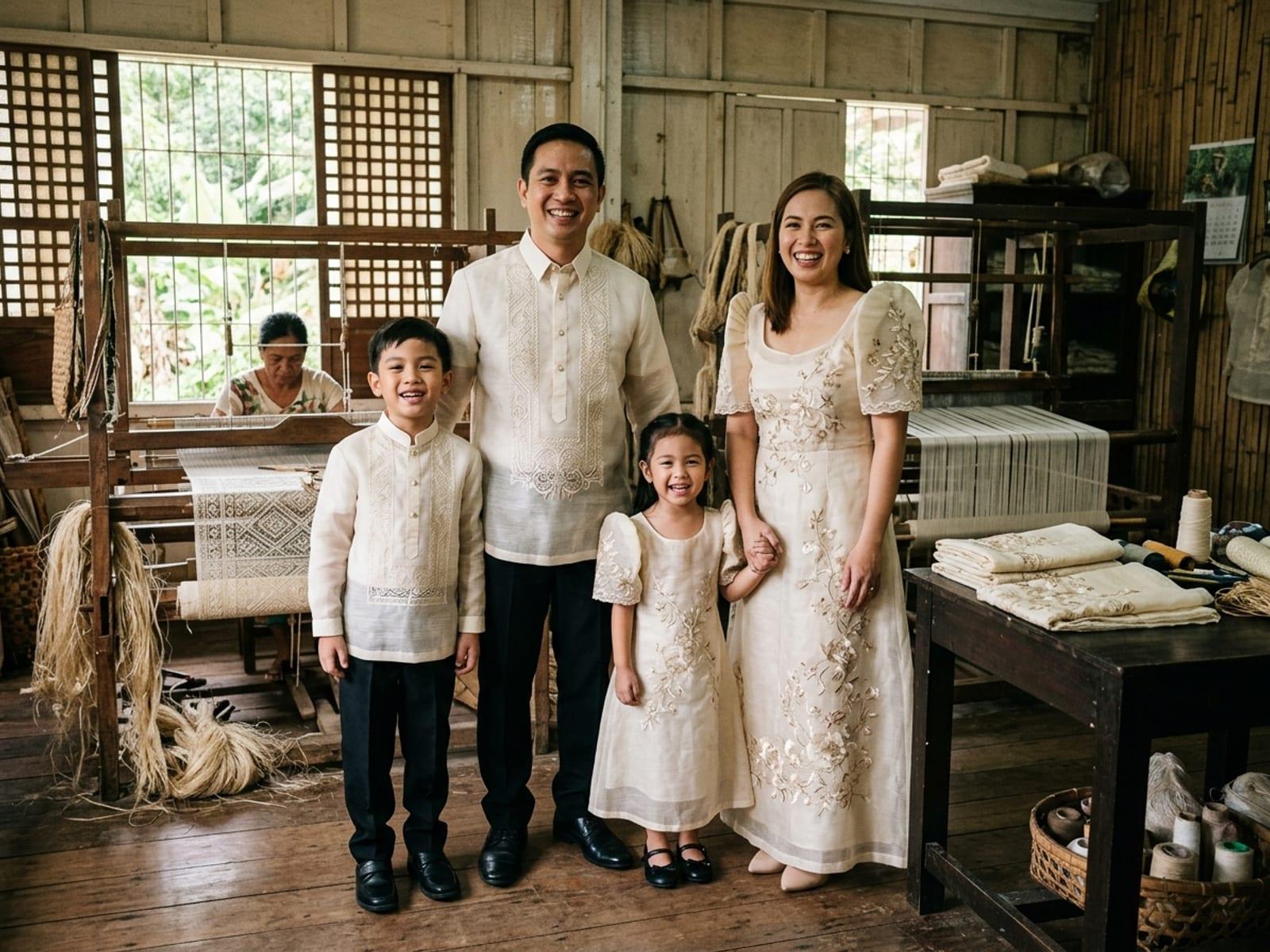
Piña is a sheer, crisp cloth woven by hand from pineapple-leaf fibers that are scraped out and knotted together one by one, and it is used for the finest barong tagalog, the formal shirt of Filipino men. Its oldest and largest center is Kalibo, capital of Aklan province in northern Panay, and in 2023 "Aklan piña handloom weaving" was inscribed on UNESCO's Intangible Cultural Heritage list. Workshops can be visited in any season, and because Kalibo's airport, a gateway to Boracay, is only about 2 km from town, families can fit a visit into half a day before or after the beach.
From leaf to thread, entirely by hand
Piña starts with pineapple leaves. UNESCO identifies the type used in Aklan as piña bisaya. Growing pineapples for fiber goes back to at least the 17th century, with a cultivar called Red Spanish.
The process begins with cutting the leaves. The fibers are drawn out of each leaf, scraped and cleaned one by one by hand, then knotted together one by one into long threads. Only when that thread goes onto a handloom does it finally become cloth. The fiber is weighed using a method peculiar to the area, with old coins as counterweights. Every single knot is tied by hand, so it takes a long time before the cloth is finished.
The craft has mostly been passed down within families. Children grow up watching older relatives grow piña bisaya and weave the cloth, and in time they're taught and start weaving themselves. What UNESCO inscribed is not the cloth itself but this whole body of knowledge and skill, from growing the plants to weaving, and the practice of handing it on.
From a Spanish-era luxury to the cloth of formal wear
Pineapples were brought to the Philippines by the Spanish, and the weaving technique is thought to have grown out of the methods already used to weave abaca (Manila hemp). In the colonial period piña became a valuable export, and in the 18th and 19th centuries it was a favorite of European aristocrats.
The industry nearly died out during the Japanese occupation in World War II, but it revived from the 1960s, and Kalibo piña is still exported to North America and Europe today. Its main use now is the men's barong tagalog. It has also been used for women's traditional dress such as the baro't saya and the traje de mestiza. UNESCO, too, describes piña as a fabric favored for formal wear. The barong is what you wear to formal occasions, and a sheer piña barong is a step above the rest.
Visiting a workshop in Kalibo
One place to see piña cloth and products up close is Dela Cruz House of Piña in New Buswang, Kalibo. It's a workshop and showroom run by the family of a woman who organized Kalibo's piña weavers in the mid-1980s, and admission is free. The two-story house is filled with folded barong tagalog, embroidered cloth, bags and small goods, and there are traditional looms as well.
Some piña is decorated with hand embroidery called calado. Embroiderers in Lumban, an embroidery town in Laguna province on Luzon, are said to buy piña cloth woven in Kalibo to embroider. In a single piece of cloth, the handwork of two places, one weaving and one embroidering, comes together. Laguna is also home to Paete, the woodcarving town that makes taka papier-mâché toys, so a trip around Luzon's craft towns can take in both.
Opening hours and whether visitors are welcome can change, so call ahead or check before you go. Piña production still depends on a network of local weavers, and everything from extracting the fiber to weaving is done the old way.
The showroom also stocks other Aklan crafts besides piña. One is nito, a fern native to the area that's dried and woven into baskets, trays and other small items; this workshop has carried nito products since 1992. Another is abaca, a fiber from a plant related to the banana, made into wallets, footwear, coasters and the like. Even if piña clothing is out of reach, a small nito basket is just the right size for a child to choose as a souvenir.
Keeping old patterns while weaving new ones
According to UNESCO, piña weavers preserve patterns handed down for generations while continuing to create new designs. The skills are passed on not only within families but also through Schools of Living Tradition, where tradition bearers teach in their communities, and there are institutions that run training in growing and weaving. Piña is the most prized traditional textile in the Philippines, and weaving it is also work that supports families and communities. That too is counted as an important part of its value as intangible heritage.
Sheer cloth changes character depending on the direction of the light when you photograph it. Stand by a window, in a spot where light comes from behind the fabric, and the fineness of the fibers and the embroidered patterns stand out. For a family portrait, light faces with bright light from the front and let the sheerness show at the shoulders and sleeves, and you'll capture both.
With children: look first, touch only when invited
Looms and fibers are extremely delicate. Tell children beforehand that this is a place where people are kindly showing you their work, and that they can touch things only when invited to. Ask before photographing a weaver's hands, too. If you're allowed to watch, stand beside your child and follow the fingertips knotting the fibers one strand at a time.
Because the cloth takes so much work, piña clothing tends to be expensive, and it isn't really suited to children's clothes that are outgrown quickly. If you want one piece as a family keepsake, starting with an adult's barong or shawl, or a small handkerchief or accessory, keeps things reasonable. The cloth is thin, so pack it flat in your hand luggage to avoid fold creases on the way home. Ask the shop how to wash and store it when you buy.
If you want to see how your whole family would look in piña formal wear before you choose, you can try it with pokesta's AI photos ($1 per photo, and your first one is free).
Kalibo is a short drive from the airport
The nearest international airport is Kalibo International Airport (KLO), about 2 km east of the center of Kalibo. It serves as an international gateway to Boracay, with domestic flights from Manila as well as international routes to places like Seoul (Incheon) (routes change over time). If you're flying in or out this way for Boracay, setting aside half a day in Kalibo on your arrival or departure day is all it takes to fit in a workshop visit.
Piña can be seen in any season. Head to Iloilo City in the south of the same island and you can add La Paz batchoy, the noodle soup born in a public market, and a boat across to the mango orchards of Guimaras. Entry requirements vary by nationality, so check your own government's official information before you travel.
References