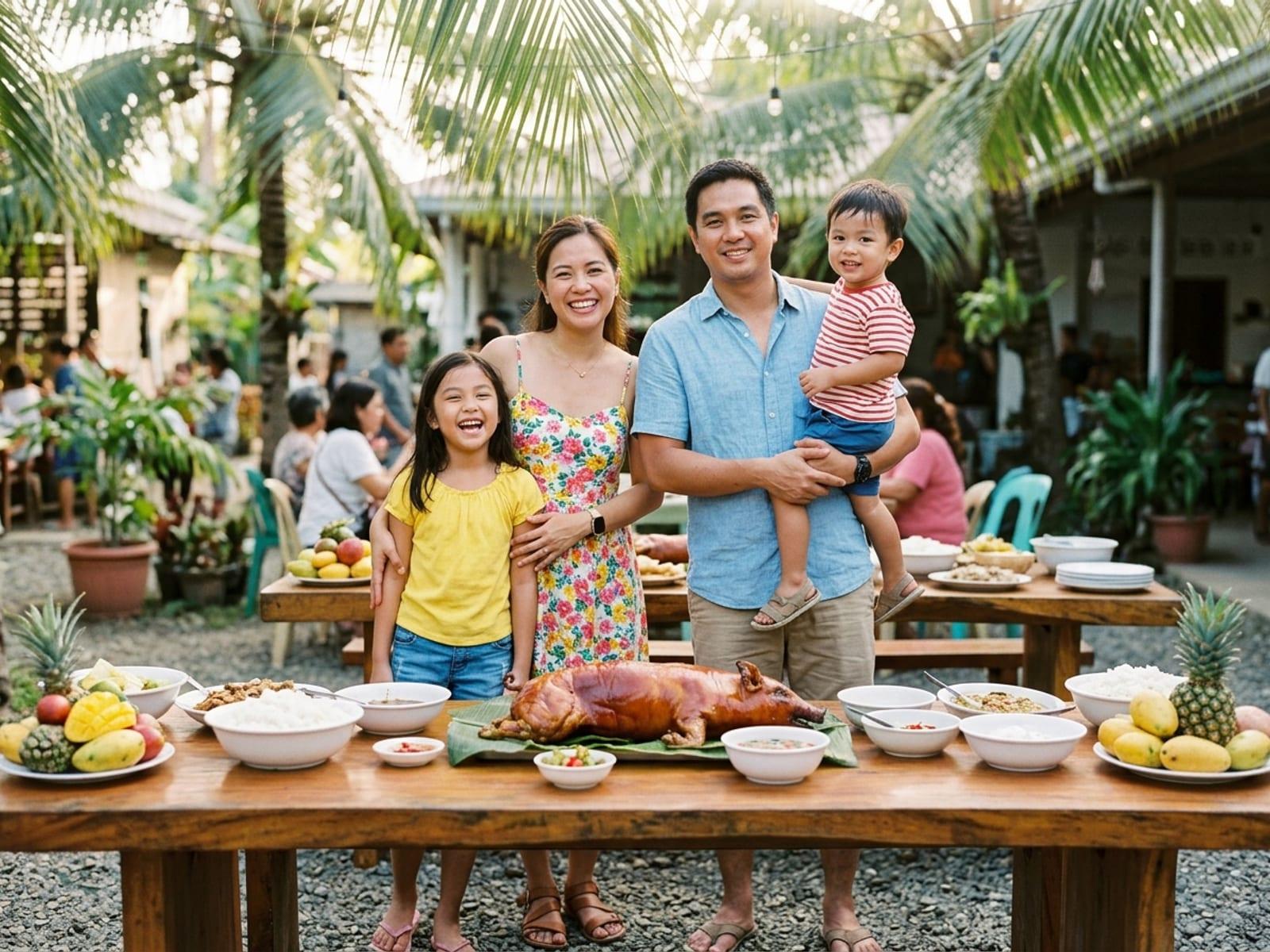
Lechon is a whole pig skewered and roasted over charcoal, the centerpiece of Filipino celebrations. Filipinos use the word for almost anything spit-roasted whole, so the names tell you the animal: lechon baboy is pig, lechon baka is a whole cow spit-roasted the Filipino way (baka is Tagalog for cow, so in English it's a whole roasted cow, or roast beef), and a piglet still on its mother's milk is lechon de leche. Cebu's pig is stuffed with herbs, roasted for hours and eaten without any sauce, and you can find it all year in Cebu City and in Talisay and Carcar to the south. As a family, eat the shattering skin first while it's fresh from the fire, break it into small pieces for little ones, and pick out the tender meat for them.
A Spanish name for a much older dish
The word lechon comes from Spanish, where it originally meant a roast piglet still fed on its mother's milk (leche). In the Philippines the meaning widened to cover any roast pig, which is why a true piglet gets the extra "de leche," literally "of milk." Roasting a whole pig, though, is thought to have existed in the Philippines before Spanish colonization. Pig raising is believed to have arrived with the Austronesian peoples who spread across the islands of Southeast Asia and the Pacific, and in the Philippines pigs have been roasted for celebrations since long ago. Unlike the roast suckling pig eaten in Spain, Filipino lechon is normally made from a pig that has already been weaned.
Lechon is food for special days. It's prepared for family celebrations, town fiestas and holidays, and it takes center stage at Noche Buena, the family meal on the night of December 24. Roasting a whole pig takes time and money, so a lechon appearing on the table is itself a signal that today is a celebration.
Cebu style and Manila style differ in stuffing and sauce
Filipino lechon falls broadly into two styles: the Visayan way of Cebu and nearby islands, and the Luzon way of Manila and the north.
In Cebu style, the pig's belly is packed with herbs and aromatics: scallions, bay leaves, peppercorns, garlic, salt, lemongrass, and the leaves of citrus or tamarind. It's roasted over charcoal made from coconut shells, and there's barely any sauce. At most it comes with salt and vinegar, or sili-mansi, a mix of the small calamansi citrus and chili. When it's carved at the stall, the herbs spill out of the belly and the aroma fills the air.
Manila style, by contrast, is roasted with just salt and pepper and eaten with a sweet-savory lechon sauce made from liver with vinegar, sugar, breadcrumbs, garlic and so on. Which is better comes down to taste, but Cebu lechon's strength is that it's full of flavor with no sauce at all. The American chef Anthony Bourdain famously praised Cebu's as the best pig ever.
Skewered on bamboo, hours over charcoal
The traditional method is to skewer the pig on a bamboo pole, hold it over charcoal and turn it by hand for several hours. In Cebu, it's said to be roasted slowly for about five hours. Salt and spices are rubbed into the skin, and basting it as it roasts finishes the surface into skin that cracks like glass.
The lechoneros, the people who sell lechon in Cebu, are said to have started out in Talisay, south of Cebu City. In the 1920s, Talisay's lechoneros began making charcoal-roasted pig they called inasal. Further south, Carcar is known for shops that serve a sauce made from drippings collected in a pan under the pig, so you can taste a slightly different style even within Cebu. Lechon belly, where only the belly is rolled and roasted, is said to have been born in Balamban on Cebu's west coast in the 1930s. It's a more manageable size than a whole pig, which makes it an easy order for a family meal.
Lechon isn't only pork
Besides lechon baboy and lechon baka, there's lechon manok, whole roast chicken. In Cebu, a whole chicken roasted over charcoal is also called manok inasal, and the chopped-up version is called sinugbang manok.
If anyone in your family doesn't eat pork, or can't handle fatty food, charcoal-roasted chicken like this is a lifesaver. If you're eating with people who avoid pork for religious or health reasons, check whether a place has chicken or fish dishes when you choose where to go. Lechon is a dish where everyone gathers around one pig, and it's most fun when everyone can share the meal.
Some shops in Carcar also serve humba lechon, lechon meat braised sweet and savory with garlic, onion and star anise. It's a different pleasure from fresh-roasted lechon, the kind of dish that has you reaching for more rice. One of Talisay's long-established shops is said to still keep its founding family's original recipe secret, and each town and each shop holds on to its own slightly different flavor.
Eating with kids: get to the skin while it's hot
The real prize of lechon is the skin. Fresh from the fire it cracks crisply, but it turns damp and tough as it sits, so start with the skin as soon as you arrive. The skin can be hard and difficult for small children to bite through. Have an adult break it into small pieces first, and pick out tender parts of the meat for them. It's a fatty dish, so have small amounts at a time with white rice and fruit. The skin is heavily salted, so bring plenty to drink as well.
Popular shops can sell out, so going early at lunchtime is the safe bet. Lechon tends to leave hands and mouths greasy, so wet wipes and clothes you don't mind getting messy make for a more relaxed meal.
For photos, the best moment is when the lechon is set on the table, before it's carved. Once the cutting starts, the whole-pig look disappears fast. Have the family line up on the far side of the table and put the lechon large in the foreground, and you'll get both the impact of the dish and everyone's faces in one shot. The shine on the skin shows up best in natural light from a window or in outdoor shade.
What isn't finished usually becomes lechon paksiw, a standard in Filipino homes, where the leftovers are simmered in vinegar along with the head and feet. Cebu's paksiw is said to be more salty than sour. Leftovers are sometimes chopped and fried on a hot plate as sisig, too. Sisig took its modern form in Angeles City, Pampanga, and our piece on eating sisig in Angeles covers it in full.
Available year-round, not far from Cebu's airport
Lechon isn't seasonal; you can eat it any time of year. The gateway airport is Mactan-Cebu International Airport (CEB), on Mactan Island next to the main island of Cebu. You can eat lechon in Cebu City, but if you have time, head south to Talisay or Carcar and compare how each town does it. If you cross to neighboring Bohol, the Chocolate Hills and the tiny tarsiers are an easy natural sight to share with children.
If you visit Cebu in January, you could pair it with Sinulog, when the whole city becomes a festival, and have lechon as your festival-day feast. Before the trip, you can also make a photo of your family around a lechon table with pokesta's AI photos ($1 per photo, and your first one is free). Rules on carrying food and entry requirements vary by nationality, so check your own government's official information before you travel.
References