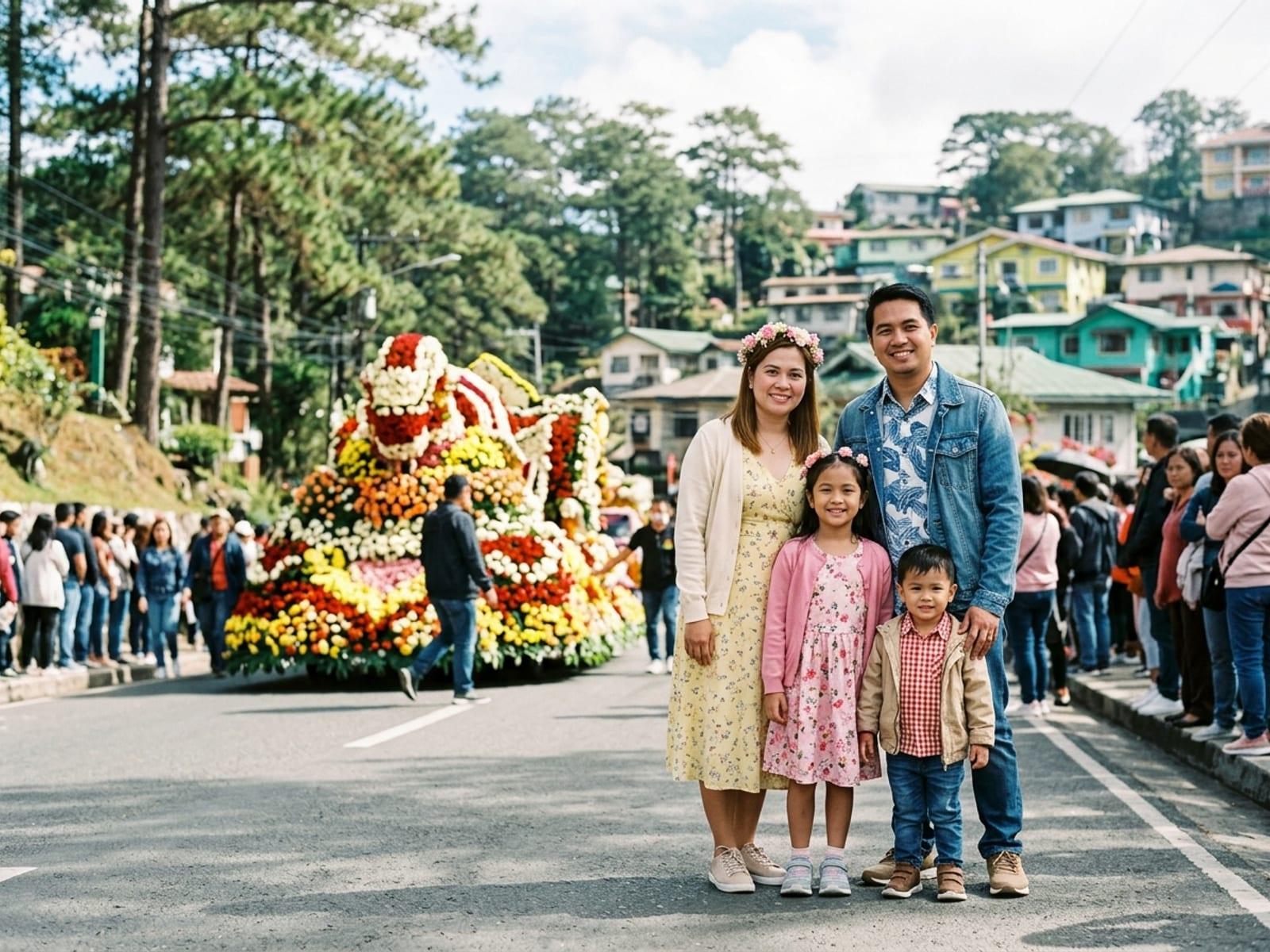
Panagbenga is the flower festival of Baguio, a highland city in northern Luzon, and it runs for a little over a month centered on February, with parades of floats covered solid in fresh flowers as its highlight. Around them come a street dance parade, a market with exhibitors from across the country, garden displays, contests from kite-flying to bouquet-making, and fireworks on the final night. The basic rule is to aim for the weekend at the end of February or start of March, when the street dance and float parades run back to back. February mornings are cold enough for a jacket and the parade route gets very crowded, so families should pack layers, pick one viewing spot and get there early.
A "season of blooming" born after an earthquake
Panagbenga means "season of blooming" in Kankanaey, one of the languages of the region. The festival began in February 1996 as the Baguio Flower Festival and has used the name Panagbenga since 1997. Baguio had been badly hit by the major earthquake that struck Luzon in 1990, and the city started the festival to celebrate its flowers and give its recovery a lift. February was chosen to draw visitors during a lull in the tourist calendar, between Christmas, Holy Week and the summer holidays. It is organized by the Baguio Flower Festival Foundation (BFFFI), and 2026 marked its 30th edition.
Around city hall, Baguio sits at roughly 1,465 meters above sea level. It's cool enough to be called the "Summer Capital of the Philippines," and its many pine trees have earned it another nickname, the "City of Pines." In February, average highs are around 23°C and average lows around 13°C. For people escaping the sticky heat of the lowlands, the mix of flowers and crisp air is a big part of the appeal.
Go on the last weekend of February, for two days of dance and floats
The festival dates change from year to year. In 2026 it ran from January 30 to March 8. An opening parade with school dance troupes and other groups took place on February 1, and for 2026 the organizers said anyone in the community was welcome to join it. From then until the last day the market stays open and contests follow one after another.
The big days come at the end of the month. In 2026 the Grand Street Dance Parade was on Saturday, February 28, followed by the Grand Float Parade on Sunday, March 1. The street dance costumes take their inspiration from the bendian, a dance of the Ibaloi, an Indigenous people of the region: the bahag loincloth for men and floral dresses for women. The floats are elaborate affairs covered in flowers, and 2024 saw a record 34 of them. For 2026 the top prize in the large float category went up from ₱600,000 to ₱1 million.
If you want good photos of the floats, shooting at a slight angle, close enough to see the texture of the petals, gets across the scale of all those fresh flowers better than a straight-on shot of the whole thing. The floats keep moving, so if you want the kids in the picture, turn to face the direction the float is coming from ahead of time, and take a burst of shots in the few seconds it takes to pass. The same goes for the dancers. Don't lean out from the curb into their path; stay back so you don't get in the way of the performance.
After the parades comes Session Road in Bloom, when Session Road, the main street, becomes car-free for about a week (March 2 to 8 in 2026). Cafés and flower stalls set up along the pavement, and it's far easier to walk around than on parade days. The festival closes with a fireworks display called Flowers in the Sky on the final day.
Dress in layers for highland mornings
There's no set costume. Since it's a flower festival, floral shirts and dresses, or clothes in flower colors like red and yellow, will look right at home in photos with the floats behind you. A small crown of fresh flowers suits young girls nicely.
The thing to plan around is the temperature. People start claiming spots along the parade route early in the morning, and before the sun comes up the highlands get properly cold. By midday, though, the sun is strong. Layer a cardigan or light jacket over short sleeves, and bring a bag to stuff them into, and you'll be fine from dawn to afternoon. Don't forget hats and sunscreen. Baguio is a city of hills, so wear sneakers you've already broken in.
Between the parades: markets, kites and highland dances
The weekends between the two parades have their own program. In 2026 there was the Flower Tee golf tournament on January 30 and 31, bouquet-making and dish garden contests for schools on February 7, an oil-painting competition and a kite-flying challenge on February 14, and Rhythm of the Highlands on February 15, when Cordillera groups showed their dances and heritage. Panagbengascapes, a landscape exhibition and design challenge, opened with the opening parade and stayed up until the last day, March 8, which closed with the Little Ms. Panagbenga pageant and the fireworks. With small children, the kite day or the garden displays are far easier going than a parade curb. The line-up and dates change every year, so check that year's announcements.
The market is the Baguio Market Encounter, which in 2026 ran from February 1 to March 8 with hundreds of exhibitors from across the country selling crafts and food on a flower or strawberry theme. Strawberries grow in the cool country around Baguio and are shipped to city markets across the country, which is why strawberry treats turn up at the festival stalls: they're a local product. For children, picking out a strawberry sweet may end up being a more lasting memory than the parade itself.
With kids, pick a spot and stay put
Parade days draw huge crowds along the route. The 2024 float parade reportedly drew an estimated 32,000 spectators. Moving through a crowd like that with small children is hard work, so the realistic plan is to choose one place to watch, get there early and stay there. The route changes from year to year. In 2026 the opening parade started from the upper end of Session Road and followed the city's main streets to the Melvin Jones Football Grounds. The 2024 float parade likewise ran from Session Road to the Melvin Jones Grandstand in Burnham Park. Check the route and road closures for your year in announcements from the city or the organizers.
On parade days you often can't push a stroller through the crowds on the curb, and the streets are steep. For babies and toddlers, a carrier is much easier. It also helps to find out in advance where the toilets are in nearby malls or hotels. Families who don't do well in crowds can skip parade days altogether and go for Session Road in Bloom afterward, or a walk around Burnham Park in the center of town. Bring both cash and an e-wallet for the market stalls.
On parade days you'll be heading out before dawn to get a spot. Buy the kids' breakfast the night before so they can eat at the curb, and the morning becomes a lot less frantic. The wait is long, so a small folding mat and a picture book or two to keep the kids occupied go a long way.
If you'd like to see what your family might look like standing in front of a flower float, you can try it before you go with pokesta's AI photos ($1 per photo, and your first one is free).
Book early, and fly into Clark or Manila
The nearest international airport is Clark International Airport (CRK) in Pampanga, about 163 km from Baguio. You can also travel overland from Ninoy Aquino International Airport (MNL) in Manila. Either way, it's a fairly long trip that includes mountain roads. With children, it's easier to spend your arrival day just getting to Baguio and watch the parades on a later day.
Accommodation in the city fills up fast for parade weekend, so book as soon as the dates are announced. The 2026 schedule came out in mid-January. Another Philippine festival, Sinulog in Cebu in January, takes place in midsummer-like heat. Panagbenga, with its flowers and cool air, calls for different packing and a different pace altogether. Flower floats also star in the parade of Davao's Kadayawan Festival in August. If you want to see more of the northern mountains, January to April is also the easiest time to walk the rice terraces of Banaue and Batad, which makes the two easy to combine. Entry requirements for the Philippines vary by nationality, so check your own government's official information before you travel.
References