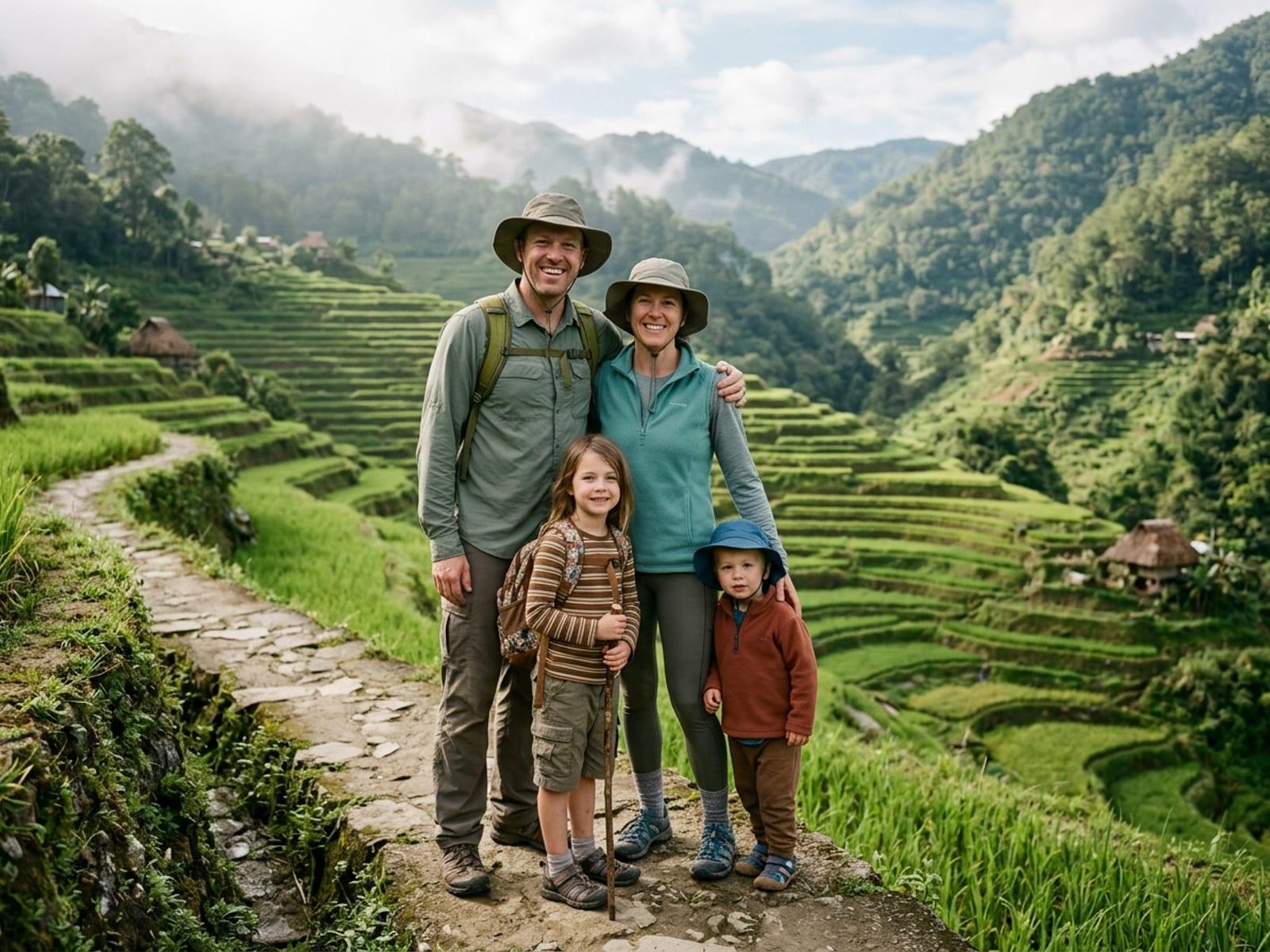
The Ifugao rice terraces are stepped paddies built by the Ifugao people on the mountainsides of Ifugao province in northern Luzon, still farmed today, and they were inscribed on UNESCO's World Heritage List in 1995 as the "Rice Terraces of the Philippine Cordilleras." For the famous view from a roadside viewpoint, go to Banaue; to walk through an amphitheater of terraces, go on to Batad. Banaue is a 9–10 hour night bus ride from Manila, so families should aim for the drier months of January to about April, stick to the viewpoint with a baby, and walk the terrace paths once children can manage on their own feet.
Forests hold the water, and the water feeds the fields
The Ifugao terraces are a system for growing rice on mountain slopes more than 1,000 meters above sea level. Above each cluster of terraces is a forest called a muyong, maintained by the community. Around 264 plant species grow in the muyong, many of them found nowhere else, and the forest soaks up and stores rainwater. Water seeping out of the forest is channeled to the terraces, which hold water all year. It's this whole system, forest, water and fields working as one, that gives the site its World Heritage value. Among World Heritage Sites, these terraces were the first to be listed in the category of "cultural landscapes," places shaped jointly by people and nature.
The landscape hasn't always been secure. Forest loss and changes in climate left terraces falling into disrepair, and in 2001 the site was placed on the List of World Heritage in Danger. Conservation work paid off, and it was taken off that list in 2012. Visitors can walk the terraces today because people are still looking after them.
When the terraces were built is still unsettled. An older theory puts them at more than 2,000 years old, while other researchers argue they're much more recent. One view holds that taro was once the main crop and rice only took over around 1600.
Farm work follows the phases of the moon, the weather and the state of the water, and pests have traditionally been dealt with using herbal remedies and religious rituals. The Hudhud, long narrative chants sung by older women at sowing, harvest and funerals, was also inscribed on UNESCO's Intangible Cultural Heritage list in 2008. After the harvest, it's said, days are set aside as a rest from farm work.
The rice that grows on the terraces
Rice here is slow to grow, taking about six months. At the Mayoyao terraces, one of the five World Heritage clusters, a rare red and white rice called tinawon is grown without chemical fertilizer. Walk the terraces, then eat the rice they grow: it's hard to think of a more direct way to understand a place through its food.
The Ifugao are also known for their crafts: woodcarving, weaving and basketry. A museum in Banaue holds a collection gathered by the anthropologist H. Otley Beyer.
Banaue's viewpoint, and Batad's "amphitheater"
The five terrace clusters on the World Heritage list are Batad, Bangaan, Hungduan, Mayoyao and Nagacadan. Batad and Bangaan fall within the municipality of Banaue.
It may come as a surprise, but the famous terraces you see from the viewpoint near Banaue town are not part of the World Heritage listing, because there are modern buildings around them. They are still magnificent, and were declared a National Cultural Treasure of the Philippines in 1973. The viewpoint is by the road and open 24 hours. For families with small children, or anyone short on time for walking, the view from here is plenty to start with.
If you have energy to spare, head to Batad, famous for terraces that wrap around the mountainside like an amphitheater. From Banaue it's about 15 km on a rough road to Saddle Point, a pass, and from there about 40 minutes downhill on foot into the village. A jeepney runs daily from Banaue town to Saddle Point, but there are only a few trips, and the ride back may leave only in the morning. Times change, so check at the town's tourism office before you set out. The way back means climbing that slope, so with your children's stamina in mind, consider staying a night in the village.
Getting ready to walk with kids
Banaue sits at an average elevation of about 1,300 meters. Daytime highs are 21 to 26°C, and mornings and evenings drop to 15 to 19°C. Even so, there's almost no shade on the terrace slopes, you'll sweat on the climbs, and heatstroke is a real risk. Bring a hat, water, a thin long-sleeved shirt and a layer for the mornings and evenings for everyone. On your feet, wear non-slip sneakers or trekking shoes.
The paths along the terrace walls are narrow, and in places there's a drop on one side. Hold your children's hands, or have an adult walk on the valley side. Carrying a baby in a carrier on these paths isn't a good idea, because it's hard to see your feet. With an infant, it's safer to build the trip around the viewpoints.
The terrace paths are the edges of someone's fields. Talk to the kids beforehand so they don't slip and knock stones off the walls or step into the paddies. When you arrive, you're expected to pay an environmental fee (50 pesos) at the town's tourism office, which is also where you can ask about guides and arranging visits. Most mountain walks require local permission, so hiring a guide makes things easier. In town, jeepneys and tricycles are easy to find, and you can also hire a van with a driver and guide, which lets you adjust the walking distance to your kids' energy.
Early morning is the best time to photograph the terraces. Before the sun climbs high, the low light picks out the edges of each step, and mist sometimes lingers in the valley. For family shots, line up at a viewpoint or on high ground in a village where the footing is solid, rather than stopping on a narrow path.
You can get a feel for how a photo of your family in front of the World Heritage terraces might look in advance with pokesta's AI photos ($1 per photo, and your first one is free).
Go in the dry season, by night bus
The dry season, when there's little rain, is the time for walking the terraces. Banaue is wettest from May to September and driest from January to March. For a family walking trip, January to about April is the easiest window to plan for. If you come in late February or early March, you can pair it with Panagbenga, the flower festival in Baguio, another highland city in the north.
The nearest international airport is Clark International Airport (CRK) in Pampanga. However, most long-distance buses to Banaue leave from Manila, so an itinerary through Ninoy Aquino International Airport (MNL) in Manila is also practical. Night buses leave from places such as the Sampaloc district of Manila and take about 9 to 10 hours. The air-conditioning on board is strong and it gets cold, so bring a jacket and a blanket for the kids. The buses leave at night, so you can spend the daylight hours before departure walking Manila's walled city of Intramuros. Banaue is about 375 km from Manila. Entry requirements vary by nationality, so check your own government's official information before you travel.
References