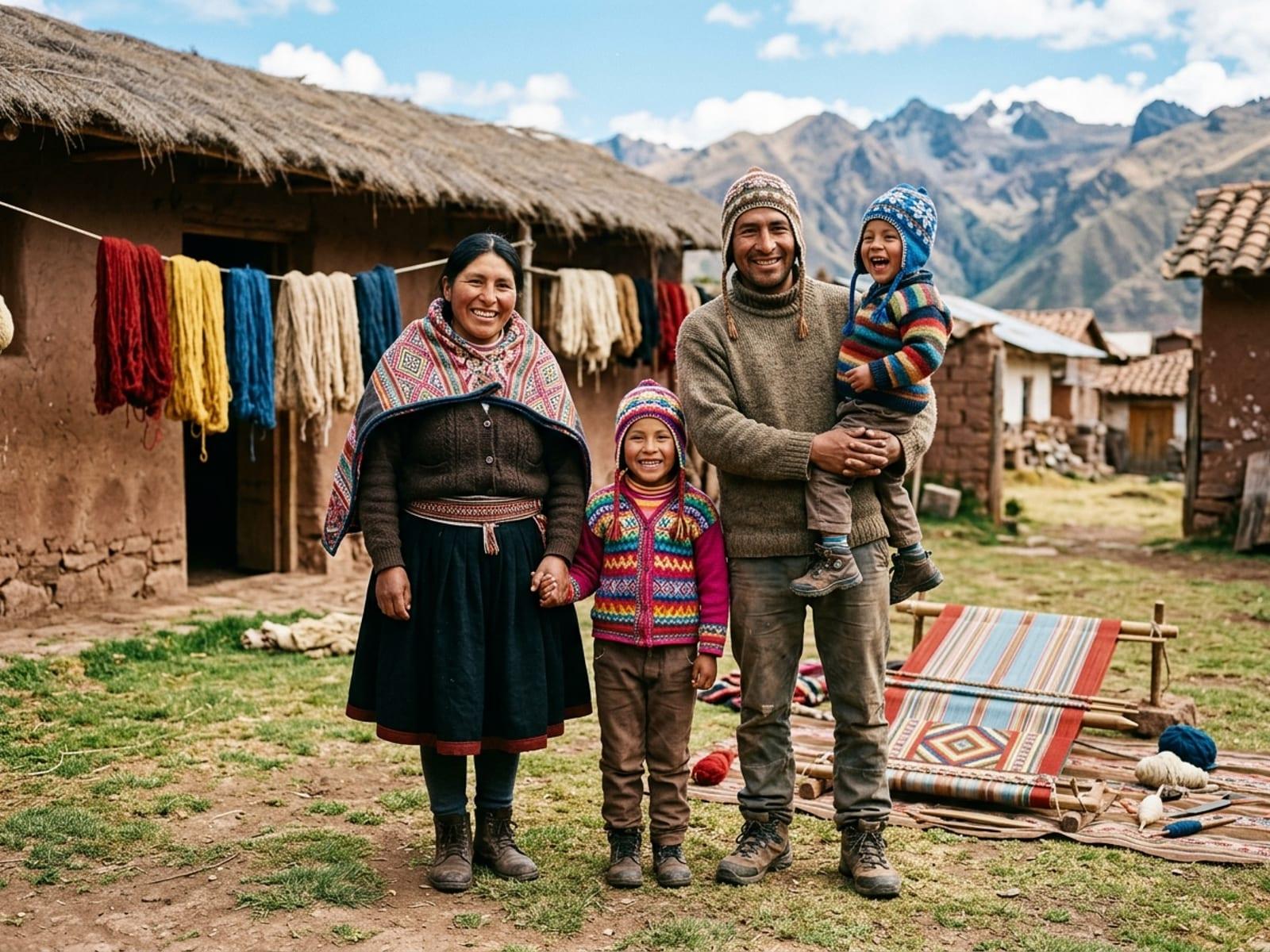
Chinchero is a highland village above 3,700 m, about 45 minutes by car from Cusco, where women's weaving centers keep traditional Andean textiles alive. You can watch the whole process year-round, from hand-spinning wool and dyeing it with plants to weaving on a backstrap loom, and at the CTTC shop in Cusco children aged 8 and up can join a weaving class. The village is higher than Cusco, so go once your family has adjusted to the altitude, and come ready for strong sun and a cold wind.
Cloth in place of writing
Weaving in the Andes goes back some 10,000 years. The earliest evidence comes from Guitarrero Cave in the Áncash region of north-central Peru, dated to around 8000 BC. The early Andean societies had no writing, so textiles were more than beautiful objects; they were an important way to convey ideas and status. Under the Inca, the finest cloth, qompi, was reserved for the nobility, the royal family and the emperor. The quipu, which recorded numbers in knotted cords, was another record-keeping tool made of fiber.
When Spanish rule began in the 16th century, making and wearing traditional textiles was outlawed. Even so, Indigenous weavers kept at it, and their cloth became a mark of Indigenous identity and a symbol of resistance to colonial rule.
In the 20th century, chemical dyes and synthetic fibers arrived, and traditional weaving began disappearing fast. Against that tide, women in Chinchero started coming together in the 1960s to recover the old techniques and sell their cloth themselves. That effort led to the founding in 1996 of the Center for Traditional Textiles of Cusco (CTTC), a nonprofit. The driving force behind it was Nilda Callañaupa Alvarez, a weaver from Chinchero. Today the CTTC works with weavers' associations in 10 communities in the Cusco region, on fair-trade principles.
Each community has its own weaving center, built around a grassy courtyard. On fine days the women weave outside; when it rains, they work indoors. Each association meets once a week to work together, elects its officers every year and runs itself. Older weavers acting as teachers for the younger generation is part of how the system works. According to the CTTC's course information, more than 600 weaving families take part in this work. Children in the villages learn the craft at the side of their parents and grandparents, handling the yarn from an early age.
In the workshop, from yarn to cloth
Chinchero's weaving center, Awayriqcharicheq, is the home base of the first weavers who started the CTTC. The village sits above 3,700 m, and the weavers gather here every day to work.
The center demonstrates how a textile comes together. Andean cloth starts with alpaca or sheep's wool spun into yarn on a hand spindle. Next, the yarn is dyed with colors drawn from plants, roots and flowers. Watching white yarn turn red or yellow in the pot is the kind of moment that holds children's attention. The dyed yarn is then strung as the warp on a backstrap loom, kept taut by a strap around the weaver's waist, and the pattern is picked up one row at a time. Try counting how many threads go into a pattern the size of your palm, and even a child can feel how long a single piece takes. Demonstrations vary from day to day, so ask on site which steps you'll be able to see.
The center has a shop too, with textiles and small items made by weavers from the different communities. Because the associations run it themselves, you can find out which village and which weaver a piece came from as you choose.
Weaving classes from age 8
The CTTC's main shop in Cusco, at Avenida El Sol 603 right by Qorikancha, the Temple of the Sun, runs backstrap weaving classes. Experienced weavers from the highland communities teach them, starting with how to set up the yarn on the loom, and you then weave a plain piece (a k'ata) or an Andean cross pattern yourself.
Classes are open to anyone aged 8 and up, and no experience is needed. They run from half a day to three days, and beginners are advised to start with a half-day or one-day class. The teachers speak Quechua and Spanish, with limited English, but they teach by showing you with their hands, and there are written instructions in English. You need to sign up and pay at least two days in advance; a booking is only provisional when you request it and is confirmed once payment goes through. There is also a spinning class where you turn alpaca fiber into yarn on a traditional drop spindle, the pushka.
The main shop has a small museum on how the textiles are made, and entry is free. Weavers are sometimes there giving demonstrations.
How to choose a good piece
Markets such as Cusco's San Pedro Market and street stalls sell plenty of Andean textiles, but hand-woven or machine-made, natural or chemical dye, can be hard to tell just by looking. Buying directly from weavers, or through a weavers' organization, lets you find out where, by whom and how a piece was made.
Hand-woven cloth varies slightly from piece to piece, even with the same pattern. A small irregularity or an uneven patch of color is a sign of handwork. If a large textile is beyond your budget, start with small things a child can choose for themselves, like a narrow band, a bracelet or a little bag.
High up as it is, Chinchero has cold wind even on sunny days, and the sun is fierce. Don't forget alpaca sweaters, hats and sunscreen. To see how a family photo with Andean textiles over your shoulders might look, with weavers at work in a grassy courtyard behind you, you can try pokesta's AI-generated photos ($1 per photo, and your first one is free).
When to go and getting there
The weaving workshops can be visited all year round. Some places close on Sundays, and opening hours vary by location and season, so check the official website before you go.
The nearest airport is Alejandro Velasco Astete International Airport (CUZ) in Cusco. From Cusco, Chinchero is about 45 minutes by car along the main road toward Urubamba. The easiest options are hiring a taxi or folding it into a Sacred Valley tour. Chinchero also has Inca ruins and a colonial-era church, so half a day lets you see those as well. It also fits neatly into a stay in the Sacred Valley on the way to the train for Machu Picchu.
Chinchero is even higher than Cusco. Rather than heading out on the day you land in Cusco, wait until your bodies have adjusted. Pair it with the nearby Maras salt pans and you can see the crafts and landscapes of the Sacred Valley in a single day. Entry requirements for Peru depend on your nationality, so check your own government's official information before you travel.
References