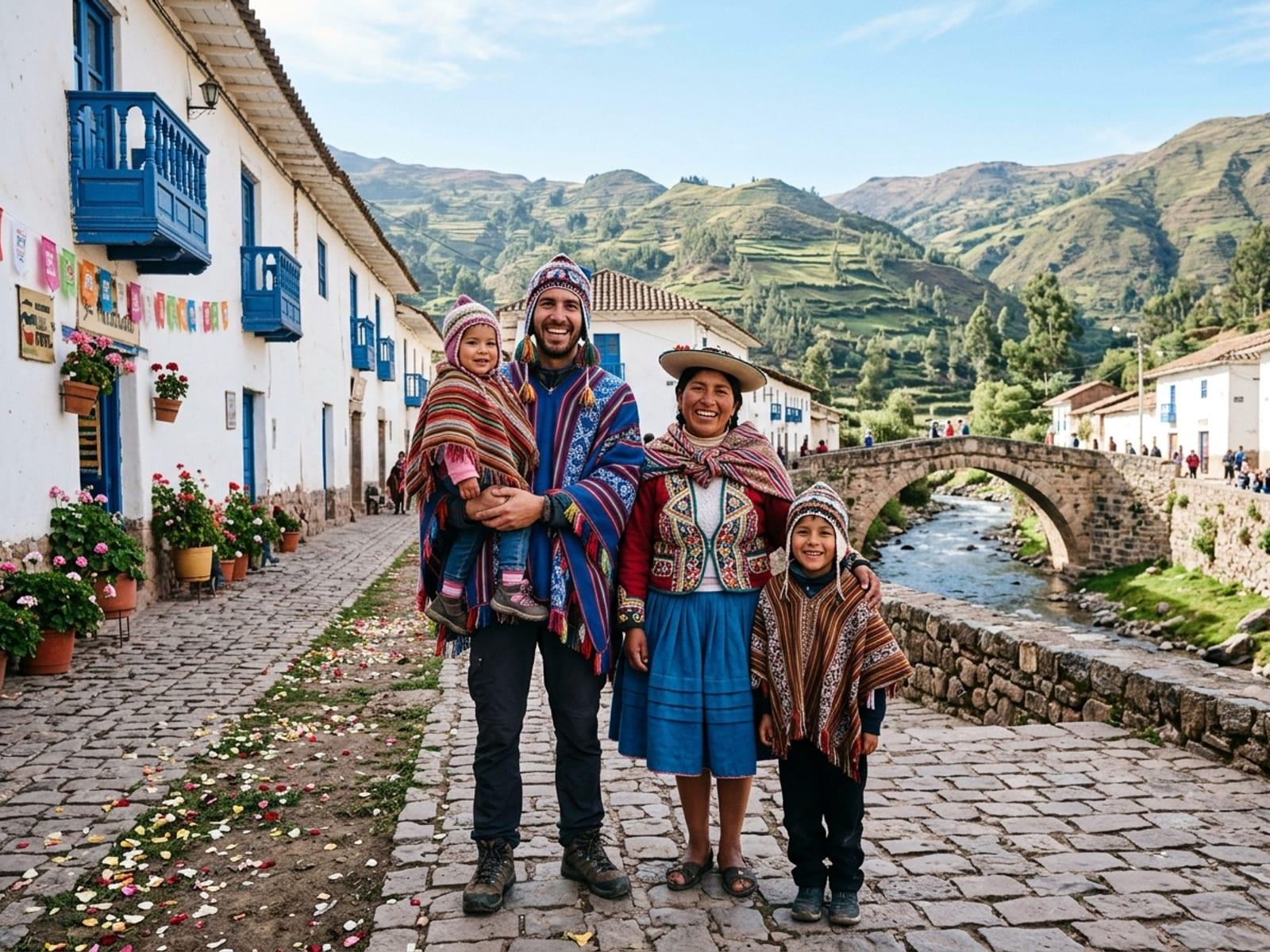
The Virgen del Carmen festival is held every year from July 15 to 18 in Paucartambo, a town about 110 km from Cusco along a winding mountain road. The high point is the 16th, when masked dancers fill the streets and, above the Virgin's procession, devil dancers called saqras leap from roof to roof. A town of just over 4,000 people takes in tens of thousands of visitors, so with children, focus on the 16th and settle early on either a place to stay or a tour from Cusco.
The Virgin they call "Mamacha Carmen"
Paucartambo sits at about 2,900 m on the Paucartambo River (also called the Mapacho) and still looks much as it did in colonial times. From the Inca period through the colonial era it was a trading post linking the Andean highlands with the Amazon forest. The main square and streets of the town center were declared a historic monument of Peru in 1980.
At the heart of the festival is the Virgen del Carmen, whom locals call, with affection, "Mamacha Carmen." Tradition holds that the festival began in the 17th century, when the Spanish Crown sent an image of the Virgin to the town. In 1985, Pope John Paul II crowned the image during his visit to Peru. In 2006, the National Institute of Culture, the forerunner of Peru's Ministry of Culture, declared the festival part of the nation's cultural heritage.
The Virgin is also described as a protector of the mestizos, people of mixed descent, and the festival weaves Catholic devotion together with dances that reflect the history and daily life of Andean people, so closely that the two can't really be pulled apart.
Four days, and devils on the roofs
The festival opens on July 15 with the entrada, when each comparsa (dance troupe) in turn comes to greet the Virgin. That is followed by the sera apaykuy, an offering of candles, and an evening of dancing that townspeople join in. At night there are fireworks known as konoy and a serenade for the Virgin, and the whole town stays up late.
The big day is the 16th. It begins with the main Mass, attended by every comparsa with its dancers and band. After Mass, each group performs its own dance and acts out the trade or social role its characters represent. Around 20 comparsas, each with its own musicians, dance through the streets and squares. In the afternoon the image of the Virgin is carried out and makes its way around town, surrounded by dancers and bands. This is when the saqra, the devil dancers, leap from roof to roof, trying to tempt the Virgin and the crowd into sin. The Virgin blesses the people and drives the devils off.
On the 17th, people visit the cemetery to remember dancers and organizers who have died, and the Virgin is carried across the stone Carlos III Bridge to bless the four directions. With the river, the bridge and the mountains behind it, this procession lets you see the festival and the lay of the town at once. That night comes the guerrilla, a mock battle between angels, devils and townspeople. Some people also climb to Tres Cruces, a mountain outside town, to watch the sunrise.
There are about 20 kinds of comparsa, including the Qhapaq Negro, Qhapaq Ch'unchu, Qhapaq Qolla, Saqra and Majeño, and each has its own role and its own melody. Each comparsa has a carguyoc, a sponsor who covers its costs, and places in a troupe are usually handed down from parent to child. The comparsas are devotional dances that townspeople spend a long time preparing; they are not for visitors to jump into. This is a festival you watch and respect. Masked devils also appear in the diablada, the devil dance of La Candelaria in Puno, held by Lake Titicaca in February.
Dress for winter mornings and nights
July is the dry season in the Andes. Days are clear with strong sun, while mornings and evenings are cold. Bring layers, a knitted hat and gloves. An alpaca sweater or a woven poncho is practical against the cold, and it also looks natural in the festival town.
Masked dancers are fully in character behind their masks. Photos are usually fine, but don't block the procession, and follow what the people around you do, such as taking off your hat when the Virgin passes. It's easy to miss a step or a surge in the crowd while you're looking up at the saqras on the roofs, so keep hold of your children's hands.
With small children, consider going just on the 16th
In 2008 the town had a population of just over 4,000, yet tens of thousands of people pour in during the festival. Around 200 people dance in the 20 comparsas, and visitors come from all over Peru to see them. The central streets become hard to move through, and toilets and places to eat are packed. With small children, it's more realistic to focus on the 16th, when you can see the Virgin's procession and the saqras on the rooftops, than to stay for all four days, and to plan breaks for the quieter times of day.
On fireworks nights the crowds are heavy and the walk back is dark and cold. A baby carrier is easier than a stroller. There are only as many places to stay as a town this size can offer, so decide early whether to book a room in town or join a tour from Cusco, and you won't be scrambling on the day.
Paucartambo is about 500 m lower than Cusco, but it is still high altitude. Don't head out the moment you land in Cusco; give yourselves a few days to acclimatize first. You could also stay on in Cusco after Inti Raymi in June and catch this festival in mid-July.
To see how your family might look in Andean dress against the white walls and blue wooden balconies, you can try pokesta's AI-generated photos ($1 per photo, and your first one is free).
Dates and getting there
The festival runs from July 15 to 18 every year, with the 16th as the main day. The dates are fixed, but the times of individual events change from year to year, so confirm them locally.
The nearest airport is Alejandro Velasco Astete International Airport (CUZ) in Cusco. Paucartambo is about 110 km from Cusco along a twisting mountain road. Allow around three to four hours by car or shared bus. Buses leave from a stop in Cusco known as the Diagonal. Plenty of people travel the same way during the festival, so leave with time to spare. Entry requirements for Peru depend on your nationality, so check your own government's official information before you travel.
References