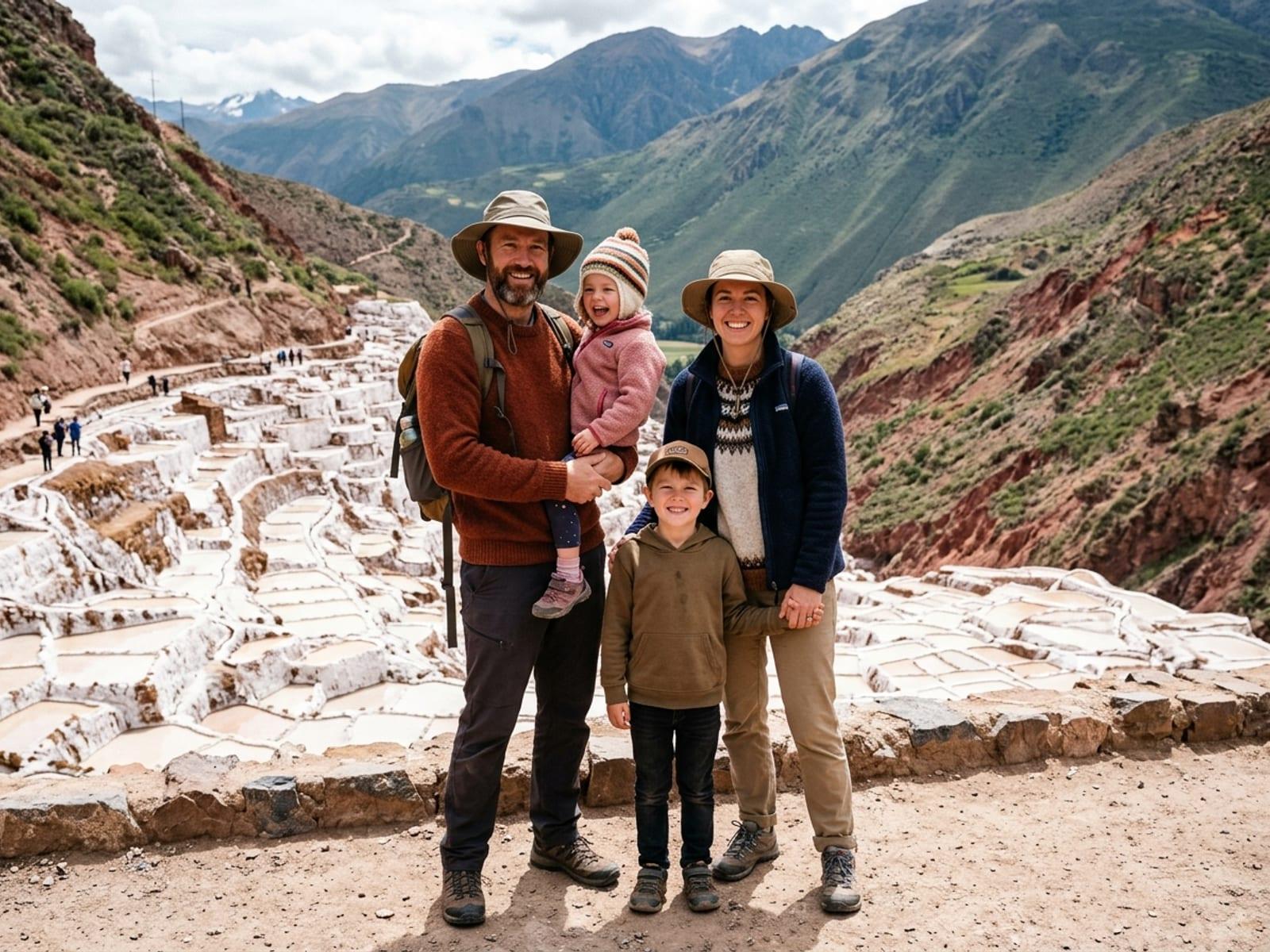
The Maras salt pans, about 40 km north of Cusco in the Sacred Valley, are some 4,500 small pools stepped down a valley slope, where salt has been made since before the Inca. Salty spring water is channeled into the pools and left to dry in the sun and wind, and the best time to visit is the dry season from May to October, when the salt comes out white. Since 2019 visitors can't walk among the pans and instead view them from paths and lookouts, so keep hold of children's hands on the set route and come prepared for strong sun and a cold wind.
Salt water from inside the mountain
Maras is a town at about 3,300 m in the Sacred Valley, some 40 km north of Cusco. The salt pans lie on the slope of a valley that runs down from the town toward the Urubamba River.
The salt comes from water flowing underground. Groundwater loaded with salt wells up from a spring on the valley slope and trickles down narrow channels into the terraced pans. There are about 4,500 of them. Each is a small pond, edged with irregular stones and clay, roughly 5 m² in area and only about 30 cm deep.
Fill a pan with about 5 cm of salt water, close off the inlet and leave it in the sun for about three days, and the water evaporates, leaving salt crystals on the walls and floor. Then more salt water goes in, and it dries again. After about a month of this, the salt has built up a few centimeters thick. It's broken up and scraped out by hand or with a small pick, dried, and carried to a local company's warehouse to be turned into the finished product.
The quality of the salt depends on the layer: from the top down, it goes to the kitchen table, to bulk sale, and to industry or farming. Shops near the pans sell salt from here. A small bag of salt is light and won't break, so it makes a good souvenir.
Shared rules kept by about 400 families
The slope with the salt pans lies at about 3,200 m. It's one of the largest salt-gathering sites in Peru that was in use before the Spanish arrived. The history of the Maras pans is long; excavations nearby have turned up Chanapata-style pottery from around 700 BCE. After the Inca era, in the colonial 16th century, descendants of Inca nobility were recorded as the owners of the pans. In the 19th century they passed into private hands and disputes followed. The state took control in 1969, but in 1980 a company funded by residents of Maras and Pichingoto was set up, and the pans returned to local hands. Today about 400 families each own salt pans.
Pans are handed down within families, and when one is given up, it can only be sold to a resident of Maras or Pichingoto. Because a single spring has to be shared among thousands of ponds, maintaining the channels and dividing up the water depend on neighbors cooperating. In 1998 the pans were declared part of Peru's national cultural heritage, and in 2019 the Peruvian government put them forward as a candidate for UNESCO World Heritage status.
You can't walk among the pans
It used to be possible to walk along the narrow edges between the pans, but in 2019 the company that manages them banned visitors from walking inside the salt pans to prevent contamination. Now you look out from prepared walkways and viewpoints. The edges of the pans are narrow and slippery, so for families with children the arrangement is actually reassuring. Hold your children's hands firmly so they don't wander outside the permitted areas.
From the viewpoints you can take in the pans spread across the whole slope. Their whiteness changes with the light, so they look best in the middle of a sunny day. From above you can see the channels carrying salt water like a net, and how each pond is a slightly different shade of white. The people gathering salt look small and far away, so bring a pair of binoculars for the kids and turn it into a game of spotting which pond someone is working in. To see how your family might look in Andean layers with the white pans behind you, you can try pokesta's AI-generated photos ($1 per photo, and your first one is free).
There is an admission fee. The amount can change, so check on site.
Aim for the dry season, May to October
Salt is made all year, but the best salt comes in the dry season, from May to October. In these months the salt builds up quickly and comes out white or pale pink. In the rainy season, from November to April, it accumulates slowly and tends to be brownish. If you want to see gleaming white pans and people at work scraping out salt, go in the dry season.
The dry season is also peak tourist season, though, with more than 1,500 people visiting the pans a day. The walkways can get crowded, so give yourselves plenty of time.
At over 3,000 m, the sun is strong and the wind is often cold. Bring hats, sunglasses, sunscreen and a windproof jacket. There are steps and slopes around the shops and along the walkways, so a baby carrier is easier than a stroller.
Getting there
The nearest airport is Alejandro Velasco Astete International Airport (CUZ) in Cusco. A paved road leads to Maras from the main highway through the Sacred Valley, and most people visit by car or on a tour from Cusco or one of the valley towns.
Maras itself is a small town, with a population of just over 1,700 as of 2005. It has a colonial-era church, and in the 17th century the Quechua painter Antonio Sinchi Roca Inca, of Inca descent, lived here. It's a pleasant place to pause in the plaza on the way to the salt pans.
Just west of Maras lies Moray, an Inca site where circular terraces are stacked ring upon ring inside bowl-shaped hollows. The temperature between the top and the bottom of a hollow is said to differ by as much as about 15°C. The site sits on a plateau at about 3,500 m, and one theory holds that the Inca used these temperature differences to experiment with growing crops. Soil analysis has also shown that the terraces were filled with soil brought from elsewhere. In February 2010, heavy rain caused the east side of the largest circle to collapse, and restoration work has continued since. Don't climb on the stonework; stay on the marked paths. Together with the colonial church in Maras, you can see them all in half a day to a day.
If you start your trip by staying in the Sacred Valley, a little lower than Cusco, to acclimatize, Maras fits easily into the early days. Another option is to stop here the day before taking the train from the Sacred Valley to Machu Picchu. The weaving village of Chinchero is close by, so Andean weaving in Chinchero fits into the same day. Entry requirements for Peru depend on your nationality, so check your own government's official information before you travel.
References