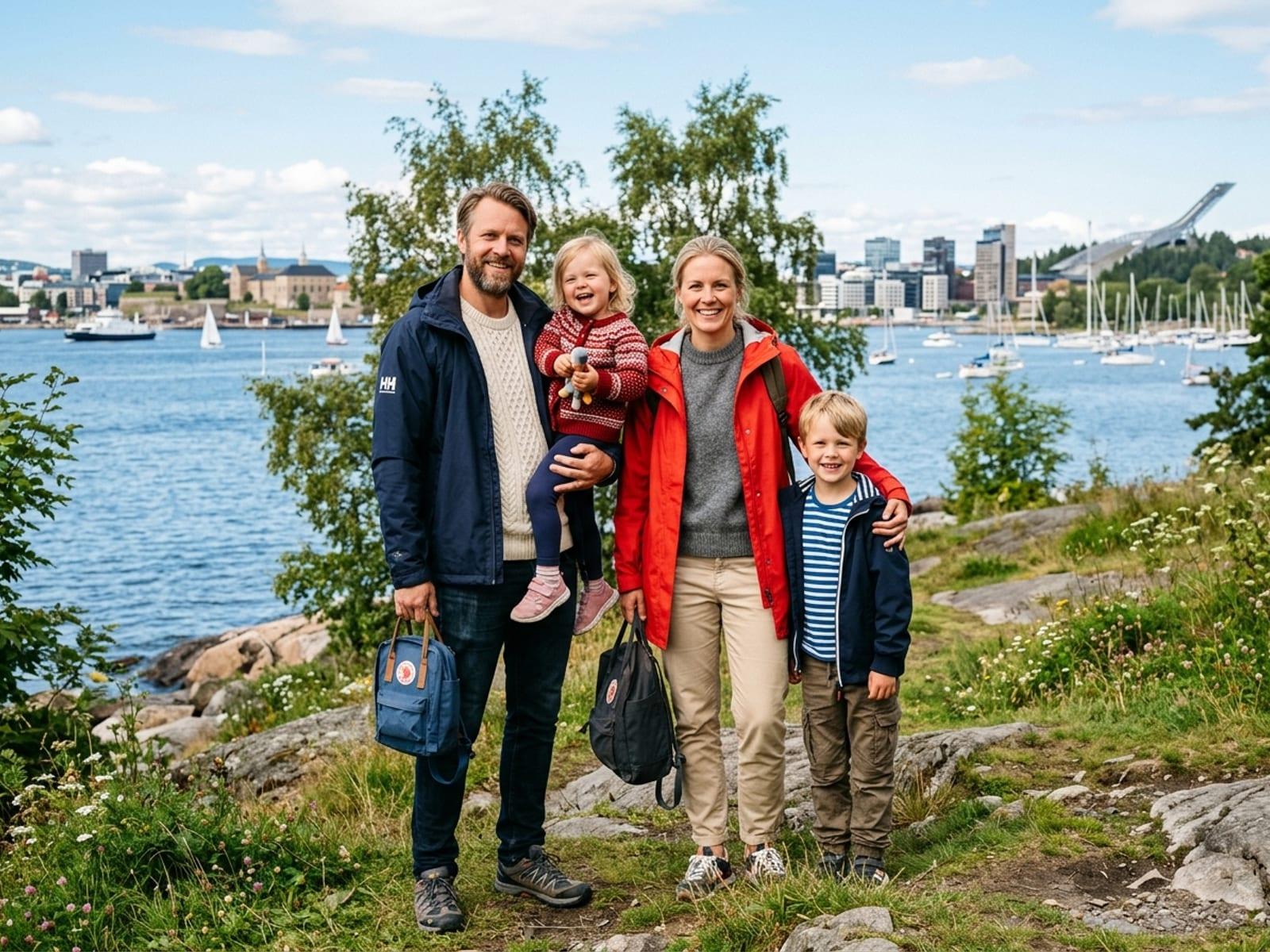
Take a boat from the harbor in front of Oslo City Hall, cross the fjord, and you land on the Bygdøy peninsula, where several of Norway's best-known museums stand close together. There's the Fram Museum, where you can climb aboard a polar expedition ship; the Kon-Tiki Museum, home to the raft that crossed the Pacific; and an open-air museum of old wooden houses and a church moved here from all over the country. These are museums where children do more than look, so if your family has a few days in Oslo, Bygdøy is worth a whole day.
A peninsula of seafaring museums
Bygdøy is a peninsula jutting out on the west side of Oslo, a leafy residential area that's also a favorite place for a day out. According to the English-language Wikipedia, it is home to five major national museums: the Kon-Tiki Museum, the Norwegian Museum of Cultural History (Norsk Folkemuseum), the Viking Ship Museum, the Norwegian Maritime Museum and the Fram Museum. The Royal Farm, where the king has his summer residence, is on the peninsula too.
The Viking Ship Museum, which displayed the Oseberg ship and others, has been closed since September 2021 for rebuilding, with reopening planned for 2027. Depending on when you travel, it may not be open, so check the latest information before you plan.
Near the tip of the peninsula, at Bygdøynes, the Fram Museum, the Kon-Tiki Museum and the Maritime Museum stand side by side. The Norwegian Museum of Cultural History is a little further inland.
In summer it would be a shame to see only the museums. On the south side of the peninsula, Huk has a swimming beach where people from Oslo gather on sunny days to swim and sunbathe. Museums in the morning, the beach in the afternoon: that kind of day suits families whose children are at the age when museums wear thin. Note that Huk also has a separate nudist beach, so check the map before you go.
Climb aboard the Fram, look up at the Kon-Tiki
The star of the Fram Museum is the Fram, a wooden polar expedition ship. According to the English-language Wikipedia, it was built by the shipbuilder Colin Archer for the explorer Fridtjof Nansen, and after Nansen it was used on expeditions by Otto Sverdrup and by Roald Amundsen, the first person to reach the South Pole. The entire ship sits inside the museum building, which opened on May 20, 1936. The official website says you can go on board and look around the cabins and deck. Next door, in a separate building, is the Gjøa, the first ship to sail through the Northwest Passage. Amundsen and a crew of six took three years to get through, finishing in 1906. Children will be struck by how small a ship people lived on for years in extreme cold. There's also a 4D flight simulator recreating Amundsen's 1925 attempt to fly to the North Pole, and an exhibit where you experience a ship trapped in ice. That one comes with a playful warning for kids to watch out for the polar witch and the polar bears. When we checked in October 2026, the museum was open daily from 10:00 to 17:00, with admission at NOK 180 for adults and NOK 70 for children.
Across the way, the Kon-Tiki Museum displays the actual Kon-Tiki, the raft on which Thor Heyerdahl and his crew crossed the Pacific from South America in 1947, along with the reed boat Ra II. The official website says both exhibits have a storyline for children, guided by Johannes the crab and Safi the monkey. Opening hours are 10:00 to 18:00 in May, 9:30 to 18:00 from June to August, and 10:00 to 17:00 from September to April (as of October 2026).
Walking through old Norway at the open-air museum
The Norwegian Museum of Cultural History, Norsk Folkemuseum, is an open-air museum that opened in 1894. According to the English-language Wikipedia, more than 150 buildings moved from towns and villages around the country stand across its grounds. At its center is the Gol Stave Church, a wooden church built in the 13th century. Its dark timber walls and stacked tiers of roofs are far more striking in person than in photos.
Old farmhouses and town houses are arranged by period, so you can walk around with your kids wondering aloud where people used to sleep and how they kept the fire going. The official website lists guided tours of the Gol Stave Church and the Hove farmhouse at 11:00, 13:00 and 15:00, Tuesday to Sunday. At certain times of year, weekend events let you meet animals and try old crafts and foods (in 2026, on Saturdays and Sundays from October 5 to November 22). When we checked in October 2026, it was open Tuesday to Sunday, 11:00 to 16:00, and closed on Mondays. Hours change with the season, so check the official website before you go.
The best order and how long to allow with kids
To see all three museums in one day, start at Bygdøynes with the Fram and Kon-Tiki museums in the morning, break for lunch, and spend the afternoon at the Norwegian Museum of Cultural History. That order keeps backtracking to a minimum. Allow about an hour each for the Fram and the Kon-Tiki, and two hours or more for the open-air museum, whose grounds are large, so the children don't feel rushed.
You can walk from Bygdøynes to the open-air museum, but if little ones are tired, take the bus. Much of the open-air museum is outdoors, so on rainy days bring rain gear and shoes that can get wet. Visit Norway's family travel advice notes that children get free or discounted entry at many museums, so ask at the ticket desk. An Oslo sightseeing pass that bundles museum admission and public transport is another option.
For a family photo with the fjord behind you, the grass and waterfront between the museums are the easiest spots. To get a feel for it before you go, try pokesta's AI photos ($1 per photo, and the first one is free).
Getting there by boat or bus
There are two ways to reach Bygdøy, depending on the season. According to the English-language Wikipedia, from April to October a public ferry leaves every 30 minutes from Aker Brygge, the harbor in front of City Hall. From the deck you can see the city and the fjord, which kids enjoy in its own right. Year-round, bus 30 runs through the city center every 10 minutes. The Kon-Tiki Museum's website also says bus 30 serves Bygdøynes all year, with the ferry running there in the summer season.
The main gateway is Oslo Airport (OSL), about 20 minutes from Oslo Central Station by airport express train. From the central station, the harbor in front of City Hall is within walking distance. For dinner on the way back, the Mathallen food hall in central Oslo lets everyone pick their own stall. If you're in Oslo in winter, the Holmenkollen ski jump and Ski Museum, reached by metro, make another good museum outing with children.
Go out by boat, come back by bus. For a child, that alone can make the day as memorable as the museums themselves. Entry requirements for Norway depend on your nationality, so check your own government's official information before you travel.
References