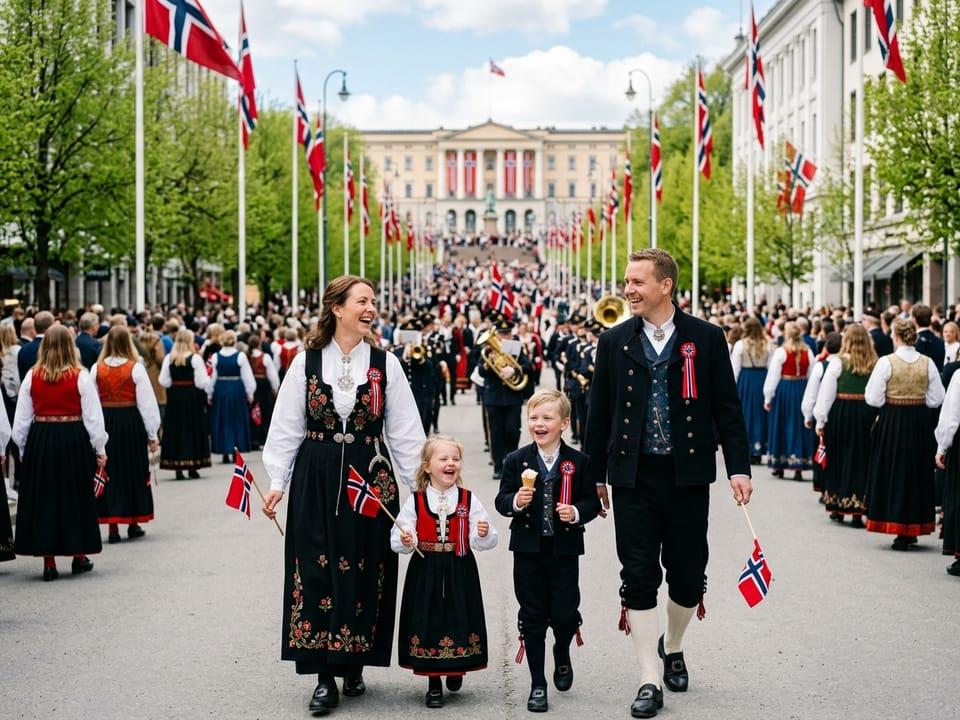
For families living in Norway, Constitution Day on 17 May is the day that shows most clearly, year after year, how much the children have grown in their bunads. That doesn't mean the whole family needs one. Settle the children's outfits first, let everyone else match by color, and take the family photo in the morning before the parade. It also helps to know what the silver on a bunad stands for, how children's bunads are made, and which rules people take seriously, because that tells you what's worth photographing.
Some 450 bunads, each tied to a place
A bunad is festive dress based on the folk costume of rural Norway. According to Store norske leksikon, the Norwegian encyclopedia, there are about 450 different bunads today, each linked to a region, and roughly 70 percent of Norwegian women and just over 20 percent of men own one. Besides 17 May, bunads are worn at christenings, confirmations, weddings and graduations. On 5 December 2024, the widespread Norwegian practice of wearing bunads was inscribed on UNESCO's Representative List of the Intangible Cultural Heritage.
Most people choose a bunad from their own or their family's home district, although more and more pick one simply because they like it. The research and documentation work happens at the Norwegian Institute for Bunad and Folk Costume (Norsk institutt for bunad og folkedrakt), a national institution based in Fagernes. It advises on reconstructions and records old costumes as they turn up around the country.
The silver was meant to protect
The silver brooch fastened at the collar or on the shirt front is called a sølje. Store norske leksikon notes that silver in particular was linked to protection against evil forces, which is why both children and adults wore it. The custom of giving silver as a christening gift grows out of the same belief.
The shapes carry meaning too. The small hanging leaves (løv) represent grains of barley, a symbol of fertility and new life that goes back to pre-Christian times. The heart shape dates from the Middle Ages and honors the Virgin Mary and a mother's love. Most søljer are silver, often gilded, though brass and pewter versions exist as well.
In photos, that silver catches the light and becomes the brightest point in the frame. If this is the first year your child wears the silver they received at their christening, take a close-up of the brooch on its own. It's the kind of picture that, years later, starts a conversation about who gave it to them.
Children's bunads are built to be let out
A children's bunad (barnebunad) can be an exact scaled-down copy of the adult version or a simplified one. According to Store norske leksikon, it usually carries less silver, and some pieces, such as the headwear, differ from the adult garments. Many are put together so they can easily be resewn, which stretches how long they last. A hand-embroidered child's bunad isn't cheap, though: it takes about as much work as an adult one.
That's why handing one down between siblings or cousins, or borrowing from relatives, makes so much sense. If you're having one made, ask the maker how much the sleeves and hem can be let out. It has also become a tradition for parents to give a bunad as a confirmation gift, so you can work backward from that when deciding how many years the child's bunad needs to last. We cover the confirmation day itself in our article on confirmation photos.
No bunad for your child? The photos won't suffer. A smart dress or shirt with a ribbon in the flag colors pinned to the chest looks every bit as much like 17 May.
There's even a "bunad police"
Each bunad comes with a set pattern for colors, fabric, embroidery, jewelry, cut and headwear. Headwear once signaled whether a woman was married; the Hardanger skaut, for instance, was worn by married women. Traditionally, women in bunad wear proper bunad shoes and carry a matching purse, and skip sunglasses, earrings and heavy makeup.
People who insist that bunads be sewn and worn strictly by the book are sometimes called, half-mockingly, the "bunad police." Others argue for a looser, more creative approach, and the two camps haven't settled it. Nor is there any rule saying you can only wear the bunad of a place you're from.
For family photos, what matters is less the debate than the result. On a sunny day it's tempting to keep sunglasses on, but take them off for the pictures. And if you're unsure how your family's bunad should be worn, the maker or shop that deals in that bunad is the most reliable source.
Festdrakt: no home district required
For people without a bunad, festdrakt has become a popular alternative. Store norske leksikon describes it as festive dress inspired by bunads and traditional folk costume that, unlike a bunad, doesn't need to be tied to any particular place in Norway. Most patterns are A-line, with a bodice and skirt, a long-sleeved blouse and an apron, and there's more room for personal style. The price gap is wide: a bunad usually costs between NOK 20,000 and 100,000, while the cheapest adult festdrakt can come in at around NOK 1,500.
When some family members wear a bunad and others don't, those without one look best in solid dark colors such as navy, black or deep green, or in white. The embroidery and silver are the focal point, and large patterns will fight with them.
May weather in Norway can change dramatically from one day to the next. A wool bunad is warm, but a child in party clothes can get cold quickly. Since a coat hides the outfit, agree in advance to take the family photo quickly with coats off, then bundle the kids back up as soon as you're done.
Take the family photo in the morning, at home
17 May marks the signing of the constitution in 1814, and the heart of the day is the children's parade, which pupils join through their schools. For the history and Oslo's parade route, see our guide to Norway's Constitution Day. As the City of Oslo puts it, many people start the day with breakfast with family and friends and then head out in their finest clothes.
The most reliable time for the family photo is right after that breakfast, before the children leave to meet their school. Clothes are still spotless and hair is still in place. After the parade, the crowds are big, the kids are busy playing, and getting everyone in one spot is hard.
The front door, the garden or a balcony with the flag out is all you need. Put the phone on a tripod and use the self-timer so whoever usually takes the photos is in it too. Before you shoot, check once that brooches are in place and that belts and ribbons aren't twisted. For a photo of a child alone, kneel so the camera is at their eye level.
During the parade your child walks with their school and is past you in moments. The night before, tell them exactly where you'll be standing ("by this corner"), and the chances of them spotting you and waving go way up. Start shooting in burst mode or video as the group approaches, and include the school's flag or banner so the picture works as a record of that year.
When in doubt, start with the children's bunads
Decide outfits in this order: the children, then any adults who own a bunad, then everyone else. The children's silver and embroidery will be what the eye goes to, so the others only need colors that stay out of its way. Nobody needs a folk costume just to make the picture match.
In years when grandparents living abroad can't celebrate with you, pokesta can create a family photo in this occasion's outfits and setting with AI, from each person's own phone photos ($1 per photo, first one free).
References