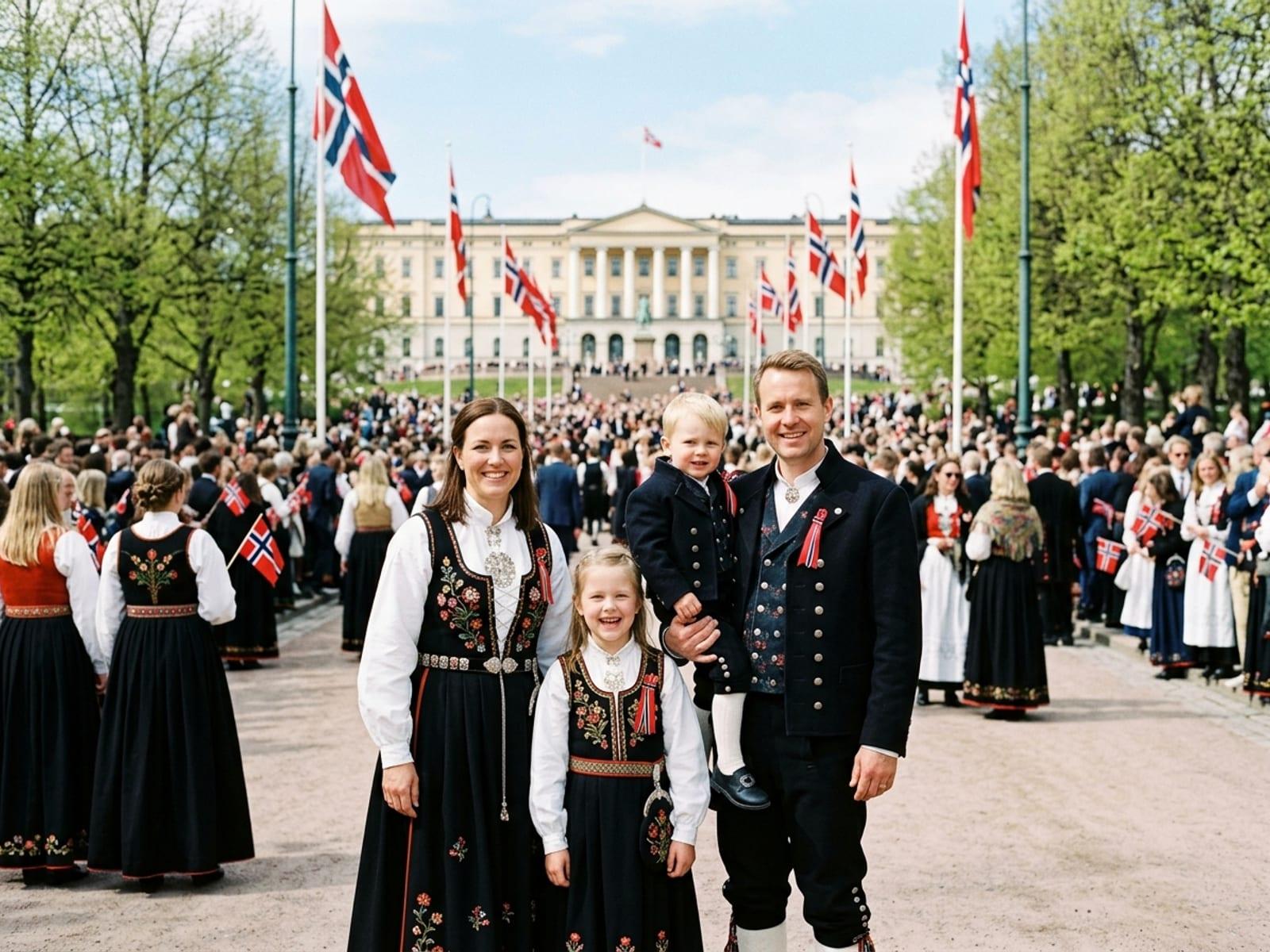
On 17 May, Norwegian towns disappear under red, white and blue flags. This is Constitution Day, known in Norwegian simply as "syttende mai" (the seventeenth of May), and its stars are not soldiers but schoolchildren, marching school by school. In Oslo the children's parade leaves the main gate of Akershus Fortress at 10 a.m., halts in front of Parliament and the Royal Palace, and wraps up on City Hall Square around 1:30 p.m. In 2027, 17 May falls on a Monday and coincides with Whit Monday, which is also a public holiday.
Signed at Eidsvoll on 17 May 1814
Norway's constitution was adopted unanimously by the constituent assembly at Eidsvoll on 16 May 1814. The next day the assembly's presiding officers dated and signed it, and the remaining representatives added their signatures on 18 May. After centuries under Danish rule, Norway had declared itself an independent kingdom.
The moment didn't last. Norway soon entered a union with Sweden, and celebrating the date turned into a political act. Festivities were banned for a time in the 1820s, and in 1829 troops were sent against students celebrating in Christiania, as Oslo was then called. After that clash, remembered as the Battle of the Square (Torgslaget), King Charles XIV John softened his stance, and in 1833 the poet Henrik Wergeland gave the first official 17 May speech.
The union was dissolved in 1905, Prince Carl of Denmark took the throne as King Haakon VII, and Norway was fully independent at last. That long road is why 17 May still feels like the nation's birthday and ranks as its most important holiday.
The children's parade began in 1870 with 1,200 boys
Wergeland is credited with turning the day from a show of patriotic pride into a celebration for children, and the first known children's parade is said to be one he held at Eidsvoll around 1820.
The capital's first official barnetog (children's parade) marched in 1870. The idea came from a school principal, Peter Qvam, who had already paraded his own pupils the year before, and it was championed by Bjørnstjerne Bjørnson, the writer who also wrote the national anthem. Around 1,200 boys took part; girls weren't allowed to join until the end of the 19th century. In 1902 the band of Møllergata school, the first school in Norway with a band of its own, played in the procession for the first time.
Since 17 May 1906 the royal family has stood on the palace balcony to greet the children. The only gaps were 1910, the year Britain's King Edward VII was buried, and the German occupation of 1940 to 1945. The parade itself was also called off during the occupation, and again in 2020 and 2021 because of the COVID-19 pandemic.
Oslo's barnetog stops only twice, at Parliament and the Palace
More than 120 Oslo schools take part, each led by a brass band, with the Norwegian Armed Forces Staff Band at the very front. The parade leaves the main gate of Akershus Fortress at 10:00 and makes its first stop outside the Storting (Parliament) at around 10:15, where the chair of the 17 May committee greets the parliament. It then heads up Karl Johans gate, Oslo's main street, to the Royal Palace and halts again at around 10:30 so the chair can greet the King and the royal family. Those are the only two stops.
The front of the parade reaches City Hall Square (Rådhusplassen) at about 10:45. Each school needs 50 to 60 minutes from start to finish, but because the schools keep coming one after another, the parade doesn't end until about 1:30 p.m., when the band of His Majesty the King's Guard brings up the rear.
The square in front of the palace, Slottsplassen, opens at 8:00. Standing room is drop-in and needs no ticket, so it's first come, first served. The benches are reserved, ticketed seating for elderly and disabled spectators and others who can't stand through the parade, and they have no backrests.
Earlier in the morning, between 8:00 and about 9:30, wreaths are laid and speeches given (in Norwegian) at graves and monuments around the city, including Vår Frelsers gravlund, where Wergeland, Bjørnson and Ibsen are buried. At noon a salute is fired from Akershus Fortress and the Liberty Bell is rung.
In the afternoon, many towns hold a separate parade for the russ, students in their final year of upper secondary school who wear red or blue overalls. It usually gets going around 4 or 5 p.m. The russ hand out russekort, calling cards with their name, photo and a joke, and children love collecting them.
Bergen starts with a 7 a.m. salute: how other towns celebrate
In Bergen the day begins with a gun salute at 7 a.m., and the city's buekorps, neighborhood groups of marching drummers, are something you won't see anywhere else. The day closes with a torchlight procession and fireworks. Stavanger also opens with a 7 a.m. salute, followed by the children's parade, the russ parade and finally a citizens' parade.
Trondheim probably held the very first 17 May celebration, in 1815. Today it has a children's parade in the morning and a citizens' parade, the Borgertoget, in the afternoon. In Asker, Skaugum, the home of the Crown Prince, has long been a traditional stop for the local parades.
Around 100,000 people pour into central Oslo, while a village parade may be just a few dozen people strong. If big crowds aren't your thing, a smaller town is a perfectly good place to spend the day. The food is much the same wherever you are. The morning starts with a shared breakfast among family, friends and neighbors, often with scrambled eggs and smoked salmon, and from midday it's all ice cream and hot dogs, often pølse i lompe, wrapped in potato flatbread. Schools put on speeches, music and games.
Watching as a visitor: where to stand and what's closed
Only children registered through their schools can march, but anyone is welcome to line the route and wave a flag. Karl Johans gate fills up with spectators, so with small children look for a spot where the crowds thin out a little, such as near the start at Akershus Fortress or around City Hall Square at the finish.
The route and City Hall Square are fenced off, and you can only cross at marked points. There are footbridges at City Hall Square, and the map on the City of Oslo's website shows crossing points and public toilets. Most roads inside Ring 1, the inner ring road, are closed to private cars, and buses and trams run diversions from 6:15 a.m. to 6 p.m. Nationaltheatret station may be closed if it gets too crowded; Ruter, Oslo's public transport operator, suggests Stortinget, Jernbanetorget or Grønland instead.
Shops and offices close for the holiday, apart from cafés and restaurants, and even large supermarkets may be shut. Restaurants fill up fast, so book a table or plan to eat from the street stalls. (Our guide to eating out in Norway covers dinner times and other local habits.)
As for clothes, people wear a bunad, a bunad-inspired festive costume called a festdrakt, or simply their best dress or suit, so visitors don't need a bunad. Bunad etiquette and tips for family photos are covered in our 17 May family photo guide, and if you're curious how your family would look in bunads, you can try it with pokesta's AI photos ($1 per photo).
2027 falls on a Monday, so stay within walking distance
The date never moves. In 2027, 17 May is a Monday and also Whit Monday, which makes a three-day weekend starting Saturday the 15th; Ascension Day, Thursday 6 May, is a public holiday too. Oslo hotels fill up around the holiday, so book early. With cars kept out of the center, a hotel within walking distance of the parade route makes the day much easier with children.
Oslo Airport (OSL) is the main gateway, and the Flytoget airport express gets you to the city center in about 19 minutes. May weather in Oslo can swing a lot from one day to the next, and even on sunny days the wind feels cold, so pack layers. The weeks around 17 May are also when the Hardanger orchards tend to be in blossom in western Norway, so you can head for the fjords once the holiday is over.
With three and a half hours of marching, there's no need to see it all. Plan around two moments: the front of the parade stopping at the palace at about 10:30, and the noon salute at Akershus Fortress. With small children, that's plenty.
References
- City of Oslo, "17th of May" https://www.oslo.kommune.no/english/17th-of-may/
- City of Oslo, "17th of May (Norway's Constitution Day) in Oslo" https://www.oslo.kommune.no/english/welcome-to-oslo/norwegian-society/norwegian-constitution-day/
- Oslo kommune, "Informasjon om barnetoget" (children's parade information, in Norwegian) https://www.oslo.kommune.no/natur-kultur-og-fritid/17-mai/informasjon-om-barnetoget/
- Oslo kommune, "Fremkommelighet i sentrum" (getting around the city center, in Norwegian) https://www.oslo.kommune.no/natur-kultur-og-fritid/17-mai/fremkommelighet-i-sentrum/
- Oslo kommune, "Inngang til Slottplassen" (entry to the palace square, in Norwegian) https://www.oslo.kommune.no/natur-kultur-og-fritid/17-mai/inngang-til-slottplassen/
- Visit Norway (Norway's official travel guide), Norway's national day https://www.visitnorway.com/typically-norwegian/norways-national-day
- Wikipedia (Norwegian), "17. mai (grunnlovsdag)" https://no.wikipedia.org/wiki/17._mai_(grunnlovsdag)
- Wikipedia (Norwegian), "Barnetog" https://no.wikipedia.org/wiki/Barnetog
- Wikipedia, "Constitution Day (Norway)" https://en.wikipedia.org/wiki/Constitution_Day_(Norway)
- Office Holidays, Norway public holidays in 2027 https://www.officeholidays.com/countries/norway/2027
- Flytoget (Oslo Airport Express Train), official website https://flytoget.no/en/