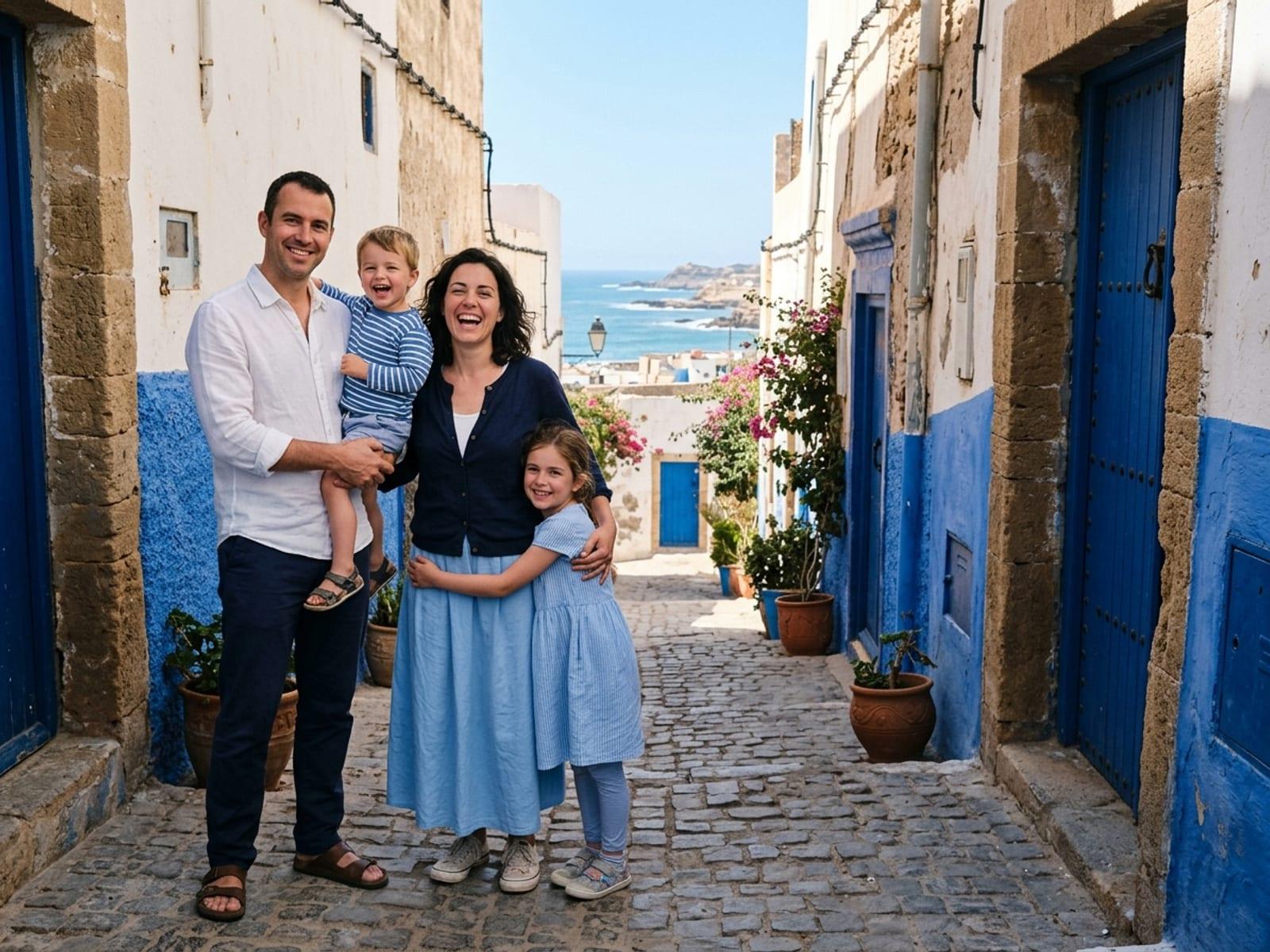
Compared with Marrakech or Fez, Morocco's capital, Rabat, is a calm city. On a hill where the Bou Regreg river meets the Atlantic stands the Kasbah of the Udayas, a citadel whose history begins in the 12th century, and inside it is a quiet neighborhood of houses with walls painted white and blue. You can walk the kasbah for free, and from the lookout at its far end you can see the river, the ocean and the town of Salé on the opposite bank. Rabat was inscribed as a World Heritage Site in 2012, and with the kasbah and gardens in the morning, Hassan Tower after lunch and Chellah if energy allows, a family can see the highlights in one day.
A 12th-century citadel, named after a tribe
According to English Wikipedia, the first citadel on this hill was built around 1150 by the Almohad caliph Abd al-Mu'min. A later caliph, Ya'qub al-Mansur, added a monumental gate to its walls. It is the oldest part of present-day Rabat. Later, the corsairs who made this estuary their base, and then the Alaouite dynasty, rebuilt and extended its walls.
The name Udayas comes from the Udaya tribe, whom the Alaouite sultan Moulay Isma'il settled here to keep unruly tribes in check. The tribe's name only became attached to the kasbah in the 19th century, after the Udayas were driven out of Fez.
In 2012, Rabat was inscribed as a UNESCO World Heritage Site as "Rabat, Modern Capital and Historic City: a Shared Heritage." The listing covers the kasbah, the old town below it, Hassan Tower and the Chellah ruins, together with the new town laid out under the French protectorate.
Through the gate and into the white-and-blue lanes
Bab Oudaya, the gate at the entrance to the kasbah, was built by Ya'qub al-Mansur between 1195 and 1199. English Wikipedia says it is considered one of the most beautiful gates in Almohad and Moroccan architecture, and that it was probably more ceremonial than defensive. Stand close with the kids and look up at the patterns carved into the stone.
Inside the gate is a residential neighborhood known for walls painted white and blue. There's none of the bustle of a medina market, just narrow lanes running quietly on. These are the streets outside people's front doors, so don't block doorways or steps, and ask before photographing residents.
At the northeastern tip of the kasbah is a lookout platform built in the early 17th century. It was once used to send signals, and from it you can take in the Bou Regreg river, the town of Salé across the water and the Atlantic all at once. The sea breeze can be strong, so give children an extra layer to put on.
The kasbah also keeps a mosque that dates from the original construction in 1150, the oldest building in the kasbah today. It's a place of worship, so admire it quietly from outside.
Rest in the Andalusian Gardens and the jewelry museum
On the south side of the kasbah are the Andalusian Gardens, created between 1915 and 1918 by Maurice Tranchant de Lunel under the French protectorate. They're formal gardens modeled on those of al-Andalus (Islamic-era Iberia), and a good place to sit down with children who are tired of walking. Near the gardens and the museum is Café Maure, with a terrace, handy for a break.
Next to the gardens, the Oudaya Museum occupies a residence built at the end of the 17th century by Moulay Isma'il (who reigned from 1672 to 1727). It became a museum in 1915 and has been the national museum of jewelry since 2006. It closed for refurbishment in 2014 and reopened in January 2023.
The unfinished Hassan Tower, and Chellah, home of the storks
Head upriver from the kasbah and Hassan Tower comes into view. It's the minaret of a vast mosque that the Almohad ruler Ya'qub al-Mansur began building in 1191. When the caliph died in 1199, work stopped, leaving the tower at 44 meters. It was meant to reach at least 64 meters, and some say 80. Inside, instead of stairs, there's a ramp, said to have been built so that the person calling to prayer could ride up on horseback. Around it stand 348 columns from the unfinished mosque, and at the southeast corner of the site is the Mausoleum of Mohammed V, completed in 1971.
If you have energy left, continue to Chellah. On the south bank of the Bou Regreg, it's a place where the remains of the Roman town of Sala Colonia overlap with the burial ground of the Marinid kings. According to English Wikipedia, storks nest in large numbers in the trees and on the ruined minaret, and eels live in a pool originally used for ritual washing before prayer. At one time, locals believed that feeding the eels would help women conceive. The excavated remains include a Roman forum, temples and the base of a triumphal arch. In the Marinid period Chellah became a royal necropolis, and Sultan Abu al-Hasan completed its main gate in 1339. Abu al-Hasan, who died in exile in 1351, was buried here too, and his tomb is considered the most richly decorated in the ruins. Since 2005, the ruins have also hosted a jazz festival, Jazz au Chellah. For children, the storks' nests and the eel pool may be more memorable than the ruins. The tourism office also describes it as a place to walk among ruins and gardens with storks.
Eight kilometers from the airport, and a tram to get around
Rabat's airport is Rabat–Salé (RBA), about 8 km east-northeast of the city. According to English Wikipedia, the Rabat–Salé tramway, opened in 2011 as Morocco's first tram line, links the two banks of the river. The main ONCF railway stations are Rabat-Ville and Rabat-Agdal. According to the tourism office, it's about 88 km and an hour by car to Casablanca, and about 207 km and 2 hours 15 minutes to Fez. If you do go on to Casablanca, a seafood lunch at the Central Market and a walk through the Habous work well with children.
The lanes inside the kasbah are narrow and uneven, so a baby carrier is handy for small children. If nobody has the legs for Chellah by mid-afternoon, stopping at Hassan Tower is perfectly fine. The tourism office also points out that well-equipped beaches run for many kilometers along the Atlantic coast from Rabat toward Casablanca. Putting a beach day for the kids between days of sightseeing keeps the whole trip from becoming tiring. Before heading to the kasbah, fill up on griddle breads like msemen and baghrir. You can picture your family in a white-and-blue lane with pokesta's AI photos ($1 per photo, with your first one free). Entry requirements depend on your nationality, so check your own government's official information before you travel.
References