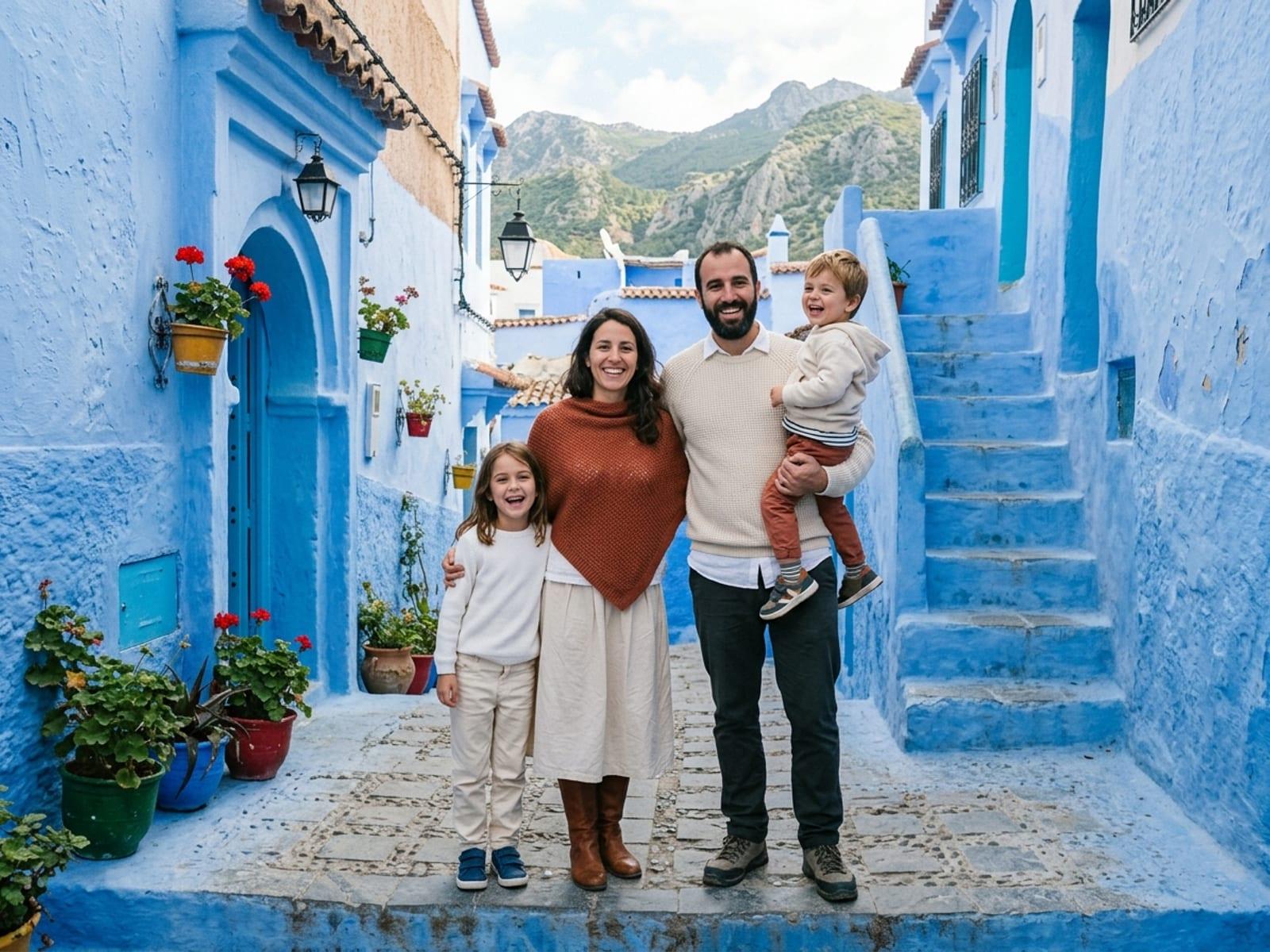
Chefchaouen is a town of fewer than 50,000 people on a hillside about 600 meters up at the foot of the Rif mountains in northern Morocco, known for an old town whose walls, doors and steps are painted blue. There's no railway; it's a little over two hours by car from Tangier airport (TNG). This isn't a place for ticking off big sights, so families do best with a night or two, a baby carrier for the stepped lanes, and plenty of breaks in the square and by the spring.
Founded in 1471 as a fort against the Portuguese
According to English Wikipedia, Chefchaouen began in 1471, when Ali ibn Rashid al-Alami built a small fortress to defend against Portuguese attacks. That fortress is the kasbah that still stands in the middle of the old town. The town spreads over the slopes at the foot of Jebel el-Kelaa in the western Rif, at an altitude of around 600 meters. The 2024 census counted 46,168 inhabitants.
The name combines an Arabic verb meaning "to look" with a Berber (Amazigh) word for "horns," meaning mountain peaks, so it reads as "look at the horns": the two peaks that overlook the town. When you arrive, see if the children can work out which mountains are the "horns."
As the Reconquista (the Christian reconquest of the Iberian Peninsula) advanced in Spain, Muslims and Jews driven out of Iberia settled here, and the small fort grew into a prosperous town. The houses of the old town, with their inner courtyards and arches of curved brickwork, show Andalusian influences that recall the streets of Granada. In the 20th century, the town was occupied by Spain in 1920 and became part of independent Morocco in 1956.
There are several explanations for the blue. English Wikipedia lists the idea that blue keeps mosquitoes away, the idea that it represents the sky and heaven, and a story told by locals that the town was ordered painted blue in the 1970s to attract tourists. No single answer has won out, so asking the kids "why do you think it's blue?" as you walk makes for a good conversation.
The square, the kasbah, the spring and the mosque on the hill
The center of the old town is Outa el Hammam square, which English Wikipedia calls "the heart of the medina." Around it stand the kasbah, the Great Mosque and an old caravanserai, and the square takes its name from a public bathhouse (hammam) that stood in its northwest corner. When you're tired of walking, come back to the square and rest while watching people go by. The town is small enough to explore by repeating that loop.
Inside the kasbah is a museum with archaeological and ethnographic collections, and a garden in its courtyard. Morocco's national tourism office describes the lush gardens in the center of town as "a haven of freshness," and says the museum holds old weapons, old photographs of the town and textiles. On a day of strong sun, it's a shady place for a break.
East of the old town, outside the former walls, is a spring called Ras El Maa. It was the town's original water source, and it's within walking distance of the medina, a natural turning point for a walk. Climb the hill farther east and you'll reach a mosque built by the Spanish in the 1920s. It's no longer in use, but it's a popular viewpoint over the whole town. If you want to see the blue medina from above, it's worth the extra effort.
Plan for stairs, baby carriers and rest stops
Because the old town covers a hillside, almost every lane is a slope or a staircase. A stroller is hard going, so plan on a baby carrier for small children, and assume that even children who can walk will want to be carried at some point. The path to the Spanish Mosque climbs steadily, so it's fine to decide on the day, based on how the children are doing, whether to go.
Because of the altitude, mornings and evenings can feel cooler than in coastal towns, so bring a layer you can add. English Wikipedia says Chefchaouen has a Mediterranean climate, with annual rainfall that varies widely: between 2000 and 2020 it ranged from about 500 mm to nearly 1,900 mm. If you visit in a wetter season, the stone steps get slippery when wet, so bring shoes with good grip and rain gear.
The same article notes that tourist numbers rise sharply in summer; around 120,000 people visited the town in 2018. If you'd rather walk when it's quiet, avoid summer, or walk the lanes early in the morning and rest at your guesthouse in the heat of the day. In front of blue walls, clothes in colors that don't blend in, such as white, cream or bright orange, make children stand out clearly in photos.
Many of the blue lanes run past people's front doors. When taking photos, don't block doorways or steps, and always ask before photographing residents or their children. For family photos, the quieter morning hours make it easier to take your time.
Mountain cheese, and waterfalls and a national park outside town
The tourism office presents goat's cheese as a specialty of northern Morocco, and notes that in Chefchaouen's lanes you can eat fresh-baked bread and tagine at small eateries. Looking into the old town's carpet and handicraft shops is part of the fun of walking around.
If you have time, the countryside is worth a trip too. At the top of the tourism office's list of places to visit around Chefchaouen are the Akchour waterfalls and Talassemtane National Park, where you can hike in the Rif mountains. Both are reached by car, so before you set out, ask at your guesthouse or a local information office whether the trails are manageable with children.
No train, so come by bus or car
Chefchaouen has no railway station. The nearest major international airport is Tangier Ibn Battouta (TNG), about 15 km southwest of Tangier's center. According to the tourism office, Chefchaouen is about 112 km and roughly 2 hours 10 minutes by road from Tangier, about 65 km and 1.5 hours from Tetouan, and about 194 km and a little over 3 hours 20 minutes from Fez. Long-distance buses run by CTM and other companies take about 2.5 hours from Tangier. The mountain roads are full of bends, so bring motion-sickness medicine for children who get carsick.
You can see your family standing in a blue lane with pokesta's AI photos ($1 per photo, with your first one free). If you come in through Tangier, you can head on to Fez afterwards, look down on the dye vats of the Chouara Tannery and try Fez's sugar-dusted pastilla. Entry requirements depend on your nationality, so check your own government's official information before you travel.
References