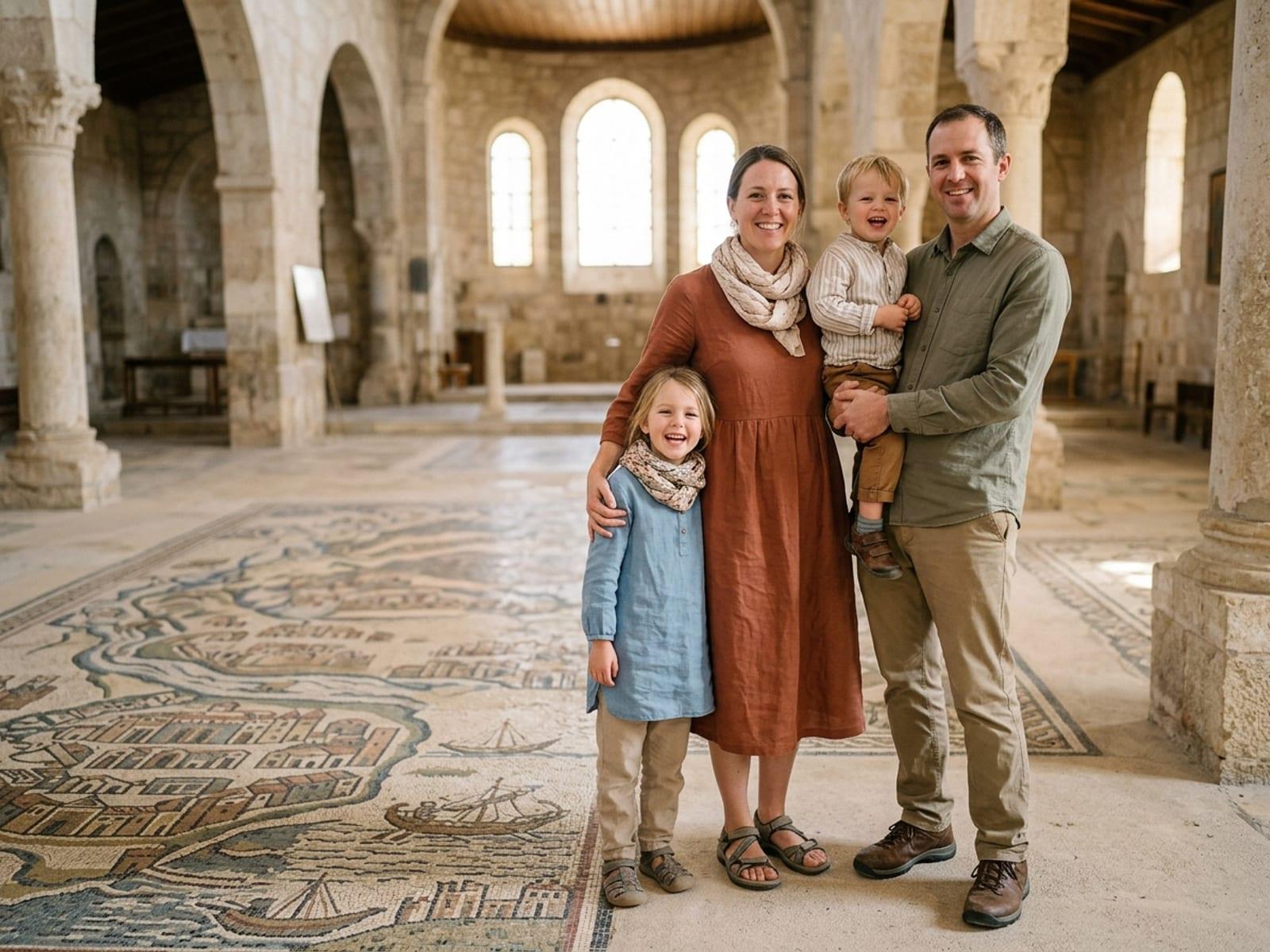
Pictures and maps made from hundreds of thousands, even millions, of tiny colored stones still lie on church floors right where they were laid. Madaba, about 30 km southwest of Amman, is a small town known as the City of Mosaics. At its heart is the Madaba Map, a floor mosaic made in the 6th century. Walk around town and you'll find not just ancient mosaics but a school where people still learn the craft, and shops selling handicrafts inspired by it. It is an easy day trip from Amman and the center is walkable; with children, spring and autumn, away from the summer midday heat, are the most comfortable times.
The oldest surviving map of Jerusalem, set into a floor
The Madaba Map lies on the floor of St. George's Church, the town's Greek Orthodox church. It's thought to date from between 542 and 570. The reasoning: it shows a church dedicated in 542, and no building later than 570 appears on it.
Originally it measured about 21 by 7 meters and was made from more than two million colored stones. What survives is roughly 16 by 5 meters. The Jordan Tourism Board gives the surviving section as 10.5 by 5 meters and the number of stones as around 700,000 to 800,000, so the figures vary depending on how they're counted. Either way, it's a staggering number of stones, each one set by hand. The map stretches from Lebanon in the north to the Nile Delta in the south. Jerusalem, the largest and most detailed element, sits at its center, and the map is the oldest surviving original cartographic depiction of the Holy Land and of Jerusalem in particular.
The orientation is the fun part. Modern maps usually put north at the top, but the Madaba Map puts east at the top. The church's altar faces east, so the map is aligned with it, and the directions on the map match the real ones. It shows the Jordan River, the Dead Sea, Karak in the south, and even the place where Jesus is believed to have been baptized, so play "Where's the Dead Sea? Where's Jerusalem?" with the kids.
The map came to light in 1884, when part of it was uncovered during preparations to build a new church, and its full extent became known in 1896.
Mosaics all over town, and the archaeological park
Madaba's mosaics aren't limited to the map in the church. Mosaics from the Byzantine and Umayyad periods, between the 5th and 7th centuries, survive all over town, showing Christian themes as well as scenes from Greek and Roman mythology. The Church of the Apostles, for example, has a mosaic personifying the sea as a human figure.
The town's archaeological park brings together a Roman road, the Hippolytus Hall with its mosaic floors, the Church of the Virgin Mary and more, so you can see a lot efficiently. The town also has an unusual history: in 1880, about 90 Arab Christian families moved here from Karak in the south and resettled what had become a ruined town.
A school that keeps the craft alive, and a street of handiwork
Madaba has a school where people learn to make and restore mosaics. It began in 1992 as the Madaba Mosaic School with support from the Italian government, and since 2007 it has been the Madaba Institute for Mosaic Art and Restoration, a two-year program teaching mosaic making and restoration. It's located between the visitor center and the archaeological park. Stop at the visitor center first, pick up a map and plan your route before you set off. The people who will look after these ancient floors are still being trained right here in town.
Tourist Street (Hussein Bin Ali Street) in the center of town is lined with shops selling handicrafts inspired by Madaba's mosaics and religious art. Beit al-Beiruti, set in a traditional house, is both a craft shop and a place that runs hands-on learning and play activities. Mosaic-themed items make easy souvenirs, but pieces made of real stone are heavy, so talk to the shop about size and how to get it home before you buy.
Near Madaba, the Bani Hamida Women's Weaving Project hand-weaves Bedouin textiles, and weaving workshops where you can learn the basics are also promoted in town. So there's a chance to see handiwork beyond mosaics, too.
Tips for touring with kids
St. George's Church is still an active place of worship. Keep your voices down inside and wear clothes that cover shoulders and knees. Agree as a family before going in: don't walk on the mosaic and don't touch it. The map is spread across the floor, so lift little ones up to let them see the whole thing from above; the shapes become much clearer.
The town center is small enough to explore on foot, but there are cobbles and steps, so a baby carrier is easier than a stroller. Take one photo of the map, and back home you can look again with the kids at what was drawn where.
You can also try a shot of the family lined up in front of a colorful mosaic with pokesta's AI photos ($1 per photo). Photos set against Madaba's churches at Christmas are also in the Jordanian Christmas gallery.
The road to Mount Nebo, and when to go
From Madaba you can also visit Mount Nebo, where, according to the Old Testament, Moses looked out over the Promised Land and died. It stands about 700 meters above sea level. From the summit you look down over the Jordan Valley; Jericho is often visible, and on very clear days you're said to be able to see as far as Jerusalem. In the church on the summit, mosaics excavated between 1933 and 1938 have been restored and went on display in a new building in 2016. Pope John Paul II visited in 2000 and planted an olive tree as a symbol of peace, and Benedict XVI visited in 2009. The summit also has a sculpture by the Italian artist Gian Paolo Fantoni combining the bronze serpent of the Old Testament with the cross of Jesus.
Madaba can be visited year-round. Summer middays are hot, so with children, spring, autumn or a sunny winter day are the most comfortable for walking. The gateway is Queen Alia International Airport (AMM), south of Amman. About 37 km from Madaba are the valley hot springs of Ma'in. Madaba is only about 30 km from Amman, and it's easy to plan a day that combines it with the Dead Sea and the Baptism Site.
The situation in the Middle East can change at short notice, and travel advice and entry requirements vary by nationality. Check your own government's latest official information while planning and again before you leave.
References