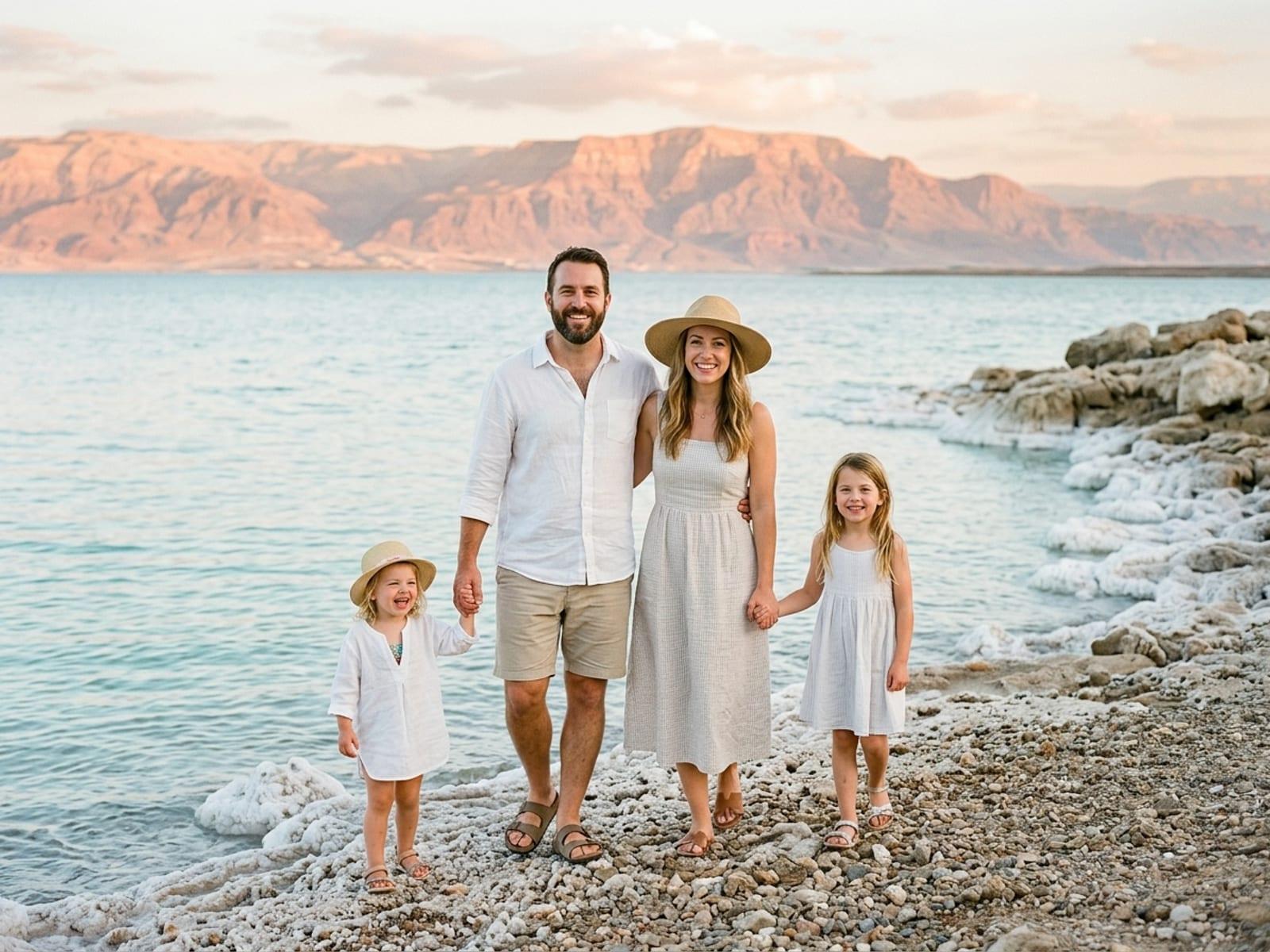
Lean back and you float without doing a thing. White salt crystals crust the shoreline, and the mud underfoot is black and silky. The Dead Sea, bordered by Jordan, Israel and Palestine, has a surface about 440 meters below sea level, the lowest point on land. It's not only a place to float: the lake is also a source of salt and minerals, and knowing that turns the trip into something like a science lesson for the kids. The most comfortable time to go is from winter into early spring, when the sun is gentler.
Why you float
The Dead Sea is about ten times saltier than seawater. One measurement in 2011 found 342 grams of salt dissolved in each kilogram of water. Its density is about 1.24 kilograms per liter, much heavier than fresh water or seawater, so it pushes up on your body far more strongly. That's why you won't sink even if you can't swim.
Rivers flow into the lake, but none flow out. In this hot, dry land the water evaporates and only the salt stays behind, and over a very long time that produced water unlike any other lake's. It's so salty it earned the name "dead": fish and most other living things can't survive in it.
The Dead Sea is also a shrinking lake. Its surface drops by roughly a meter a year, and its area has shrunk by about a third since the 1960s. From about 1,050 square kilometers in 1930, it was down to about 554 square kilometers by 2025, nearly half. The main cause is that water from the Jordan River, which feeds the lake, is now used upstream. As the shoreline retreats, underground salt layers dissolve and the ground collapses into sinkholes, another growing problem. As you walk the shore with your kids, wonder aloud whether the water once came up this far.
Black mud and salt become an industry
Most of the Dead Sea's salt is magnesium chloride and sodium chloride (table salt). It also contains potassium, bromine and more. On the Jordanian side, the Arab Potash Company, founded in 1956, produces about 2 million tonnes a year of potash (potassium chloride), a raw material for fertilizer, at Safi on the southern part of the lake. Industries based on Dead Sea minerals amount to about 4% of Jordan's GDP.
For visitors, the most familiar products are cosmetics and bath salts made from the mud and salt. The Jordan Tourism Board says the Dead Sea's black mud and water are used to improve circulation and skin condition. How much difference people notice varies, so if you use them on children's skin, start with a small amount. The ancient Greeks called it Lake Asphaltites, because lumps of asphalt (natural bitumen) would float up from the bottom. Greek and Jewish writers recorded that the Nabataeans, who built Petra, held a monopoly over the sea.
At Ghor al-Safi in the south, Safi Crafts sells handicrafts made by 15 local women and is open from 8 a.m. to 2 p.m. If you want a souvenir other than mud and salt cosmetics, it's worth a stop.
Ground rules for kids in the Dead Sea
Because the water is so salty, it stings badly if it gets in your eyes and is harmful to swallow. Agree on a few rules with the kids before going in: no faces in the water, no splashing, no rubbing eyes. An adult should stay right beside them, steady them with a hand once they're floating, and help them get their feet down when standing up from lying on their back. Even small cuts will sting, so skip the water on days when they have scraped knees or hands. As soon as you come out, rinse off the salt under a freshwater shower.
The shore can be rough with stones and salt crystals, so flip-flops or water shoes will save your feet. When you put on the mud, skip the face and do just the arms or legs; kids are less likely to protest. Once it dries, take a photo as is. Mud-covered grins are a shot you can only get here.
On the Jordanian side there's the reasonably priced Amman Tourist Beach, good for a day trip from Amman, the Dead Sea Public Beach with a pool, and a seafront promenade about 3.5 km long with family rest areas. On the northern shore, the King Hussein Bin Talal Convention Center, which can host more than 3,000 guests, sits at the heart of the hotel area. Jordan is a predominantly Muslim country, so wear a cover-up over your swimwear when you're away from the beach and hotel.
You can also try the shot before you go with pokesta's AI photos ($1 per photo): the family lined up on the shore at dusk, with white salt crystals at your feet.
Winter is the comfortable season
The area around the Dead Sea is dry and sunny most of the year. Average summer temperatures reach 32 to 39°C, with an average of 192 days a year above 30°C, heat that's hard going with children. Winter averages are a mild 20 to 23°C, and annual rainfall is under 50 mm. For floating as a family, roughly November to March is the most comfortable time.
At this low elevation, UV radiation is known to be weaker, especially UVB, the type that causes sunburn. The sun is still strong, though, so don't forget hats and sunscreen. Another feature of the area is the higher air pressure, which means slightly more oxygen in the air.
Getting there, and places to pair with it
The gateway is Queen Alia International Airport (AMM), south of Amman. From the hotel strip on the northern shore, it's about 20 minutes by car to the Baptism Site, the World Heritage Site where Jesus is believed to have been baptized. A winter visit can coincide with Epiphany at the Baptism Site in January. Near the lake is the Museum at the Lowest Place on Earth, and from there you can walk up to Lot's Cave on the hillside. Pair the Dead Sea with Madaba, the town of mosaics on the plateau above, and you'll feel Jordan's dramatic changes in elevation in a single day.
The mountains east of the lake have family-friendly stops too. The Dead Sea Panorama Complex, perched on a cliff in the Zara mountains, is known for its sunset views and has a restaurant. Wadi Mujib, near the Dead Sea, is a canyon the Jordan Tourism Board calls the largest nature reserve in the Levant, and the same board describes the Heba Trail as a family-friendly water park in nature, with abseiling and swimming. You will get soaked, so bring a change of clothes and shoes that can get wet. Ma'in Hot Springs, at 264 meters below sea level, is another easy side trip from the Dead Sea.
The situation in the Middle East can change at short notice, and travel advice and entry requirements vary by nationality. Check your own government's latest official information while planning and again before you leave.
References