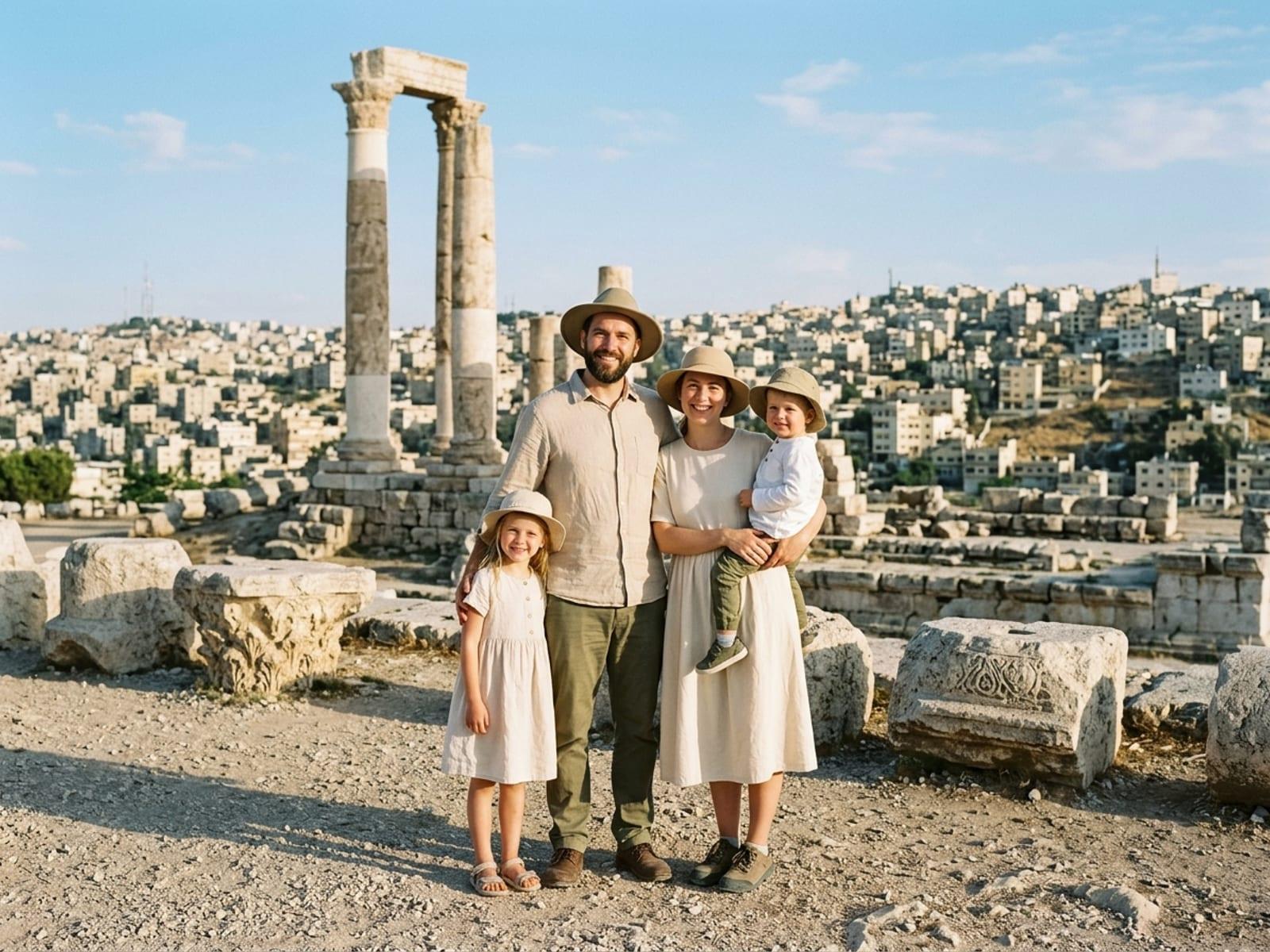
You don't have to travel to Petra or Jerash to see thousands of years of history in one go. Right in the middle of Amman are Citadel Hill (Jabal al-Qal'a), looking down over the old downtown, and the 2nd-century Roman Theatre in the valley below it. On the hilltop, the columns of a Roman temple, a Byzantine church and an Umayyad palace stand side by side; at the theatre, you can climb right to the top row of seats that once held 6,000 people. For a family, doing the hill while it's cool, then the theatre and the plaza around lunchtime, fits comfortably into half a day.
An L-shaped hill with thousands of years of homes
Citadel Hill is an L-shaped hill towering over downtown. People first lived here in the Neolithic period, and around 1800 BC, in the Bronze Age, it was fortified. Sometime after 1200 BC it became the capital of the Ammonite kingdom. Around 30 BC it came under Roman rule, and in 661 under Muslim rule. After that it was largely abandoned for about a thousand years, until in 1878 the Ottoman Empire settled Circassian refugees here and a town came back to life.
Looking out from the top, you can see clearly how Amman spreads over a chain of valleys and hills. Every hill is packed with stone houses, and in the middle of the valley floor sits the half-circle of the Roman Theatre, your next stop. Ask the children to find "the theatre we're going to," and the shape of the city starts to make sense to them.
A giant statue reduced to fingers and an elbow, and an Umayyad palace
The first thing you see on the hill is the Roman temple known as the Temple of Hercules. According to an inscription, it was built between 161 and 166. It stood on a podium of about 43 by 27 meters, with six columns about 13.5 meters tall across the front, and some of those columns still reach up into the sky. In fact, no one knows for certain which god it was dedicated to, and the name "Temple of Hercules" may not be accurate.
What children enjoy most may be the fragments of a huge statue lying near the temple. Of a figure estimated at about 13 meters tall, all that survives is three fingers and an elbow. If the fingers alone are this big, how large was the whole statue? Stand with your children at the "feet" and try to imagine looking up to its head.
On the higher, northern part of the hill are the remains of a palace built by the Umayyad caliph Hisham (r. 724–743). An audience hall for receiving guests, four meeting rooms and a colonnaded street survive, and nearby is a large cistern that supplied water to the baths and other buildings. There are also the remains of a 6th-century Byzantine church and a watchtower built by the Ayyubids in 1220, so on a single hill you can walk through the Roman, Byzantine and Islamic eras in turn.
The hilltop is also home to the Jordan Archaeological Museum, opened in 1951. It has been known for the Ain Ghazal statues, among the oldest human-made statues in the world, and plastered skulls found at Jericho. Since the national Jordan Museum opened in 2014, some of the finds have been moved there.
Down the hill to the north-facing Roman Theatre
The Roman Theatre on the valley floor was built in the 2nd century, and a Greek inscription shows it was dedicated to Emperor Antoninus Pius (r. 138–161). It seated about 6,000 people and faces north so the sun stayed out of the audience's eyes. The seating is very steep, and climbing to the upper rows is work even for adults, but the view down to the stage and across to the houses on the opposite hill rewards everyone who makes it. About 45 km to the north, the Roman ruins of Jerash have stone theaters of their own, which become festival stages in summer.
Behind the entrances on either side of the theatre are the Jordan Folklore Museum and the Jordan Museum of Popular Tradition, with tools of everyday life from the past and traditional costumes. In front of the theatre, to the north, is the Hashemite Plaza, and on its east side stands the Odeon, a smaller theatre for about 500 people. The theatre is still used today as a venue for book fairs, concerts and other events.
On hot or rainy days, head to the Children's Museum
The sites have very little shade, and walking them with small children at midday in high summer or in the rain is hard going. For days like that, the Jordan Tourism Board points to the Children's Museum Jordan in Amman. Opened by Queen Rania in 2007, it has hands-on exhibits plus a library of more than 5,000 children's books, an art studio and a garden behind the library. Its website lists exhibits on the sky and flight, electricity and magnetism, stars and space, the human body, the past and Jordan's wildlife, as well as an area for children aged 1 to 5 and their parents. There are role-play exhibits modeled on a police station, a bank and a supermarket, a maker workshop, a climbing wall and an on-site restaurant, so children can move between running-around exhibits and sit-down play. Check opening hours and prices on the official website (information as of October 2026).
The order to do it in, and what to watch for
The Citadel sits high above downtown up a steep climb, so it's easiest to take a taxi to the top. Allow roughly an hour to an hour and a half for the hill and about an hour for the theatre and plaza, and you can cover both in half a day with lunch in between. The hilltop catches the breeze but the sun is strong and there's little shade. Always bring hats and water, and in summer go early in the morning.
The site is full of unfenced drops and loose stones, and the theatre's steps are high and steep. Keep small children in sight and hold hands both going up and coming down. Strollers are almost useless inside the sites, so a baby carrier works better. On Fridays museums may be closed or open late, so if you want to see the museums, avoid Friday. Admission fees and opening hours can change, so check before you go.
When to go and getting there
You can visit the Citadel and the Roman Theatre all year, but spring and autumn are the most comfortable for walking. The gateway is Queen Alia International Airport (AMM), about 30 km south of central Amman. The downtown markets are close to the theatre, handy for lunch and shopping afterward. Visit around Independence Day on May 25 and you'll also catch the holiday mood in the city. You can try a shot of your family lined up in front of the temple columns ahead of time with pokesta's AI photos ($1 per photo, first one free).
The situation in the Middle East can change quickly, and travel advisories and entry requirements vary by nationality. Check your own government's latest official information while planning and again before you leave.
References