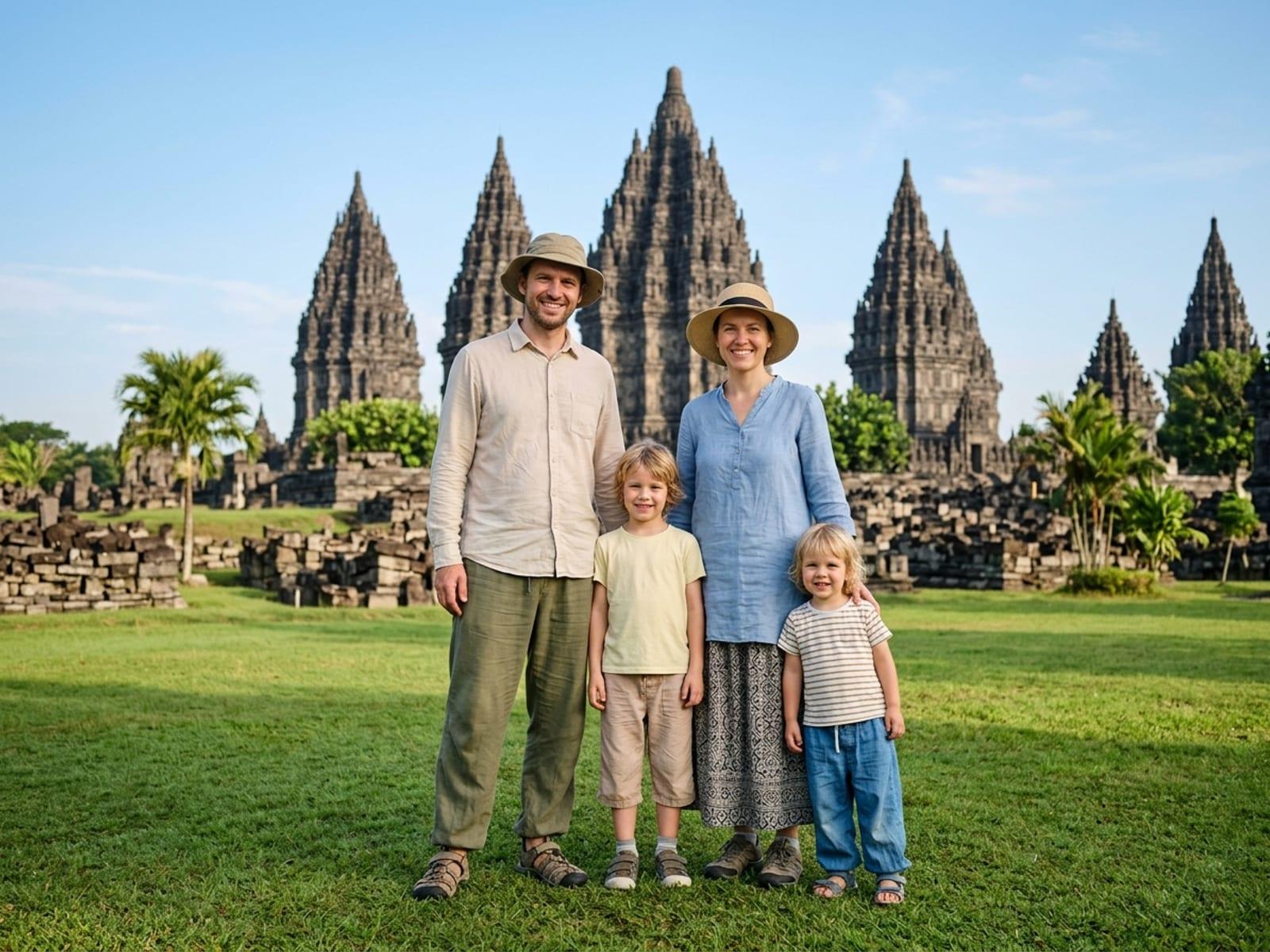
About 17 km northeast of Yogyakarta, a cluster of slender towers of dark stone rises above the fields. Prambanan, built in the 9th century, is the largest Hindu temple complex in Indonesia, dedicated to the three gods Brahma, Vishnu and Shiva. The central Shiva temple stands about 47 m tall. In 1991 the "Prambanan Temple Compounds" were added to UNESCO's World Heritage List. There's a lot of ground to cover on foot, so the best way to enjoy it with children is to arrive in the cool of the morning.
A temple to three gods, built by 9th-century Javanese kings
Prambanan was built as a Hindu temple during the Sanjaya dynasty, which ruled Central Java. Construction is thought to have been started by King Rakai Pikatan, and an inscription found at the site dates the completion of the Shiva temple to 12 November 856. Later kings expanded it, and it was originally a vast complex of 240 structures.
At its center are three large temples, each dedicated to one of the Trimurti: Brahma the creator, Vishnu the preserver and Shiva the destroyer. The Shiva temple towers above the others. Facing the three are smaller temples for each god's mount: Nandi the bull, ridden by Shiva; Garuda the bird, ridden by Vishnu; and Hamsa the swan, ridden by Brahma. The statue of the bull still sits in the Nandi temple. The central chamber of the Shiva temple holds a 3 m statue of Shiva, and the smaller chambers around it house statues of the sage Agastya, the elephant-headed Ganesha and the goddess Durga.
Over the centuries the temple collapsed, and in 1918 the Dutch colonial government began reassembling it. Full-scale restoration started in 1930, and reconstruction of the Shiva temple was completed in 1953. The temple was damaged again in the 2006 Central Java earthquake, which scattered fallen stones and carvings across the ground, but it reopened to visitors within a few weeks. Of the 224 small shrines that once surrounded the main temples, only six had been reassembled as of February 2023, and one estimate puts the time needed to restore them all at no less than 200 years. In July 2026, the governments of Indonesia and India announced a joint effort to restore these small shrines, launching a long-term plan that combines archaeological research, digital documentation and the study of AI-assisted reconstruction.
The gallery reliefs are picture stories in stone
The part to enjoy with children is the reliefs carved along the balustrades of the temples' galleries. The Shiva and Brahma temples tell the story of the Indian epic the Ramayana, and the Vishnu temple tells the story of Krishna, scene after scene like a picture strip. Prince Rama's quest, with an army of monkeys, to rescue his wife Sita after she's kidnapped is an adventure children can easily follow. Tell them the story before you go, with a picture book if you have one, and they'll be able to spot the monkey general Hanuman and the giant bird for themselves.
The temple also has a Javanese legend of its own, the story of Loro Jonggrang. After defeating her father the king, Prince Bandung Bondowoso asks Princess Loro Jonggrang to marry him. She sets an impossible condition: build a thousand temples in a single night. With the help of spirits, the prince finishes 999, and at that point the princess tricks him by making it look as if dawn has come. Furious, the prince turns her to stone, and she is said to be the statue of the goddess Durga in the northern chamber of the Shiva temple. Tell your children the story while you stand in front of it.
Sewu, the Buddhist temple to the north, and ballet under the full moon
About 800 m north of Prambanan is Sewu, a Mahayana Buddhist temple built at the end of the 8th century. Sewu means "thousand" in Javanese, and in the legend it's the "unfinished thousand temples." A great Hindu temple and a great Buddhist temple stand within walking distance of each other. The grounds are large, so with small children, don't try to walk the whole site; limiting yourselves to Prambanan's three main temples and Sewu keeps things manageable.
West of the temple, across the Opak River, are an open-air and an indoor stage where the Ramayana Ballet has been performed on full-moon nights since the 1960s. It's a dance drama in Javanese dance and music that tells the same epic as the gallery reliefs. Follow the story through the reliefs during the day, then watch it on stage at night, and children will find the plot much easier to follow. Performance dates and start times vary by season, so check the official information before booking. Evening shows finish late, so a nap beforehand helps younger children.
Arrive at opening time and rest in the shade
The Javanese sun is strong, and there's almost no shade around the stone temples. Arrive when the gates open and plan to finish before noon, and you can see the site before the children run out of energy. Always bring hats, sunscreen and water bottles.
Prambanan receives about 2.4 million visitors a year from Indonesia and abroad, and since 2022 it has also been designated a center of worship for Hindus in Indonesia and around the world. It's a tourist site and also a place of prayer that still matters to people. Choose clothes that cover shoulders and knees, and agree with children beforehand that they won't touch the reliefs or statues or climb on the stones. The stairs inside the temples are steep and dark, so hold small children's hands going up and down. Strollers can't be used on the temple stairs, so a baby carrier is handy.
Admission and opening hours can change, so check the latest from the official information of the company that manages the temple.
Getting there
The gateway is Yogyakarta International Airport (YIA). Take the airport rail link into Yogyakarta, and from there Prambanan is about 17 km by car. It's on the main road between Yogyakarta and Solo, and the city's Trans Jogja buses also run to their terminus at the Prambanan bus terminal. Brambanan railway station is about 750 m southeast of the temple.
If you're staying in Yogyakarta, you can start the day with the city's famous gudeg before heading to the temple, and spend the afternoon on the silversmiths' street in Kotagede in the southeast of the city. At Borobudur, the Buddhist temple, the Vesak festival is held around May or June. Entry requirements for Indonesia depend on your nationality, so check your own government's official information before you travel.
The Shiva temple is often busy, which can make a family-only photo tricky. pokesta's AI photos ($1 per photo, first one free) let you try one of your family lined up before the stone towers.
References