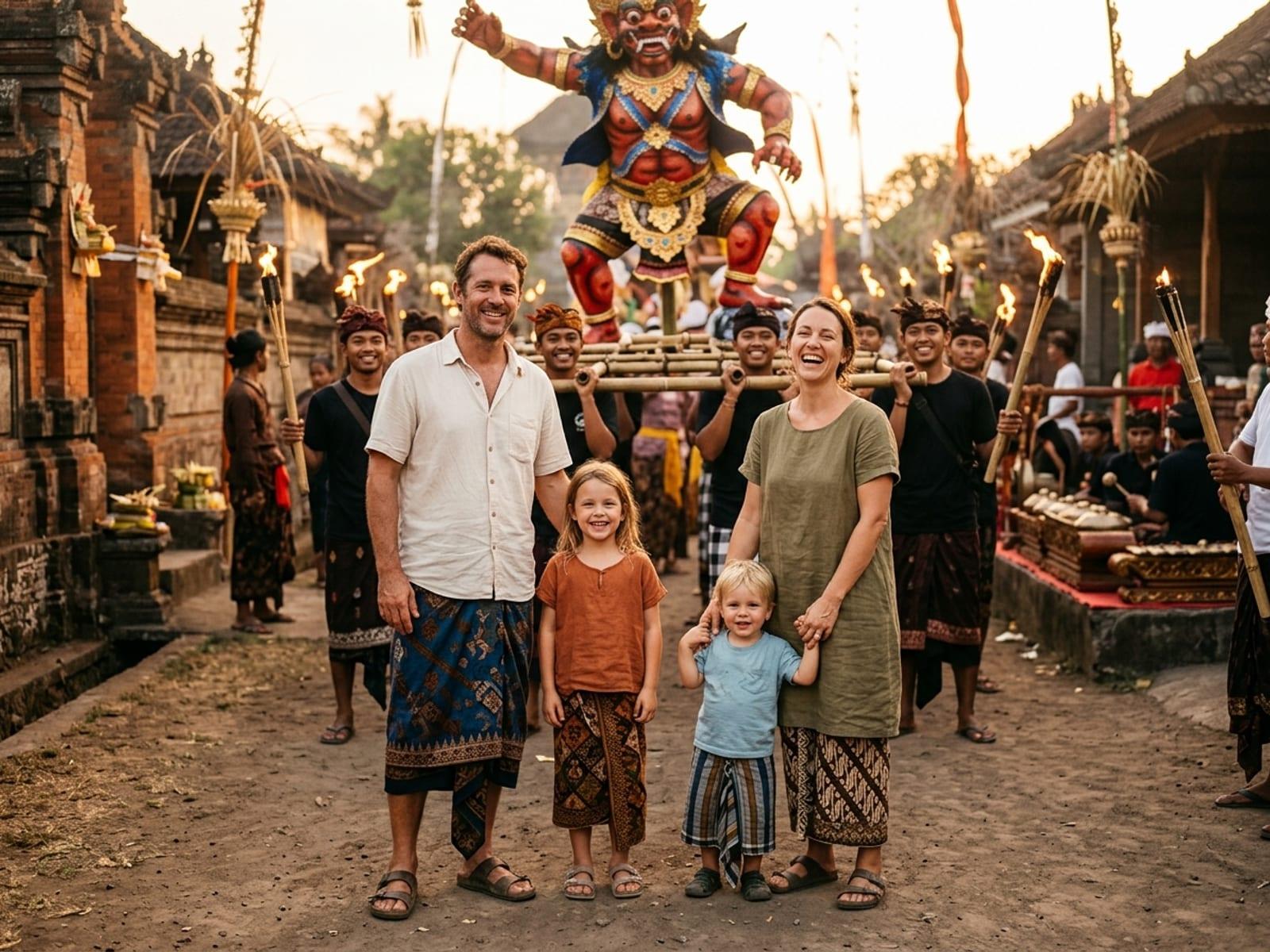
On the night before Nyepi, the Balinese Hindu new year, villages all over the island haul out ogoh-ogoh: giant demon figures built from bamboo and paper. They're shaken and spun through the streets to the clash of gamelan drums and cymbals, and in the end they're burned. The very next day, everything stops. Nyepi is the Day of Silence, and even the airport closes. In 2027 the ogoh-ogoh parades fall on the night of March 7 and Nyepi on March 8. If you want to see it, plan the two days as a pair.
Drive out what's bad, then greet the new year in silence
Nyepi is New Year's Day in Bali's Saka calendar. Because the Saka calendar is lunisolar, tracking both the moon and the sun, its date on the Western calendar changes every year. In the list of 2027 public holidays the Indonesian government released in September 2026, Nyepi (the start of Saka year 1949) is on Monday, March 8.
A few days before the new year comes Melasti, a ritual in which sacred objects are purified at temples near the sea and holy seawater is collected. The day before Nyepi, the equivalent of New Year's Eve, is Pengerupukan. In the evening, people bang pots and bamboo tubes and carry torches of dried palm leaves through their homes to chase out evil spirits. It's part of a set of rituals meant to restore balance between people, the gods and nature.
Ogoh-ogoh are the effigies carried into the village streets that night. They take frightening forms known as bhuta kala, which stand for the bad side of the human mind. The bearers shake the figures again and again and spin them as they go. After the parade, most are burned, often at the village cemetery, a way of burning away what is bad.
Built over months by the village youth
The people who build ogoh-ogoh are mostly the youth groups of the banjar, Bali's neighborhood communities. They weave a frame from bamboo and rattan, layer it with paper, then paint and decorate it. Sizes run from under a meter to nearly 8 meters tall, and some weigh close to a ton. Building one takes anywhere from a week to about five months.
It's easy to assume the parades are ancient, but their current form is fairly recent. They caught on after Nyepi became a national holiday in 1983, and became an island-wide custom once they were included in the Bali Arts Festival in 1990. For a while, builders used easy-to-shape polystyrene foam, but the province banned it in 2015 because the smoke from burning it is toxic. No parades were held from 2020 to 2022 because of COVID-19, and they came back in 2023.
Small ogoh-ogoh carried by children are part of the fun too. At a 2024 parade in Tuban, in Badung Regency, the local news agency reported that children carried eight of the ten figures on show.
Where to watch: central Denpasar or your own neighborhood
The biggest effigies gather in Denpasar, the provincial capital. Some of the most impressive figures in the city converge around the Catur Muka statue, which marks the city's central point, and the streets fill with spectators. Villages in Kuta, Legian, Sanur, Ubud, Canggu, Nusa Dua and other tourist areas each bring out their own ogoh-ogoh, so the easiest option is to watch wherever you're staying.
The parades start around dusk. In Tuban, reports said the roadside was already packed with spectators by late afternoon. While the parades are on, the streets are packed with processions and onlookers, and traffic slows to a crawl. If you head into central Denpasar, sort out how you'll get back before you go.
With children, skip the main intersections and watch on a village street near your accommodation. Compared with the crowds on the big roads, it's easier to get near the front, and you can see the faces of the young bearers and hear their shouts. Keep in mind, though, that the effigies are shaken hard and can swing around without warning. Make sure the kids know two rules: stay out of the bearers' path, and keep away from the torches.
What to wear and how to take photos
There's no dress code for watching ogoh-ogoh. Bali is still hot by day in March, and you'll be standing in a crowd from evening into the night, so cotton clothes that soak up sweat and comfortable sandals you won't mind having stepped on work best. Bright clothes make it easier to keep your eyes on a child in the crowd after dark.
A few days earlier, you may also come across a Melasti procession on the coast. These are prayer processions carrying sacred objects to seaside temples, not shows put on for visitors, so watch quietly from a distance. If you enter a temple compound, cover your shoulders and knees and tie a sarong and sash around your waist.
For photos, it's safer to stand back on the sidewalk and capture the whole procession than to get in front of an effigy. Go easy on the flash, which can dazzle the bearers. The best light is the half hour or so around dusk, when the flames and the colors of the figures stand out.
The next day you can't go out: spending Nyepi
For the 24 hours from 6 a.m. on Nyepi to 6 a.m. the next day, four restrictions apply: no fire or lights, no work, no travel and no entertainment. Everyone on the island stays in, visitors included, whether or not they're Balinese Hindu. Tourists can move around their hotel grounds but can't go out to the beach or onto the roads. Ngurah Rai International Airport, the island's only airport, closes for the whole day. The island's warungs and restaurants are shut too.
Hotels differ in how they serve meals and handle lights at night, so ask when you book. For children it can be a long day with no outdoor play. Books, paper games and coloring sets make the time in your room much easier.
On the following day, Ngembak Geni, normal life returns. Families and friends ask each other's forgiveness, and fires and lights are lit again.
In 2027, Nyepi runs into a long national holiday
The thing to watch in 2027 is that Eid al-Fitr, the festival that ends the Muslim fasting month (expected on March 10 to 11), follows right after Nyepi. Put the announced public holidays and collective leave days (March 9, 12 and 15) together with the weekends, and you get a 10-day break from Saturday, March 6, to Monday, March 15, so travel within Indonesia will be very busy. The date of Eid al-Fitr can shift depending on the Ministry of Religious Affairs' decision.
The gateway is Ngurah Rai International Airport (DPS) in Denpasar. There are no flights on Nyepi itself, so arrive by early on the day before at the latest, and leave no earlier than the day after. Roads are jammed on the night of the parades, so try to finish the drive from the airport to your accommodation before that evening. Entry requirements depend on your nationality, so check your own government's official information.
You can preview what a family photo in front of a demon effigy might look like with pokesta's AI photos ($1 per photo, first one free). Bali's Galungan, when bamboo penjor line the streets, is a gentle festival for family and ancestors with a completely different mood. You can also pair the trip with the Jatiluwih rice terraces in the island's interior.
References