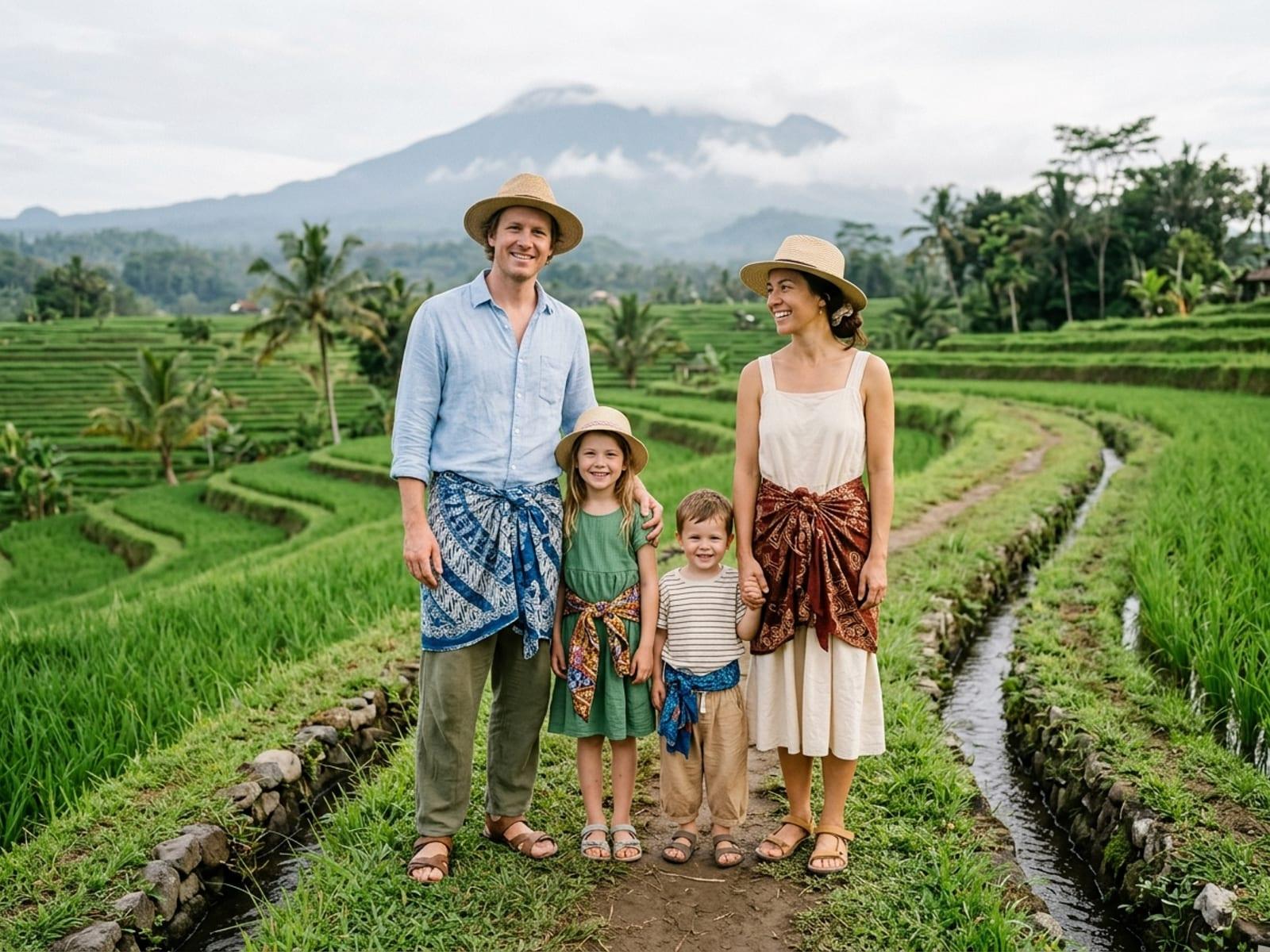
In west-central Bali, at the foot of 2,276-meter Mount Batukaru, spread the rice terraces of Jatiluwih. Paddy after paddy steps up and down the folds of the hills, and on a clear day you can see the whole scene backed by Mount Batukaru and Mount Agung. What has kept these terraces going is subak, Bali's traditional system for sharing water. In 2012 the subak landscape was inscribed as a UNESCO World Heritage Site, and Jatiluwih became one of its central places. It's a World Heritage Site where you can walk right through working rice fields, which makes it a good one for families.
Subak, a system for sharing water
Subak is the community system that distributes water to Bali's rice fields. It's thought to date from around the 9th century, and the oldest written record comes from around the 11th century. Water flowing out of the mountain forests is led to the fields through channels, tunnels and weirs, and farmers have decided among themselves how to share it.
At the center of the system are the water temples. Temples stand at springs and at key points along the channels, and each temple is tied to the fields of one watershed. Behind it lies Tri Hita Karana, a philosophy that values harmony between people, nature and the gods.
One place subak's wisdom shows clearly is in synchronized planting. Farmers on the same water system plant at the same time and leave their fields fallow at the same time, which keeps pests down and lets them share limited water efficiently. Terms survive for the different seasons, too: kerta masa for planting in the rainy season, gadon for planting in the dry season, and palawija for growing crops other than rice where water is scarce.
The site's official name is "Cultural Landscape of Bali Province: the Subak System as a Manifestation of the Tri Hita Karana Philosophy." It's made up of five areas: the subak landscape around Mount Batukaru, Lake Batur, the Pakerisan river basin, the royal water temple of Taman Ayun and Ulun Danu Batur, the highest-ranking water temple. Together they cover about 19,500 hectares. Jatiluwih is part of the landscape around Mount Batukaru.
Walking the terraces: from 30 minutes to 3.5 hours
Jatiluwih is a village in Penebel district, Tabanan Regency, at about 700 meters above sea level. The air is noticeably cooler than at the beach resorts, which makes it a pleasant place to walk. The village covers a little over 22 square kilometers, and in 2016 it had fewer than 3,000 residents. Visitors began coming for the views of the terraces from around 2000.
Within the terraces is a protected area of about 300 hectares, and walking all the way around it takes around three and a half hours. Electric bicycle tours, run by villagers since 2017, cover it in about an hour. With small children, even a short out-and-back walk along a path near the entrance gives you a good look at the stepped fields and water channels.
The paths are mostly paddy embankments and narrow trails. They turn muddy after rain, and in places you'll step over channels, so a baby carrier works better than a stroller. The fields are the farmers' workplace. Before you set off, agree on three things with your children: stay on the marked embankment paths and don't walk into the paddies, don't touch the crops, and don't block the water in the channels.
The view changes with every season
Because subak synchronizes planting within each water system, the color of the terraces depends on when you go. Sometimes freshly flooded paddies reflect the sky like mirrors; sometimes lush green rice covers everything; sometimes ripe grain turns the fields gold; and sometimes harvested fields lie resting. No season is the "right" one, so enjoy whatever view your travel dates bring.
The best time of day is the morning, before the sun gets strong; it's easier to walk and easier to take photos. This is mountain country, and in the afternoon clouds can roll in and hide the peaks. Bring rain gear, a towel for sweat and more water than you think you'll need.
Finding the water's path with your children
As you walk, look not only at the view but at the water at your feet: the narrow channels beside the embankments, the small outlets between one field and the next, the weirs that split the flow in several directions. Water runs from the upper terraces down to the lower ones in turn, and if it's blocked in one spot, every field below suffers. Here children can see with their own eyes why subak has always shared water by agreement.
Follow a channel up a terrace or two and you can trace with your children where the water splits and which field it flows into. Just don't leave the embankment paths to chase it upstream.
What to wear, and manners at temples
For walking the terraces, wear light, breathable clothes, a sun hat, and non-slip sandals or sneakers. Clothes you don't mind getting muddy are the most relaxing choice. Long trousers protect children's legs from grass and insects.
If you stop at a subak water temple or another temple nearby, cover your shoulders and knees and tie a sarong and sash at your waist. Some temples lend them at the entrance. Balinese temple etiquette, such as not walking in front of people at prayer and not stepping on offerings, is covered in more detail in our Galungan article.
Getting there: from Denpasar up into the hills
The gateway is Ngurah Rai International Airport (DPS) in Denpasar. Jatiluwih is reached by car, either via Kediri, Tabanan and Penebel from Denpasar, or via Mengwi and Baturiti. In the town of Mengwi, about 19 km north of Denpasar, is Taman Ayun, the royal temple that is also part of the same World Heritage Site. It was built in 1634 by the king of Mengwi to honor his ancestors. Water surrounds the grounds like a moat, and multi-tiered shrine towers called meru stand in rows. The inner sanctum is for people at prayer, so view it from outside. Stopping there on the way in or out shows clearly how the fields and the temples are connected through water. The road winds through the hills, so bring motion sickness medicine for children who get carsick. Eating nasi campur at a warung in town before you head into the hills helps keep hungry children from derailing the day. Whether there's an entrance or parking fee for the terraces, and how much, can change, so check the latest on site.
You can visit Jatiluwih year-round, but on Nyepi in March, nobody can go out anywhere on Bali and the airport closes. If your dates might overlap, plan around it together with the Ogoh-ogoh parades the night before. Entry requirements for Indonesia depend on your nationality, so check your own government's official information.
You can try out a family photo in front of the green terraces with pokesta's AI photos ($1 per photo, first one free).
References