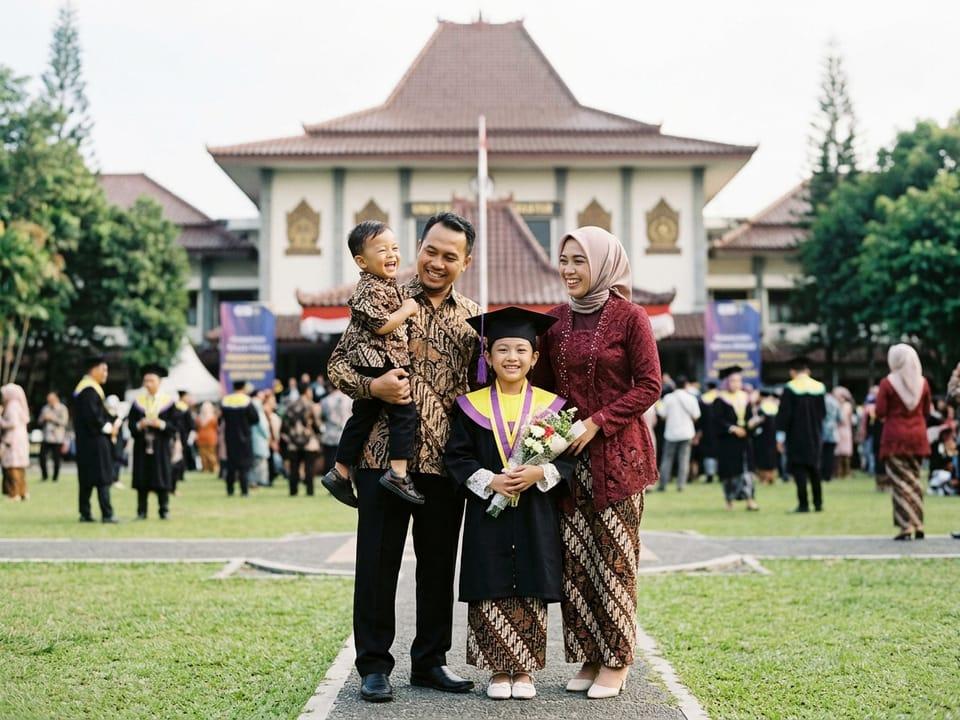
There is no national graduation day in Indonesia. Each university sets its own wisuda, or graduation ceremony, and most hold several a year: Universitas Gadjah Mada (UGM) runs four undergraduate ceremonies, in November, February, May and August, and Institut Teknologi Bandung (ITB) held three in the 2024/2025 academic year. Ceremonies start early and finish around midday, and some universities let only two family members into the hall. The surest way to get the family group photo is to agree in advance that it happens in the first ten minutes after the ceremony, before classmates claim the graduate.
Each university sets its own dates, three or four times a year
Wisuda dates follow each university's academic calendar, with ceremonies spread across the year at the ends of terms. UGM's 2025/2026 calendar started the first semester on August 19, 2025 and the second on February 9, 2026. Its undergraduate wisuda fell in late November 2025, on February 25–26, May 20–21 and August 19–20, 2026, with four separate graduate-school ceremonies on other dates. ITB held three in 2024/2025: the second on April 25–26, 2025 and the third at the end of August. Some universities still hold just one a year.
Dates are not announced far ahead. UGM notified its faculties of the August 19–20, 2026 ceremony on June 22, and graduates had until July 24 to register. When registering, they pick the round of yudisium, the faculty's formal confirmation of final results. If relatives are flying in, that leaves under two months to book flights and a photo studio. UGM's calendar also warns that the schedule can change, so ask the graduate to check the latest notice.
Kindergartens and schools up to senior high hold wisuda too. In June 2023 the Ministry of Education, Culture, Research and Technology issued a circular from its secretary-general (No. 14 of 2023) stating that school graduations are not compulsory and must not burden parents. The rest of this guide is about university ceremonies.
A 6 a.m. start and two seats per family: UGM's rules
For UGM's May 2025 ceremony, graduates collected their gowns on loan from the university two to six days beforehand, in time slots by faculty, and attended a rehearsal (gladi bersih) in the hall the morning before. The ceremony itself ran from 6 a.m. to noon in the Grha Sabha Pramana auditorium on campus. ITB's April 2025 ceremony was split into two sessions, one each day, both running from 8 a.m. to noon.
A wisuda usually opens with the university senate, the rector, vice-rectors and deans, entering in procession. The high point is when the tassel on the cap is moved from left to right, a sign that the student has become a graduate.
What matters most for families is the seating. Under UGM's rules, companions enter with an invitation, and no more than two may come into the auditorium. Children under seven are not allowed into the ceremony; a streaming room was set up on the ground floor instead. Guests are asked not to walk about or leave during the ceremony and to keep phones on silent. If there are young siblings, decide beforehand who goes into the hall and who waits with the children in the streaming room.
A 6 a.m. start means kebaya dressing and makeup are done before dawn. Before the ceremony, with registration and seating to get through, keep it to a few shots with the parents at the entrance. Find out whether the university provides official photos of the moment on stage; from your seat, one picture of the hall with the graduate seen from behind is enough.
Start the family's outfits from the graduate's kebaya
Under the gown, the classic combination is a white shirt with black trousers and black shoes for men, and a light traditional kebaya with batik cloth for women. In 2024 the kebaya was inscribed on UNESCO's intangible cultural heritage list, in a joint nomination by Indonesia, Brunei, Malaysia, Singapore and Thailand.
Build the family's clothes around the color of that kebaya. Mom in a kebaya or blouse in the same color family, Dad in a batik shirt with that color in it, siblings in smart plain clothes. Matching the color family rather than dressing everyone in the same fabric is the same idea behind sarimbit, the matching family outfits worn at Lebaran. If Dad's shirt is going to be hand-drawn batik, Pekalongan's batik guide explains how to tell hand-drawn from stamped. If everyone wears dark colors, the group looks heavy next to the black gown; lighter mid-tones make faces stand out.
Take the family photo in the first ten minutes after the ceremony
Once the ceremony ends, the area outside fills with graduates and families. Agree on a meeting point beforehand, something like "the big tree beside the hall," so you can find each other even if calls won't go through. Classmates and club friends will pull the graduate into photo after photo, so settle it in advance: family group photo in the first ten minutes, then off to friends. That way both sets of pictures happen without anyone feeling short-changed.
Before shooting, check that the gown sits straight on the shoulders, the cap is level, and the tassel has been moved to its post-ceremony side. Hold the bouquet below chest height so it doesn't hide the face. Put the graduate in the middle with the parents on either side; grandparents can sit on chairs in the front row, with siblings standing behind or at the ends. For full-length shots, crouch a little and shoot from about chest height so legs don't look short.
An early start and the crowds can wear grandparents out. Find a shady spot where they can sit and bring drinks, and take the picture of just the grandparents and the graduate early, before the crowds peak.
ITB adds the arak-arakan, a parade in which the study-program student associations honor the graduates and walk the campus with them. In April 2025 it took place on Sunday the 27th, the day after the two-day ceremony, with 35 associations taking part. The route ran from the Saraga futsal field through the Sunken Court tunnel to Lapangan Cinta on the Ganesha campus, with each association carrying large props that stand for its program. It is staged as a spectacle that families and the public can watch. Because it fell on a different day from the ceremony, talk with the graduate about whether the family will come out to photograph it too.
In the rainy season, scout a covered spot
Indonesia's rainy season runs roughly from October to March, which takes in UGM's November and February ceremonies. Scout places on campus where you can shoot in the rain, such as covered walkways or under building eaves. Clear umbrellas keep faces from going dark. On wet ground, watch the kebaya hem and heels.
Even without rain, the sun and humidity will have everyone sweating. Avoid shooting outdoors around midday, use the shade, and build in time for makeup touch-ups.
Booking a studio: check the gown return date and the time slot first
Your wisuda day is shared with a great many other graduates from the same university, so if you want a slot on the day itself, book as soon as the date is announced. Where the gown is on loan from the university, as at UGM, a studio session on another day means either shooting before it has to go back or using the studio's own gowns, so decide that first. Ask every studio the same things: which slots are free and whether you can get there in time after the ceremony; whether you can bring your own gown and cap or they provide them; how many people can be in the photo and whether the price changes with group size; what backdrops there are, how many files you get and how long delivery takes; and whether there is a mirror and space to fix a hijab or kebaya.
Shooting on the day means outfits and makeup are ready, but a family that has been up since before dawn will be tired. Another day is more relaxed. Use phones for the snaps around the ceremony and a studio for the formal portrait, and the day itself stays calm.
If relatives couldn't come, whether because they live far away or the hall only had two seats, pokesta can create a wisuda family photo with AI from each person's own phone photos ($1 per photo, first one free).
References
- Wikipedia (Indonesian), "Wisuda" https://id.wikipedia.org/wiki/Wisuda
- Universitas Gadjah Mada, Academic Calendar 2025/2026 (undergraduate) https://dbsmb.sv.ugm.ac.id/wp-content/uploads/sites/67/2026/08/KALENDER-AKADEMIK-UGM-2025-2026-3.pdf
- Universitas Gadjah Mada, circular on the Period IV 2025/2026 undergraduate wisuda (June 22, 2026) https://akademik.ugm.ac.id/wp-content/uploads/sites/35/2026/06/Edaran-Wisuda-Program-Sarjana-dan-Sarjana-Terapan-Periode-IV-TA-2025-2026.pdf
- Universitas Gadjah Mada, May 2025 wisuda arrangements and ceremony rules https://deb.sv.ugm.ac.id/wp-content/uploads/sites/98/2025/05/Wisuda-Mei-2025-1.pdf
- ITB, "Over 1.800 Students Graduate in ITB's Second Graduation Ceremony of The 2024/2025 Academic Year" https://itb.ac.id/news/over-1800-students-graduate-in-itbs-second-graduation-ceremony-of-the-20242025-academic-year/62275
- ITB, "Festive Arak-Arakan Event Colors ITB April 2025 Graduation Parade" https://itb.ac.id/news/festive-arak-arakan-event-colors-itb-april-2025-graduation-parade/62293
- RRI, "Tassel yang Menjadi Simbol Penting Bagian dari Wisuda" (May 9, 2026) https://rri.co.id/jambi/berita-lain/2401126/tassel-yang-menjadi-simbol-penting-bagian-dari-wisuda
- detikEdu, "Kemdikbud Terbitkan Surat Edaran Wisuda PAUD-SMA" (June 25, 2023) https://www.detik.com/edu/sekolah/d-6791348/kemdikbud-terbitkan-surat-edaran-wisuda-paud-sma-tak-wajib-jangan-membebani
- Wikipedia, "Kebaya" https://en.wikipedia.org/wiki/Kebaya
- Wikipedia, "Climate of Indonesia" https://en.wikipedia.org/wiki/Climate_of_Indonesia