
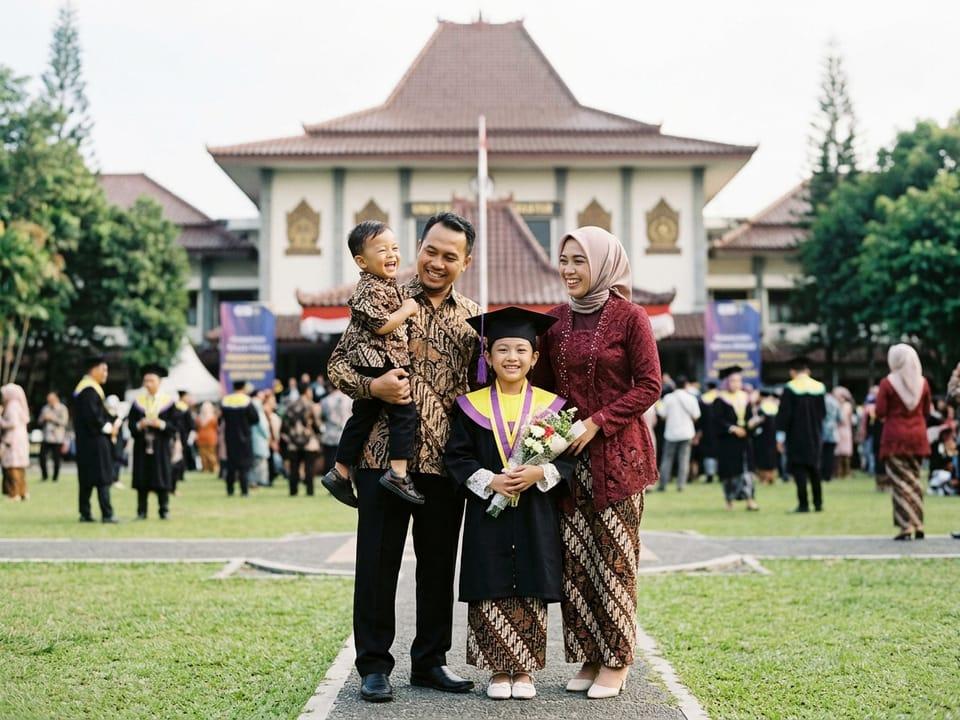
If the kebaya will be worn again, at Lebaran, a wedding or a family event, buy it; if it is only for wisuda day, rent it. Under the toga, the photos show little more than the sleeves, the neckline and the kain (batik cloth) below the hem, so spend on the color near the face and a sleeve that sits neatly, not on embroidery the gown will cover. Two prices checked in October 2026 give a sense of scale: ready-made kebaya from one Yogyakarta label are listed at Rp 445,000 to Rp 655,000, and a Jakarta studio adds a kebaya loan to its makeup-and-hair package for Rp 200,000 more.
Under the toga, only the sleeves, neckline and kain show
The classic wisuda outfit is a white shirt, black trousers and black shoes for men, and for women a light, traditional kebaya with batik cloth, with the gown worn over both. The gown itself is usually borrowed or rented from the university. At Telkom University's ceremony on 25–26 September 2026, graduates rented gowns from their faculty cooperative for Rp 100,000 plus a Rp 125,000 deposit, to be returned by 9 October; after that date the deposit would not be refunded and the loan would count as a purchase. Even the toga, in other words, works on rent-plus-deposit terms.
With a black gown on top, three things decide how the kebaya looks in photos. The color sits right beside the face, so soft, light-to-mid tones keep faces bright next to the black. The neckline frames the face: a kutubaru kebaya has an extra panel across the chest that makes a square collar, while the Kartini style, in non-transparent fabric, is often white. And the kain shows from the knees down, so its pattern matters more than the kebaya's hem. If you plan photos without the gown later in the day, the whole kebaya will show, which is an argument for buying a little better.
Rent, buy ready-made or tailor: what each really costs
| Rent | Buy ready-made | Tailor | |
|---|---|---|---|
| Up front | Rental fee plus a deposit | Full price, e.g. Rp 445,000–655,000 at one label | Fabric plus the tailor's fee; ask for a quote |
| Hidden costs | Cleaning, late return, damage; sizes are limited | Alterations | Your time for fittings |
| Lead time | Collect a few days before | Buy, try on, alter | Several weeks with at least one fitting |
| Afterwards | Nothing to keep | Lebaran, weddings, family events | Yours, cut to fit |
| Suits | A one-off look | Someone who will wear it again | A specific color, size or fabric |
Renting is cheapest on the day, but read the terms as carefully as for the toga. Ask how many days are included, how much the deposit is and when it comes back, whether cleaning is charged, what a day's late return costs, and whether you may pin or take up the hem. Ask, too, what happens if foundation marks the collar, because that is where it usually goes. Some studios bundle the kebaya with makeup. For LSPR's November 2025 wisuda, Tarzan Photo offered graduates who booked a studio package makeup and hair for Rp 400,000, or makeup, hair and the loan of a "grand deluxe" kebaya for Rp 600,000. That is one appointment for face, outfit and portrait, but you choose from what they have in your size.
Buying ready-made makes sense when the kebaya is simple enough to wear again. Lemari Lila, a label based in Bantul, Yogyakarta, lists kebaya in rubia cotton, batik and chiffon at Rp 445,000 to Rp 655,000, with 10% off when we checked. A cotton kebaya like that can return for Lebaran, where families often coordinate colors (see matching sarimbit outfits), or for a wedding invitation.
Tailoring gives you the exact color and fit, but only if there is time. Wisuda dates arrive late: Telkom University announced its September 2026 ceremony on 28 July, with registration from 3 to 7 August. Start choosing fabric as soon as the faculty confirms you will graduate in that round. Prices for any of these options change by shop and season, so check the seller's own page.