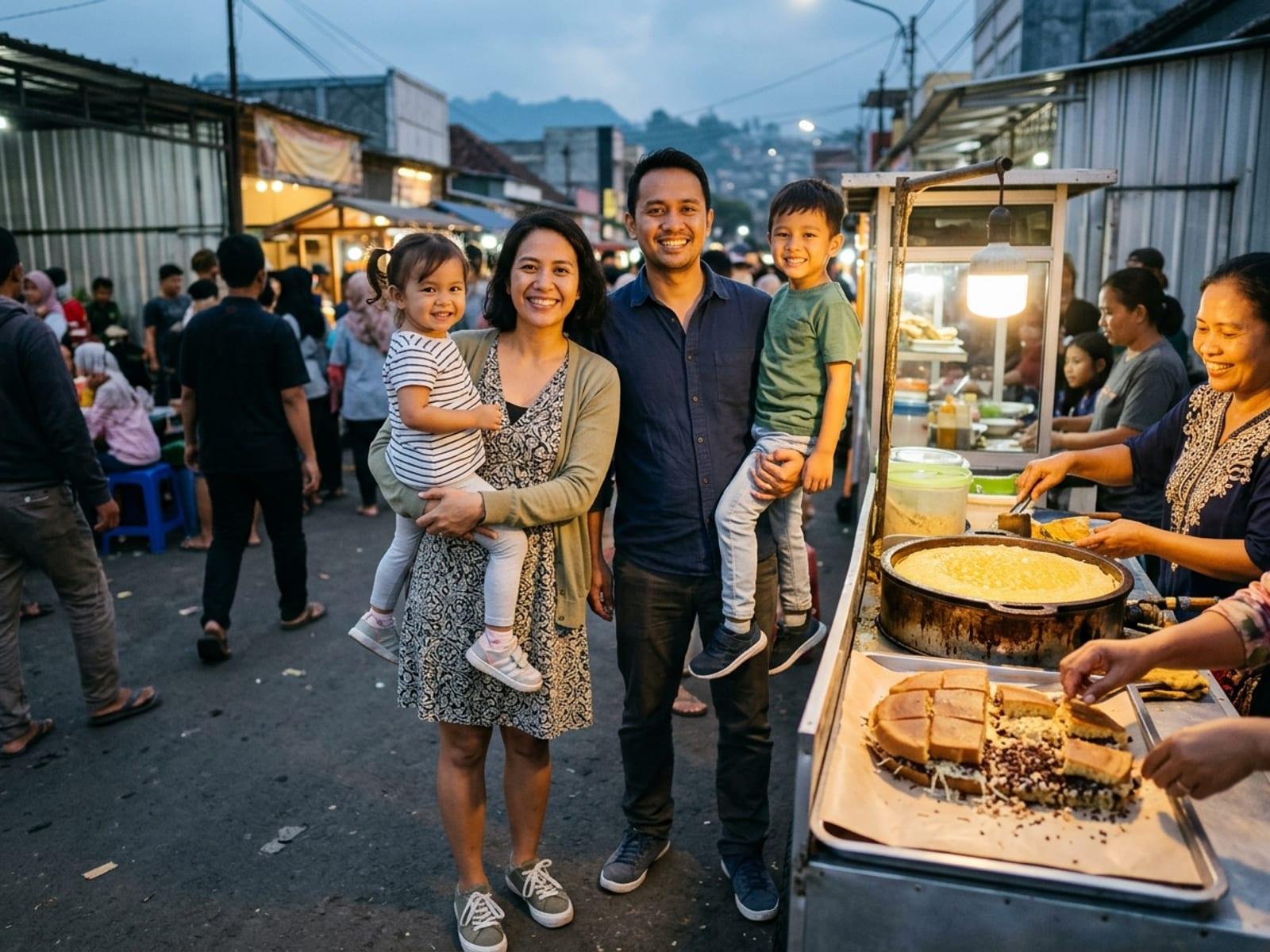
As the sun goes down, a thick iron pan heats up at a roadside stall and the batter starts to bubble. The finished round pancake is spread with a generous layer of butter or margarine, scattered with chocolate sprinkles, cheese or crushed peanuts, folded in half and cut into squares. This is martabak manis, "sweet martabak," a fixture of Indonesia's night stalls. In some regions it's called terang bulan, "moonlight," and the story goes that it was popularized by a family who moved from Bangka Island to the West Java city of Bandung. The stalls open from late afternoon into the night. With children, order one pancake for the family to share and keep it to two toppings at most, which keeps the sweetness and richness manageable.
Bangka's hok lo pan took a new name in Bandung
Trace it back far enough and this pancake is said to be a dish from Fujian, China. One tale has a 19th-century Qing general in Fujian ordering it created as food for his soldiers, though there's nothing to back that up. It spread through Southeast Asia with people who emigrated from Fujian and Chaozhou, and in Malaysia and Singapore it's known by names such as apam balik.
In Indonesia, it started in the Bangka Belitung Islands, east of Sumatra, where it was eaten among the Hokkien and Hakka communities under the name hok lo pan. In North Sumatra and the Riau Islands it also goes by martabak Bangka.
Indonesian Wikipedia tells the story like this. Around 1950, a man from Bangka moved to Bandung and began selling snacks from the afternoon into the night in front of the house he rented. His wife did the cooking, and since the hok lo pan sold best, they eventually sold only that, making each one to order. Later they rented a spot at a night market near Bandung's town square (alun-alun), next to a stall selling Indian-style martabak. To make things easier for customers, they called the neighbor's savory one martabak asin and their own sweet one martabak manis. The Wikipedia article cites almost no sources for this, so read it as one version of the legend.
Relatives and friends then opened stalls in Jakarta and other West Java towns, and later in Semarang in Central Java. That, the story goes, is why it's still called kue Bandung, "Bandung cake," in Semarang. In East Java and elsewhere it's called terang bulan, for its round shape and because it's sold on nights when the moon is out.
A heavy iron pan and a honeycomb crumb
The batter is flour, eggs, coconut milk and water, with baking soda and yeast. Cooked all the way through in a dedicated thick cast-iron pan, it turns into a honeycomb, its cut face full of tiny holes. In Indonesian this is described as bersarang, "having nests."
Once it's done, the top is spread with butter or margarine and finished with your choice of sugar, chocolate sprinkles, sesame seeds, crushed peanuts, grated cheese, condensed milk and so on. The old-fashioned fillings are sugared crushed peanuts and sweet corn; chocolate sprinkles and cheddar came later. Salty cheese on a sweet pancake may sound odd, but it's one of the most common fillings at stalls today. Because the pancake is folded in half and then cut, every piece has filling sandwiched inside. There's also a small martabak mini and a thin version baked until crisp, and around 2011 martabak pizza appeared, left unfolded to show off the toppings.
The other martabak is savory, wrapped around egg and meat
The stall usually has a second headline item: savory martabak telur, "egg martabak." A thin sheet of dough is wrapped around beaten duck egg, seasoned minced beef, chicken or mutton, and chopped spring onion, then cooked on a big griddle. It comes with acar, cucumber, carrot, shallot and chili pickled in sweet vinegar, and a sweet-salty soy sauce. In Palembang and in Padang, the home of rendang, on Sumatra, there's also a version dipped in curry sauce.
The name martabak is said to come from an Arabic word meaning "folded," and the dish is thought to have reached Southeast Asia with Indian traders and, later, Tamil Muslim traders. The sweet and savory martabaks share a name, but they arrived by completely different routes.
Sharing with kids: two fillings at most
Martabak manis is very sweet and weighed down with butter or margarine and condensed milk. Size varies by stall, but since each one is baked as a whole round and then cut, the least wasteful approach is to order one, share it as a family and get another if you're still hungry. You can also have it boxed or wrapped in paper to take away and share back at your hotel as dessert after dinner. Charcoal-grilled sate Madura stalls set up in the evening too, so satay for dinner and a martabak to take away makes a good pairing. Each extra filling adds sweetness and heft, so with children, stick to chocolate or cheese, or two fillings at the very most.
If anyone has allergies, look at the ingredients. The batter contains wheat, egg and coconut milk, and dairy, peanuts and sesame are common fillings. It's safest to assume the pans and utensils aren't kept separate for each filling.
Fresh off the pan it's hot all the way through, so wait until steam stops rising from the cut edges before handing a piece over. With savory martabak telur, set the chilies in the acar aside from the children's plates.
To the highland city of Bandung
Bandung sits on a plateau more than 700 m above sea level, with an average annual temperature of about 24°C, cooler than most Indonesian cities. Because so many of its shops once sold the latest fashions from Paris, it was called Parijs van Java, "the Paris of Java," in Dutch. Jalan Braga in the city center flourished in the colonial period as a street of cafes, restaurants and boutiques.
For international flights, the gateway is Soekarno–Hatta International Airport (CGK) in the capital, Jakarta. Bandung is about 145 km southeast of Jakarta, and the Whoosh high-speed train, which opened in 2023, runs from Halim station in Jakarta to Padalarang and Tegalluar stations on the outskirts of Bandung. A connecting train runs from Padalarang to Bandung station. A trip that used to take about three hours on conventional trains has become much shorter. By car, you can also come from Bogor over the Puncak Pass and its tea plantations. Entry requirements for Indonesia depend on your nationality, so check your own government's official information before you travel.
You can see how your family might look tucking into martabak at a stall at dusk with pokesta's AI photos ($1 per photo, first one free).
References