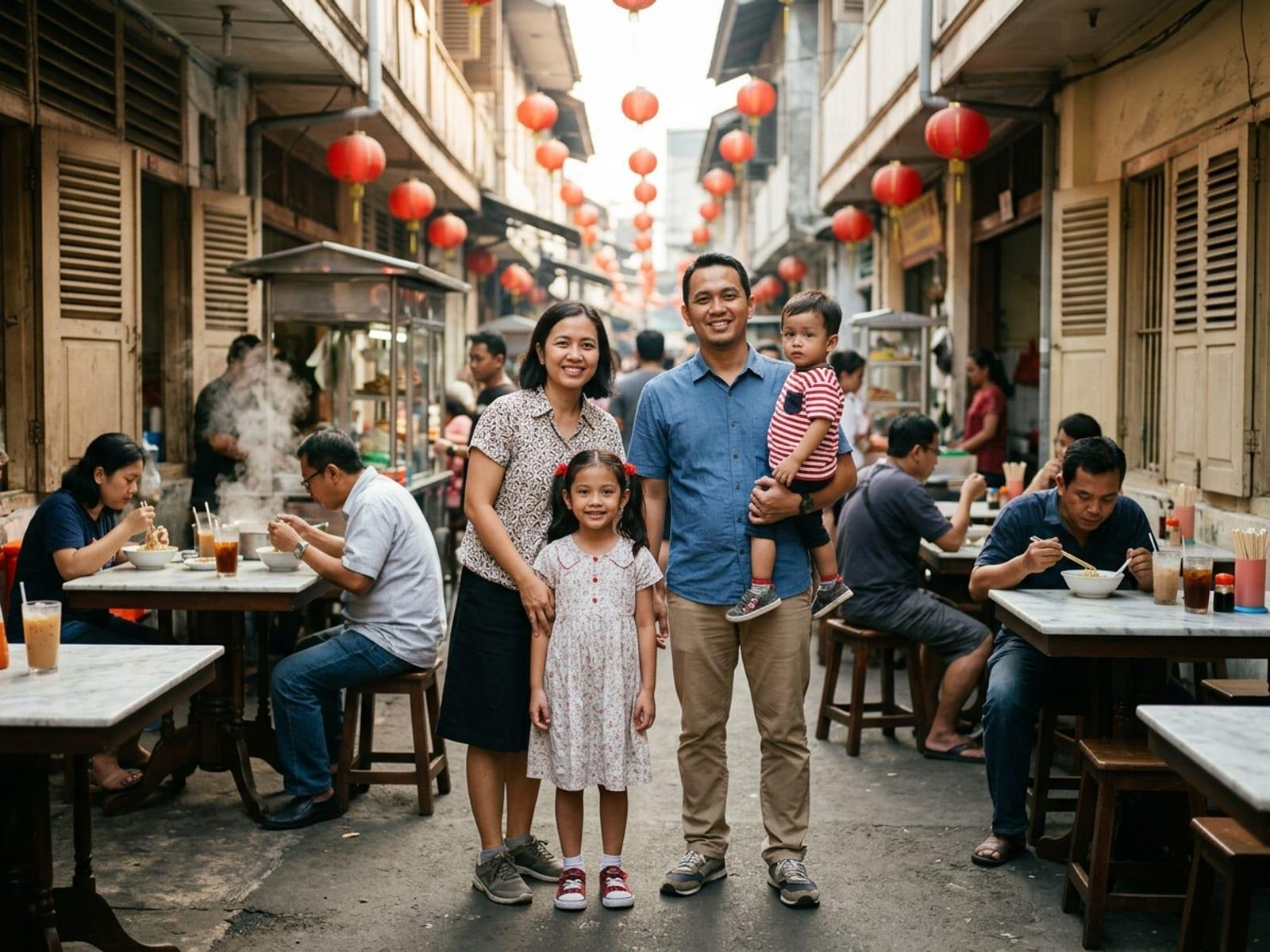
In northwest Jakarta, just south of the old town, Kota Tua, is a neighborhood of red lanterns and old two-storey shophouses. This is Glodok, the Chinatown of Indonesia's largest city. There's Gang Gloria, an alley about 4 m wide packed with more than 30 stalls and eateries; Petak Sembilan market, selling incense and Lunar New Year sweets; and a temple first built in the 17th century. It's compact enough for a family to cover on foot in half a day, and several shops here have been running for close to a century. Many dishes use pork, frog or softshell turtle, though, so it pays to do a little homework before you start eating.
A Chinese quarter built outside the city walls
Glodok's history goes back to the days when the Dutch East India Company ruled Batavia, today's Jakarta. In October 1740, large numbers of ethnic Chinese were killed inside the walled city and around it, and afterward the Chinese were required to live in Glodok, outside the walls. For more than 280 years since, it has remained the center of Chinese trade and life in the city. Old herbal medicine shops, shops selling prayer items, bakeries and barbers are still here, and for a time the area was also known for its electronics stores. Today people come for the food, the culture and the shopping. Traces of Chinese Indonesian life run across the country: in Medan on Sumatra, the old Kesawan quarter keeps a Chinese tycoon's mansion and a long-running restaurant.
There are two theories about the name. One traces it to a Sundanese word for the entrance of a house; the other says it's a corruption of grojok, the sound of water from a fountain that once stood in the courtyard of the old city hall. Locally it's also called Glodok Pancoran, pancoran meaning fountain. The gate at the entrance to Chinatown was first built in the 18th century, torn down during the Japanese occupation, and rebuilt in 2022.
Gang Gloria starts with a morning coffee
The center of the food walk is a narrow alley called Gang Gloria. Here dishes loved across Indonesia, such as gado-gado, soto Betawi (a beef soup with coconut milk) and ketupat sayur (rice cakes with stewed vegetables), sit right next to Chinese Indonesian home cooking. Plenty of Indonesian street food has Chinese roots, like martabak manis, a pancake from Bangka Island's Chinese community that took off in Bandung. One of the gado-gado stalls has been going since 1967.
The alley's best-known address is Kopi Es Tak Kie, a coffee shop founded in 1927. It's now run by the fourth generation counting from the founder, and its pale walls and plain chairs are unchanged. The signature drinks are kopi O, strong black coffee with sugar, and the iced coffee that gives the shop its name. Since the days of the founder, Liong Kwie Tjong, Dutch aristocrats and presidents are said to have stopped by. It once also served lemper (sticky rice wrapped around chicken), bakpao (steamed meat buns) and sweet mung bean porridge. Order the children a sweet drink while the adults have the coffee.
Jakarta is hot and humid all year, and the alleys get steamier the closer it gets to noon. Starting early, with breakfast as part of the walk, and wrapping up around midday is an easy plan with kids.
Petak Sembilan market and two old places of worship
At the far end of the alley is the old Petak Sembilan market. It sells lanterns, incense and other prayer items, along with Lunar New Year clothes and sweets, and there are stalls for long-established foods such as swikee (frog dishes) and the noodle dish bakmi. Before Lunar New Year the whole neighborhood fills with red decorations, and lion dancers sometimes appear. Lunar New Year and Cap Go Meh, the Lantern Festival on the 15th day, have been celebrated this openly only since 2000, when President Abdurrahman Wahid eased restrictions on Chinese festivals. If you want to avoid crowds, skip the New Year period; if you want to see the neighborhood at its liveliest, aim for it.
On Jalan Kemenangan, near the market, is Dharma Bhakti temple (Kim Tek Ie, Jin De Yuan), built in 1650 as a hall dedicated to Guanyin. It's considered the oldest temple in Jakarta. It burned in the events of 1740 and was rebuilt in 1755. It gets crowded with worshippers at Lunar New Year and on the 1st and 15th of each lunar month. Nearby is another temple, Toa Se Bio, built around 1751. On the same street stands Santa Maria de Fatima Church, with its Chinese-style roof, a Chinese merchant's mansion converted into a church in the 1950s. Both are places of worship, so keep your voices down inside, and before taking photos ask someone or look for signs on whether photography is allowed.
Check for halal and ingredients before you eat
Most of Glodok's residents are Buddhist or Christian, and pork is common in the cooking. You'll find dishes rarely seen elsewhere in Indonesia, such as sekba (stewed pork offal), frog dishes and pi oh (pi-oh), a softshell turtle stew. Muslim families and anyone avoiding pork should look for a halal sign or ask what meat is in a dish before ordering. Whether to try the more unusual ingredients is a decision for each family, depending on the children's ages and tastes.
With kids, it's easiest to start with things where you can see what's inside, such as noodles without much broth, fried snacks and steamed buns. The alleys are narrow and motorbikes sometimes squeeze through, so hold small children's hands or use a baby carrier. A stroller can be hard to push over the steps and through the crowds. Small shops often have no toilet, so use one at the station or a larger shop before you set off.
Getting there, and pairing it with Kota Tua
Jakarta Kota station on the KRL commuter rail network is inside Glodok, and the main lines of the greater Jakarta area run into it. On the TransJakarta bus system, get off at the Glodok or Kota stop on Corridor 1 (Kota–Blok M). The international gateway is Soekarno–Hatta International Airport (CGK); take the airport rail link into the city and change to a train or taxi.
Walk north and you reach Kota Tua, the old town, where the Dutch-era city hall still stands. Eat your way through Glodok in the morning and cool off in a museum at midday, and even hot Jakarta becomes a comfortable day out. Opening hours vary by shop and can change, so check before you go. Entry requirements for Indonesia depend on your nationality, so check your own government's official information before you travel.
You can see how a photo of your family walking a lantern-hung alley might look with pokesta's AI photos ($1 per photo, first one free).
References