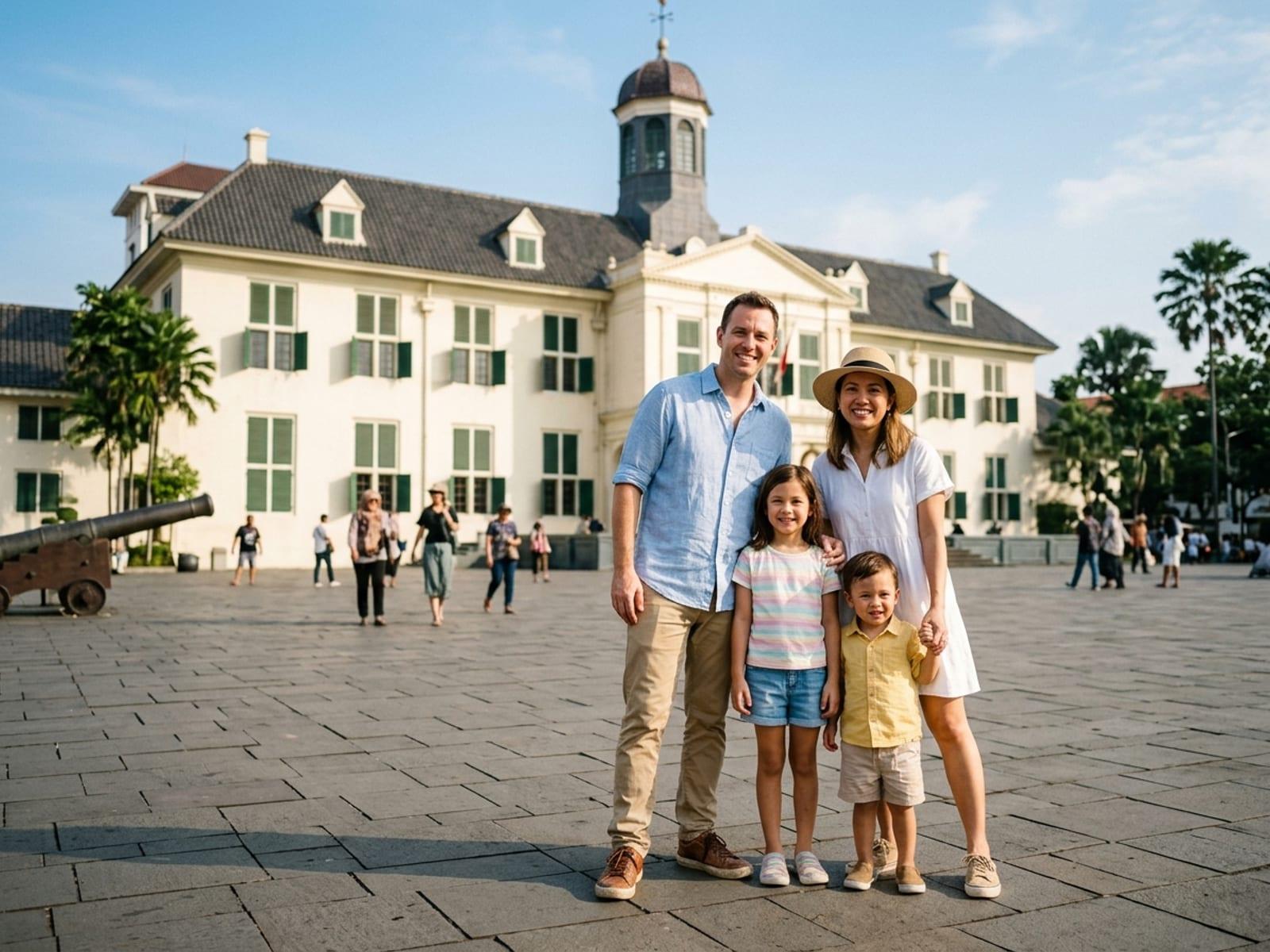
North of Jakarta's high-rises and traffic jams, old white-walled buildings surround a cobbled square. This is Kota Tua, the old town, once the heart of Batavia, the city built by the Dutch East India Company in the 17th century. The square and the streets around it are closed to cars, and the history museum in the old city hall, a museum of puppets and a museum tracing the history of money are all within walking distance of one another. Keep two things in mind, that many museums close on Mondays and that midday is hot, and it makes a good half day or full day out with children.
From the port of Jayakarta to the Company's capital
The site was originally a port called Sunda Kelapa. In 1526 a commander named Fatahillah captured it and renamed it Jayakarta. In 1619 the Dutch East India Company destroyed Jayakarta and the following year began building a new town, Batavia. The planned city was completed in 1650 and became the Company's Asian headquarters for the spice trade.
Malaria and fouled canals later brought the city into decline. In 1808 the government moved farther south, and most of the city walls were torn down. After independence the center of the city shifted even farther south, and the old town was neglected for a long time. It was designated a conservation area in the 1970s, and from the 2000s work began: sidewalks were widened, bike lanes added and street vendors relocated. Restoration continued from 2014 with Dutch cooperation and reached a milestone in October 2022. Today's old town covers about 1.3 square kilometers, straddling North and West Jakarta.
Fatahillah Square at the center
In the middle of the old town is Fatahillah Square. It appears in records around 1627 as a "new market" and served as the square in front of the city hall. Being wide and car-free, it's one of the rare places in traffic-heavy Jakarta where children can roam a bit. You may also see ondel-ondel here, the giant puppet figures of the Betawi, Jakarta's native people.
The white two-storey building on the south side of the square is the old city hall. Work on the current building began in 1707 and was finished in 1710, and it's said to have been modeled on the Royal Palace in Amsterdam. In the middle of the square stands an 18th-century well-pump house restored in 1974, and in the yard on the north side of the old city hall, facing the square, sits Si Jagur, a cannon cast in Macau by a Portuguese founder.
Three museums children enjoy
The old city hall now houses the Jakarta History Museum, with about 23,500 objects in its collection. Room by room, from prehistoric finds through the maps, paintings and ceramics of the Company era to Betawi-style furniture of the 17th to 19th centuries, you can follow how Jakarta developed. The rooms are arranged by period, with names like Prehistoric Jakarta, Tarumanagara, Jayakarta, Fatahillah and Sultan Agung, and there's a replica of the stone pillar the Portuguese left at Sunda Kelapa. Under the front colonnade are the dungeons, used until 1846; in 1830 Prince Diponegoro, leader of the Java War, was held here. The dungeons are dark and low-ceilinged, so for a nervous child, a look from outside is enough.
The Wayang Museum, also on the square, collects puppets used in puppet theater, such as wayang kulit, the leather shadow puppets of Java, and wayang golek, the wooden rod puppets of West Java. It opened in 1975 and also has Chinese glove puppets (potehi). Puppet performances and puppet-making events are sometimes held, and if your dates line up, your children can watch the puppets in action up close.
Another good choice is the Bank Indonesia Museum, in the building that was the head office of the central bank in Dutch colonial times. It opened in 2009 and uses films and models to tell the history of money and trade, from the spice trade era through colonial banking and the currency of the Japanese occupation to the 1997 financial crisis. Old money from around the world going back to the 14th century is on display, and comparing it with the rupiah notes you've been spending on the trip makes the history feel real to children.
Also facing the square is the Fine Art and Ceramics Museum, in the former courthouse. The Wayang Museum building was built in 1912 as a warehouse, on the site of a 17th-century church. If you treat the old buildings themselves as part of the exhibition, children will find more to look at.
With older children and time to spare, the old town also has the Mandiri Museum in the former Dutch trading company building, the Maritime Museum, the old Kota post office (now a contemporary art space), the 18th-century mansion Toko Merah, and Sion Church, the oldest church still standing in Jakarta. Don't try to do everything; picking one or two based on how the children are feeling that day is about right.
Mind the Monday closures and the midday heat
The thing to watch most is closing days. Both the Jakarta History Museum and the Bank Indonesia Museum are closed on Mondays, and the history museum also closes on public holidays. According to a news report, as of October 2025 the history museum was open Tuesday to Sunday from 9 a.m. to 3 p.m., with admission of Rp5,000 for adults and Rp2,000 for children. Admission to the Bank Indonesia Museum is also Rp5,000. Hours and prices can change, so check before you go.
Jakarta is hot all year, and the wide square has little shade and a lot of glare. An easy order for children is the square and history museum in the morning, a break in an air-conditioned museum or over a meal during the hottest hours, and back to the square once the sun is lower. Always bring hats and water bottles. Glodok, Jakarta's Chinatown, is right next door to the south, so having breakfast or lunch there pairs well.
Getting there
At the southern edge of the old town is Jakarta Kota station on the KRL commuter rail network. It was built in Dutch times as Batavia South station, and the main lines of the greater Jakarta area run into it. On TransJakarta buses, the nearest stop is Kota on Corridor 1 (Kota–Blok M). The international gateway is Soekarno–Hatta International Airport (CGK); take the airport rail link into the city and change to a train or other transport. Farther north are Sunda Kelapa, the port where the city began, and Kota Intan, the only surviving Dutch-era drawbridge in Indonesia. If the heat wears you down, set aside another day for the cool tea plantations of Puncak to the south, a common day trip from Jakarta. Entry requirements for Indonesia depend on your nationality, so check your own government's official information before you travel.
A family photo in front of the white city hall is something pokesta's AI photos ($1 per photo, first one free) can make too.
References