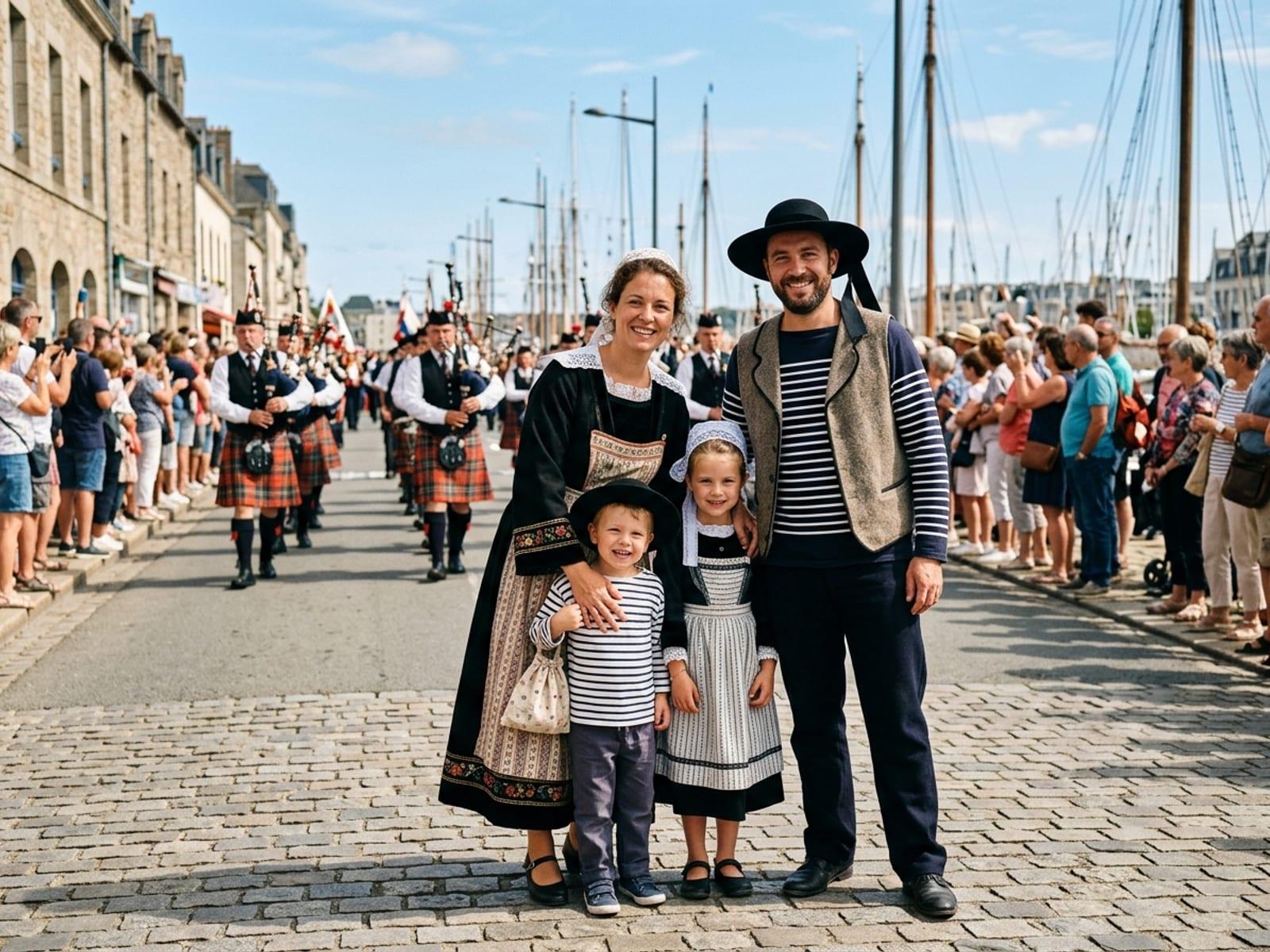
For ten days around the start of August, the port town of Lorient in Brittany, northwest France, hosts the Festival Interceltique. Musicians and dancers come from regions that carry on Celtic culture, such as Scotland, Ireland and Galicia in Spain, and the 56th edition runs from July 30 to August 8, 2027. If a family can do only one thing, make it the Grand Parade of the Celtic Nations on the first Sunday morning: around 3,500 people walk through town in traditional dress, and the roadside is free.
A different guest of honor every year, and the 2027 theme
The festival began in August 1971 as a bagpipe festival built around the bagadoù (singular bagad), Brittany's pipe bands. Galicia sent its first delegation in 1976 and the Isle of Man followed in 1977, and from 1979 the event used the name "Interceltique." In 1987 Asturias in northern Spain was welcomed as the "eighth Celtic region."
Since 1994 the program has been built around one guest region each year. Galicia was the first, followed over the years by Scotland, Ireland, Wales, Acadia in eastern Canada and Australia, among others. Recently it was Asturias in 2022 and Ireland in 2023. In 2024 the Paris Olympics pushed the festival back a week and cut it to seven days, and instead of a single region the theme was "Celtic youth." 2025 took "Cousins d'Amérique" (American cousins) as its theme, and in 2026 Cornwall, at England's southwestern tip, was the guest of honor for the first time in 11 years, since 2015. For 2027 there's no single region; the theme is "Women of the Celtic nations."
Crowds keep growing. According to press reports compiled on French Wikipedia, both 2023 and 2025 drew 950,000 visitors, far more than the town's own population, all passing through the port over ten days.
The first Sunday: parade in the morning, triumph in the evening
The face of the festival is the Grande Parade des Nations Celtes on the morning of the first Sunday. About 3,500 pipers, drummers, singers and dancers, each group in its own region's dress, walk from the Cours de Chazelles to the Stade du Moustoir, which takes around four hours. In 2026 it started at 10 am on August 2. The Breton groups wear costumes whose shapes change from one part of Brittany to the next, while the Scottish bands are in tartan kilts, so just by watching, children can see that "Celtic" looks completely different from place to place.
The organizers put the crowd at more than 90,000. The roadside is free, but you have to stake out a spot, and four hours on your feet is far too long for small children. The stadium at the finish has paid seating for about 10,000, and booking a seat there is by far the easiest way to watch with kids. In 2026 an extra park-and-ride ran from the K2 shopping area on the outskirts on parade day only.
That same evening comes the Triomphe des Sonneurs (the musicians' triumph): about 60 bagadoù play around town and then gather near the Grand Théâtre. Even if you missed the morning parade, this is a chance to meet the bands in the streets.
The bagad championship: Brest in February, Lorient in August
The pipe band contest the festival grew out of is still at its heart. The national championship is run by Bodadeg ar Sonerion, the Breton pipers' association, and dates back to 1949. Bands compete in five categories, and the top one is decided over two rounds: the first in spring at Le Quartz, a theater in Brest (February 25 in 2024), and the second here at the festival in summer. Finals for the first, second and fourth categories take place on the festival's first weekend, in the same stadium where the parade ends. Bagad Cap Caval has won every year from 2023 through 2026.
The bagad spread from the mid-20th century as a band format modeled on Scottish pipe bands, with bagpipes joined by drums and the bombarde, a Breton woodwind. On the festival's second weekend there's also a Scottish-style pipe band contest, and plenty of solo competitions, the best known being the Macallan Trophy for bagpipes, first held in 1980. If the kids get hooked on tartan-clad bands, the place to see them compete at home is a summer Highland Games in Scotland.
Where to go each day, and dancing a fest-noz
Venues are spread across the town center and around the harbor. According to the organizers, the stadium (Le Stade) hosts the parade finish and the championship as well as the big evening show, Horizons Celtiques, which is also broadcast on the French TV channel France 3. The Espace Jean-Pierre Pichard, a big marquee seating over 5,000, is the main concert venue, and the Palais des Congrès hosts seated performances. Down by the harbor, the Quai de la Bretagne stage sees close to 100 acts over ten days, and there's also a Place des Pays Celtes, a square for the Celtic nations. Bands play in bars around town as well, so even without tickets you won't be short of music.
On days without the parade, the easiest thing to join as a family is a fest-noz. The name means "night festival" in Breton: to live music, crowds link hands and dance in rings or lines. It was added to UNESCO's list of Intangible Cultural Heritage in 2012. During the festival there's one every day at the Salle Carnot, and late at night the dancing spills onto the Quai de la Bretagne too. The music comes from the talabard, a woodwind a bit like an oboe, the biniou kozh, a small bagpipe, the accordion and more. Some tunes have fast, intricate steps, so watch from outside the circle first and join in on a slower one. Keep small children to the early part of the evening.
This being a fishing port, there's also a big shared meal of cotriade, a Breton fish stew. For one more taste of Brittany, try buckwheat galettes and the galette-saucisse of Rennes.
Under-7s need a ticket too, and photos happen outside
Stadium seats for the parade and the main shows, such as the big evening performances, are ticketed. Under the 2026 terms, ages 7 to 12 paid a child rate, ages 12 to 18 a reduced rate, and children under 7 went free. Under-7s still need a ticket, though: request one by email with proof of age, or pick one up at the box office while seats last. The box office adds 1.80 euros per ticket (2 euros on tickets over 20 euros), so buying online works out cheaper.
You're asked to arrive at least 30 minutes before the start; after that, entry and seats aren't guaranteed and there are no refunds for latecomers. Cameras aren't allowed into indoor venues such as the Palais, so take your photos along the route and around town. Tickets for 2027 go on sale on November 26, 2026, the same day the first names on the lineup are due to be announced.
Spectators can wear what they like. A navy-and-white striped top with a black or navy skirt or an embroidered waistcoat sits nicely in photos next to the parade costumes. Even in August the sea breeze is cool and the weather changes fast, so always pack a light jacket and rain gear. Before you go, you can see what the family might look like in Breton-style dress with pokesta's AI-generated photos ($1 per photo, with your first one free).
Book a room early; Paris is under three hours away
The festival runs for ten days around the first weekend of August, and in some years it starts at the end of July. Hotels and campsites fill up fast every year, so the organizers suggest contacting the Lorient Bretagne Sud tourist office and also looking at private rental sites.
If you're coming via a major airport, Nantes Atlantique (NTE), the main air gateway to western France, is an option. From Paris, the high-speed line gets you to Lorient station in under three hours, and the town center is about a 15-minute walk away. You could spend Bastille Day in Paris on July 14 and head to Brittany at the end of the month, or pair the festival with Mont-Saint-Michel and its famous tides on Brittany's eastern edge. During the festival, the Pass FIL gives ten days of unlimited bus and boat travel in the area for 10 euros, a day ticket costs 3 euros, and buses run from a free car park at the exhibition grounds in neighboring Lanester (2026 arrangements). Entry requirements for France depend on your nationality, so check your own government's official information.
Buy tickets only for the parade seats in the stadium, and spend the other days following whatever music you hear near the harbor. With small children, ten days needs that much slack.
References