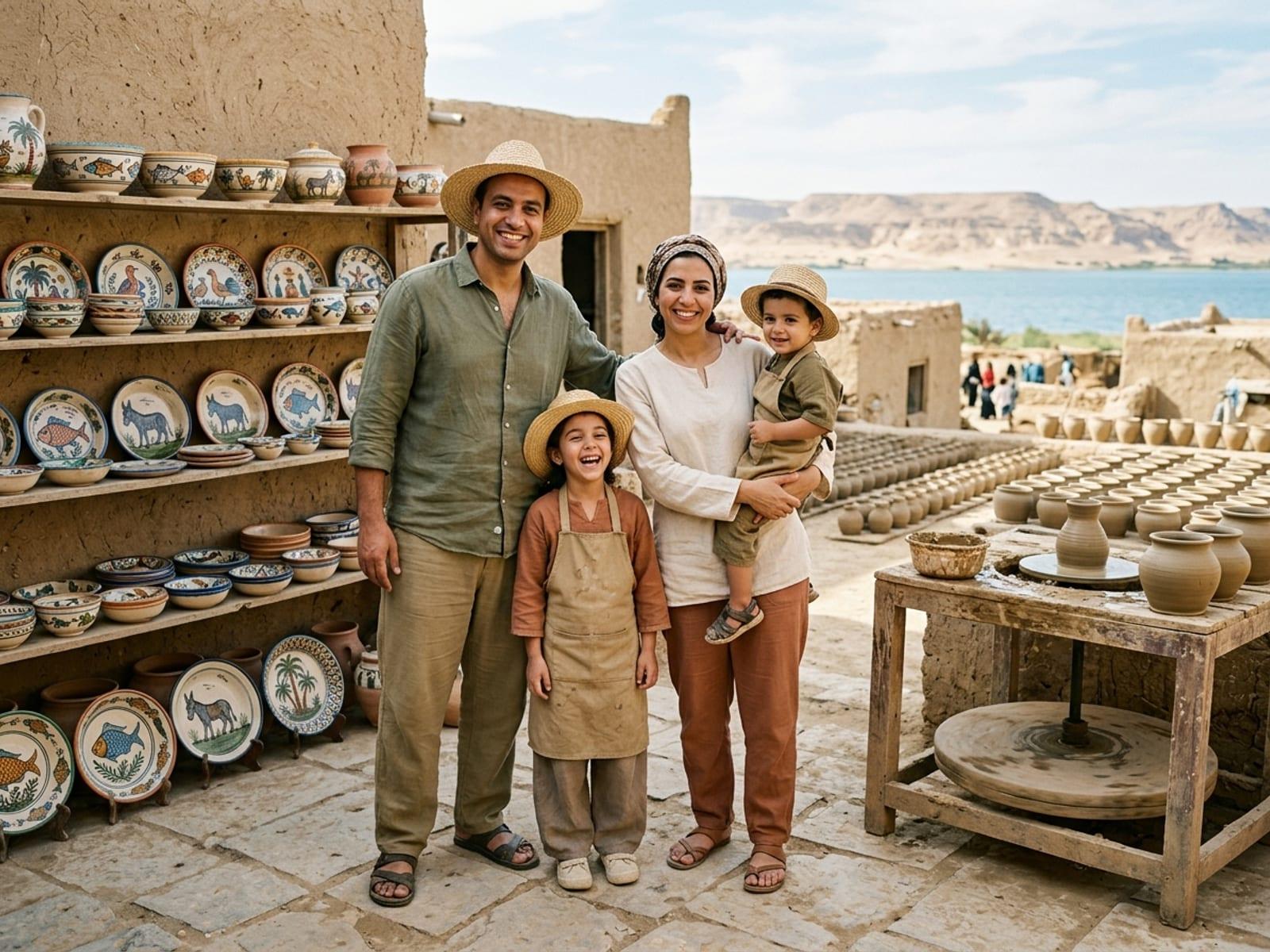
About 90 km southwest of Cairo, green fields spread across the desert in the Faiyum oasis, and on a hillside overlooking a large lake sits the village of Tunis. Pottery workshops are scattered among its earth-colored houses, and simple pieces painted with fish, birds, donkeys and date palms are lined up outside. It's a place where children can get a feel, with their hands and eyes, for an Egypt that has nothing to do with pyramids or museums. The best months are October to March, and with children it works well to drive from Cairo and stay one night, adding the nearby lakes and waterfall.
It began with village children playing in lake mud
Pottery in Tunis Village started with one Swiss potter. Evelyne Porret was born in Switzerland in 1939, studied at the school of decorative arts in Geneva and moved to Cairo in 1960. In the 1980s she came to live in Tunis, where she noticed village children playing with the mud that lay thick along the lakeshore. Could she teach these children a skill they could make a living from? With that in mind, she opened the village's first pottery school.
The school carried on as an organization teaching pottery to children, and it's now considered the largest pottery school in Faiyum. Thousands of people have trained there, set up their own workshops and begun selling to visitors. Small children start by handling clay, the most skilled pupils go on to teach, and eventually they set up on their own. Bit by bit, that turned the village itself into a pottery center. According to a Swiss media report on the school, the children learned under an arrangement in which they received 10 percent of the price when one of their pieces sold. Some former pupils later opened a school of their own in Luxor. Porret died in 2021, but the school is still going.
A handicrafts festival is held every autumn, bringing together makers from Tunis, Cairo and abroad. The dates and program change from year to year, so check before you go.
Fish, donkeys and date palms: pottery that paints daily life
What sets Tunis pottery apart is its loose, free painting of the everyday scenery around it: fish caught in the lake, donkeys going back and forth to the fields, the oasis's date palms, birds in flight. The lines and colors recall naive painting, almost like a child's drawing, which seems fitting for a village whose pottery began in a school for children.
The shapes vary from plates and bowls to mugs and little boxes, and each workshop has its own favorite motifs and colors. The same fish might be painted mostly in blue at one workshop and in ochre and green at another. Visit a few and compare, and you'll start to see which makers you like best.
When choosing with children, it works well to let them decide first what picture they want: a fish plate, a donkey mug, a small bowl with a bird. If you pick one thing to use at the table every day, it'll keep the trip in conversation long after you're home. Pottery breaks easily, so wrap each piece in newspaper or clothes and put it in the middle of your suitcase, or carry it in your hand luggage. For larger pieces, ask the workshop whether they can pack or ship them.
Visiting the workshops
Many of the village workshops combine studio and shop, so you may be able to watch the wheel turning or the painting up close. Whether you can watch or try your hand, and whether there's a charge, depends on the workshop and can change with the season. If you'd like a hands-on session, the surest approach is to check in advance through your hotel or tour operator.
If you want to photograph a potter at work, always ask permission first. Village children sometimes help out in the workshops, so take particular care not to point your camera at them. Long-sleeved cotton tops and long trousers that you don't mind getting clay or paint on are easy to move in and suit the village, too.
Pair it with Lake Qarun and Wadi El Rayan
Lake Qarun, below the village, lies 43 meters below sea level. In ancient times it was a large freshwater lake called Lake Moeris, but it shrank over the ages and is now saltier than seawater. Ancient Lake Moeris drew its water from the Nile through a channel and is thought to have been six to eight times the size of today's lake. In the Middle Kingdom the canals were improved and farmland expanded; later, in the Ptolemaic period, dikes cut back the inflow and the lake gradually shrank. In today's salty lake the Nile's freshwater fish have mostly disappeared, and sea fish such as mullet and sole have been stocked for fishing instead. Look out over the lake after seeing the fish painted on the pottery, and the link between village life and the lake comes into view.
Some 88 species of waterbirds, including grebes, herons and ducks, have been recorded on the lake, and in winter it fills with migrants. If you come in winter, a pair of binoculars gives children one more thing to enjoy.
Wadi El Rayan, about 65 km southwest of the town of Faiyum, is a nature reserve managed by Egypt's Ministry of Environment. Two lakes, upper and lower, formed by runoff from farm irrigation, are linked by what's described as Egypt's largest waterfall, with sand dunes all around. In 2012 it was also designated a Ramsar wetland. You can fit the pottery village, the lake, the waterfall and the dunes into one day, but with children it's easier to stay a night and split it over two.
You can see how a photo of your family holding pottery in front of a village workshop might look with pokesta's AI photos ($1 per photo, and your first one is free).
When to go and getting there
The Faiyum oasis lies about 90 km southwest of Cairo. The nearest international airport is Cairo International Airport (CAI), and you reach Tunis Village from there by road. Public transport involves many changes, so for families, hiring a car from Cairo or joining a day or overnight tour of Faiyum is the realistic choice.
The easiest time to visit is roughly October to March, when the heat eases. The autumn handicrafts festival and the winter months, when waterbirds gather on the lake, are the highlights. In summer the daytime heat is intense, so keep outdoor sightseeing to mornings and evenings. Back in Cairo, comparing the pottery with the hand-stitched khayamiya of the Street of the Tentmakers makes an interesting pairing. For lunch, try feteer, Egypt's layered pastry, which the official Egyptian tourism site lists among Faiyum's pleasures. Entry requirements and safety information for Egypt vary by nationality, so check your own government's official information before you leave.
References