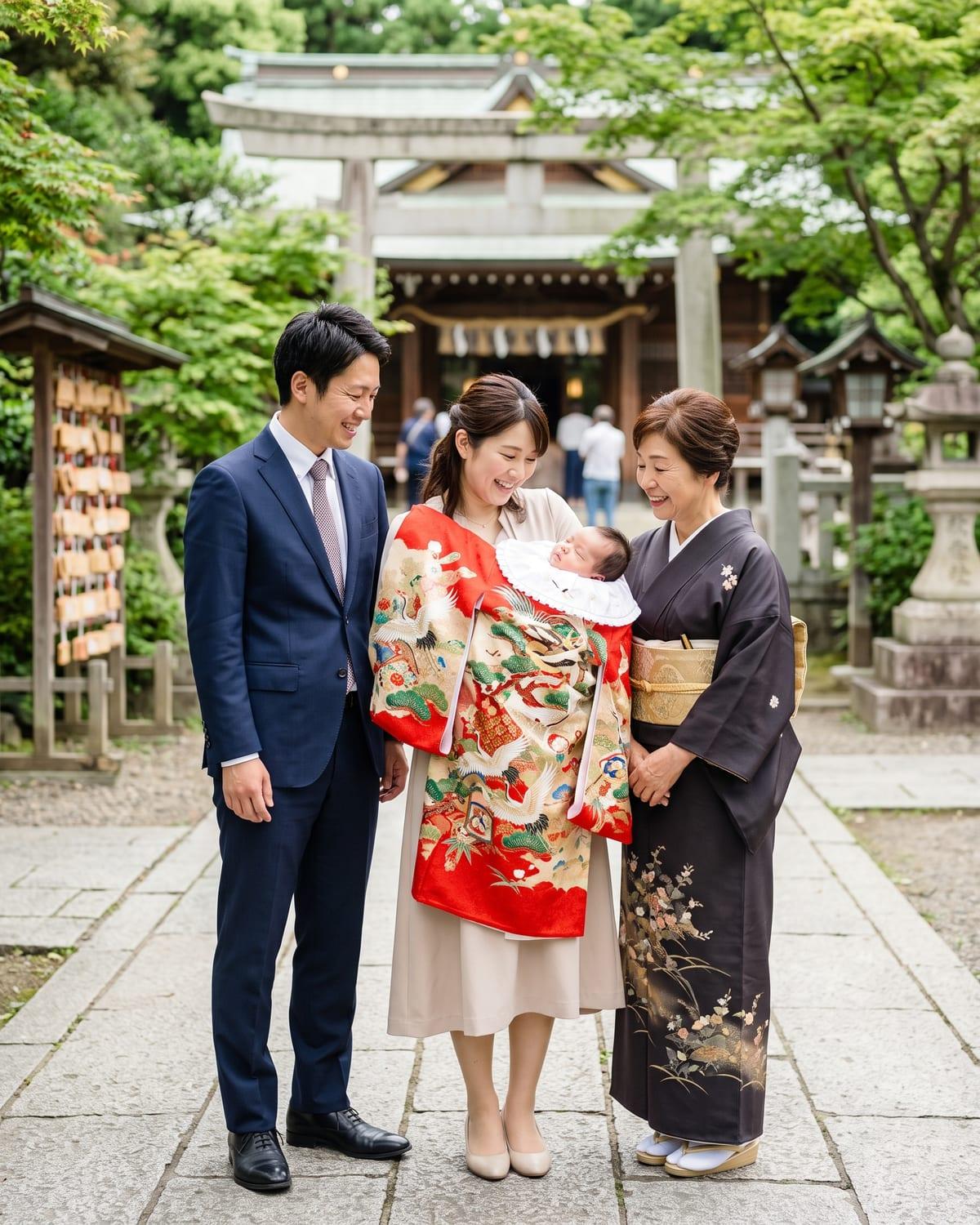
Going to Omiyamairi (a newborn's first Shinto shrine visit, about a month after birth) with your baby in just a baby dress is not disrespectful. A white baby dress is considered Western formal wear on a par with the traditional Japanese outfit, and these days it's common to dress the baby in one instead of shiro-habutae, the white silk kimono worn underneath. If you go dress-only, the thing to watch is less etiquette than how the photos turn out. All-white clothing can blow out to pure white depending on how you shoot it, and the lace and embroidery you chose so carefully disappear.
A dress on its own doesn't make the visit less formal
The formal Omiyamairi outfit is shiro-habutae with an iwaigi, a celebratory kimono draped over the baby and the person holding them. Today, though, it's common to put the baby in a baby dress instead of shiro-habutae and drape an iwaigi or a cape over that, and a growing number of families skip the iwaigi and treat the baby dress itself as semi-formal ceremonial wear.
If you go with the dress alone, dressing the adults in Western clothes to match makes the photos look more coherent. Whether to skip the iwaigi at all, and how to explain that to relatives, is covered in Omiyamairi without an iwaigi. This article focuses on choosing the dress itself and how it looks on camera.
The shape of the dress changes the photos
Baby dresses come in two main types: a long dress, and a two-way all-in-one (a romper that converts between a gown and a legged outfit, easy to use as everyday wear). You can also layer an overdress on top of the two-way.
The long dress photographs best. When the baby is held, the hem falls down over the holder's arm, and that alone gives the picture a special-occasion look. The two-way is practical and makes diaper changes easy, but in photos of the baby being held it looks much like everyday clothes. If you want both, put an overdress over the two-way and let the baby wear the dress only for photos.
Lace and frills are often seen as girls' styles, but they look perfectly natural on boys. If you'd rather tone it down, choose a dress with subtler embroidery, or a set with a detachable bow tie, and the photos will look a little crisper.
If you're adding a cape or hat, match it to the dress in white or off-white, and everything around the baby will read as one unit in the picture. Whites vary from product to product, so if you buy the dress and cape separately, lay them side by side and check the colors.
Shooting so the white doesn't blow out
The classic mistake with white dresses is shooting in full sun on a bright day, so the dress turns into a solid white blob. When you tap the baby's face on your phone screen, the phone sets the exposure so the face looks right, and white clothing, which is much brighter than skin, ends up too bright.
Shade does the most good. Shoot under trees or in the shadow of a building, and the texture of the lace casts tiny shadows, so the embroidery and patterns show up properly. If you have no choice but to shoot in the sun, tap the baby's face and then nudge the brightness down a little. Lower it as far as you can without making the face too dark, and the texture of the dress comes back. The background matters too. In front of green trees or a vermilion shrine hall, the outline of a white dress stands out clearly, while against a white wall or pale stone paving the dress melts into the background.
If you want the whole shape of the dress on record, you can also lay the baby down at home and shoot from directly above. The embroidery on the chest and the lace on the hem, which get hidden when the baby is held, all fit in one frame. Here too, lay the baby on fabric with a bit of color rather than a white sheet, and the outline of the dress will show more clearly.
Pick fabrics for the season, and check what touches the skin
In summer, breathable, absorbent fabrics such as mesh, gauze and plain cotton jersey are best. One short-sleeved undershirt with the dress on top is plenty. In winter, choose warmer fabrics such as rib knit, velour or knitted gauze, and layer short- and long-sleeved undershirts under a two-way, with the dress on top. If it's still cold, have a cape or swaddle blanket ready.
In spring and autumn, layer a two-way and the dress over a short- or long-sleeved undershirt, and adjust with an outer layer. Some days there's a big difference between an air-conditioned or heated waiting room and the temperature outside, so a light cape makes it easy to add or remove warmth.
Along with fabric, check the parts that touch the skin and the size. Stiff lace and frills can rub and irritate a baby's skin. Feel the neckline and cuffs with your hand to make sure the parts touching the skin are soft. For size, if the dress is only for Omiyamairi, a snug 50 to 60 cm fits well and is easy to move in; if you want it to last longer, look for one labeled 50 to 70 cm. A very long hem can catch around the feet of the person carrying the baby on stone steps, so gather the hem over your arm while walking.
Wash the dress once before the day, and after the visit, deal with any milk or drool stains the same day.
If you use both, split them by moment
If you want both the iwaigi and the dress, the simplest approach is to divide them by moment. Drape the iwaigi only for the blessing and the family group shot, and let the baby wear just the dress while moving around and waiting. With the iwaigi off, the dress looks its best, so you come home with both Japanese-style and Western-style photos from the same day. On a hot summer day, keeping the iwaigi on only for the moment of the photo also helps the baby stay cooler.
Even in photos with the iwaigi on, the dress isn't wasted. Hold the baby so a little white lace peeks out from under the iwaigi's hem, and it adds a Western softness to the Japanese outfit. When you take photos without the iwaigi, frame from the holder's knees up rather than just the waist, so the flowing hem of the dress is in the shot.
A hat and bib often come as a set with the dress. Decide before shooting whether the hat stays on. It frames the face nicely, but the brim can shade the eyes, so the safest bet is to take both and choose afterward.
Going dress-only? Find your spots first
A baby-dress-only Omiyamairi is completely fine as far as etiquette goes. To get good photos, find two places on the grounds before you start: one patch of shade where the white won't blow out, and one dark background that makes the dress stand out. That's enough to get a photo where even the lace shows clearly. For choosing spots on the shrine grounds, see Where to take Omiyamairi photos at the shrine.
References