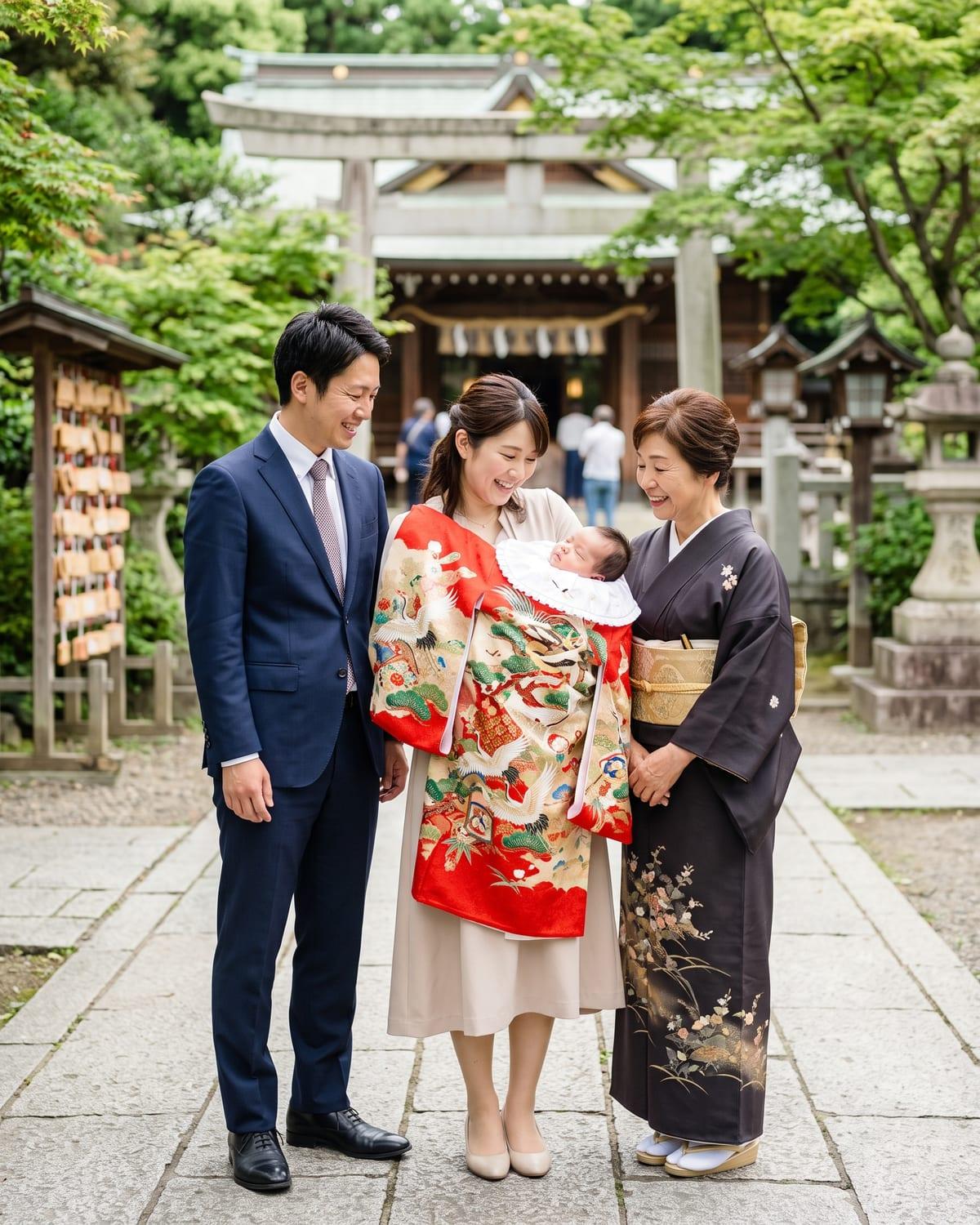
For Omiyamairi (a newborn's first visit to a Shinto shrine, usually around one month after birth), three spots on the grounds are all you need: the torii gate, the front of the main hall, and a patch of trees or greenery. Give each one a job. The torii says "this was the day we went to the shrine," the main hall is for the family group shot, and the greenery is where the baby's face looks its best. With that plan, you won't spend the day wandering around looking for places. What affects the photos even more than location, though, is which direction the light is coming from.
At the torii, step back and get the whole gate in
A photo in front of the torii will tell you instantly, years later, that it was taken on Omiyamairi day. But stand right underneath it and the pillars and the kasagi (the top crossbeam) run out of the frame, so you end up with a picture of people in front of a post. Have the family stand off to one side a few meters from the gate, then move back further yourself until you find a spot where the whole torii, or at least its upper half, fits in.
Shooting up close on a phone's wide-angle lens makes the torii huge and the family tiny. If your phone has a telephoto lens (2x or similar), step back and switch to it, and you can keep the family a good size with the gate behind them. On phones without one, zooming in is digital and the image gets grainy, so don't push the zoom too far. If there's a stone pillar carved with the shrine's name (a shagohyo), put it at the edge of the frame so anyone can tell which shrine it was.
The color of the torii changes what works. Vermilion gates are strongly colored, so a white baby dress or a pale iwaigi (the ceremonial kimono draped over the baby) looks lovely against them. A bright red or pink iwaigi, on the other hand, can clash with the vermilion, so keep the gate small in the background and frame the family larger. Stone and unpainted wooden torii are a calm gray or natural wood, and they go with an iwaigi of any color.
The space under the torii and the middle of the approach path are walkways, so don't stand there long. Our full guide to etiquette is Shrine photo etiquette for Omiyamairi.
At the main hall, shoot from an angle and a little way back
The front of the main hall is the classic place for a full family group shot. Avoid the area directly in front of the offering box, where worshippers line up, and instead include the hall from an angle, slightly off the path. Shooting diagonally brings out the depth of the roof, and the building looks more three-dimensional than it would head-on.
If the hall sits at the top of a flight of stone steps, the steps can help keep people in the back row from being hidden. It isn't safe, though, to have someone holding the baby or an older grandparent stand partway up a staircase. If you use the steps, stick to a flat landing or the bottom step only.
In front of greenery, faces look their softest
Shade under trees or in front of shrubbery is the least obvious spot and the most useful. The leaves soften the sunlight, so harsh shadows don't fall on the baby's skin, and white baby clothes or the pattern on an iwaigi don't wash out. Blur the green background and the whole photo feels bright and calm.
To blur the background, have the family step two or three meters out in front of the greenery, then use your phone's portrait mode, or the telephoto lens if your phone has one. The more distance between the people and the background, the softer the blur. This is the place for close-ups of the baby being held, or the baby asleep.
The greenery changes with the seasons. In spring, fresh leaves, and in autumn, the colored foliage, tell you the season at a glance. In winter, bare trees can look bleak, so look for evergreens or a hedge that still has leaves. Whatever the season, too much sky in the background tends to darken faces, so keep just a sliver of sky at the top of the frame.
Put the sun behind or beside the family
Once you've picked a spot, check the direction of the light. With the sun at the photographer's back, light hits the family straight in the face; the adults squint and the baby scrunches up. A better choice is to have the sun to the side of the family or slightly behind them. With no direct sun on their faces, expressions relax, and the edges of their hair and the iwaigi pick up a glow.
Backlight can leave faces looking dark. If that happens, tap the baby's face on your phone screen to set focus and exposure there, then nudge the brightness up a little. If a white iwaigi or baby dress turns pure white, bring it back down slightly.
Light from directly overhead around midday tends to throw shadows under the eyes and nose. If you're shooting at that time, step into the shade of a building or a tree; photos taken in shade come out better.
On overcast days the whole sky becomes one big light, so the light is soft wherever you stand. You don't have to worry about direction as much as on a sunny day, but photos tend to come out darker and the colors flatter. Raise the brightness a little, and pick backgrounds with strong color, such as a vermilion hall or deep green leaves, so the photos don't look drab.
Avoid the busy hours and use the waiting time for photos
Many shrines take blessing reservations or walk-ins from around 9 a.m. to 4 p.m. Mornings are easier to plan the rest of the day around, which makes them busier, while afternoons are often quieter. Taian days (dates considered especially lucky in the traditional calendar) also draw crowds, and on weekend or taian mornings you may have to wait your turn at the popular photo spots.
The wait between checking in and the start of the blessing is ideal for photos. If the baby is awake, take the close-ups in front of the greenery then, and save the family group shot in front of the hall for after the blessing, with the iwaigi on. That order gets you the photos you need while the baby is still in a good mood.
It also helps to choose one person as photographer and limit each spot to two or three minutes. If everyone pulls out a phone, you'll stand there that much longer, and whoever is holding the baby gets tired. The rest of the family can stand behind the photographer and talk to the baby, which makes it more likely the baby will look toward the camera.
Pick your three spots, then let the light decide the order
When you arrive, walk around once before taking any photos and note where the sun is at the torii, the main hall and the greenery. Shoot first wherever the light is coming from the side, and leave places with sun straight in the face for later, or move into the shade. If you're unsure, choose the shade under a tree. It rarely goes wrong.
To see where other families took their photos, and how the shots turned out, browse the Omiyamairi posts. Phone settings and shooting techniques are covered in Taking Omiyamairi photos on your phone.
References