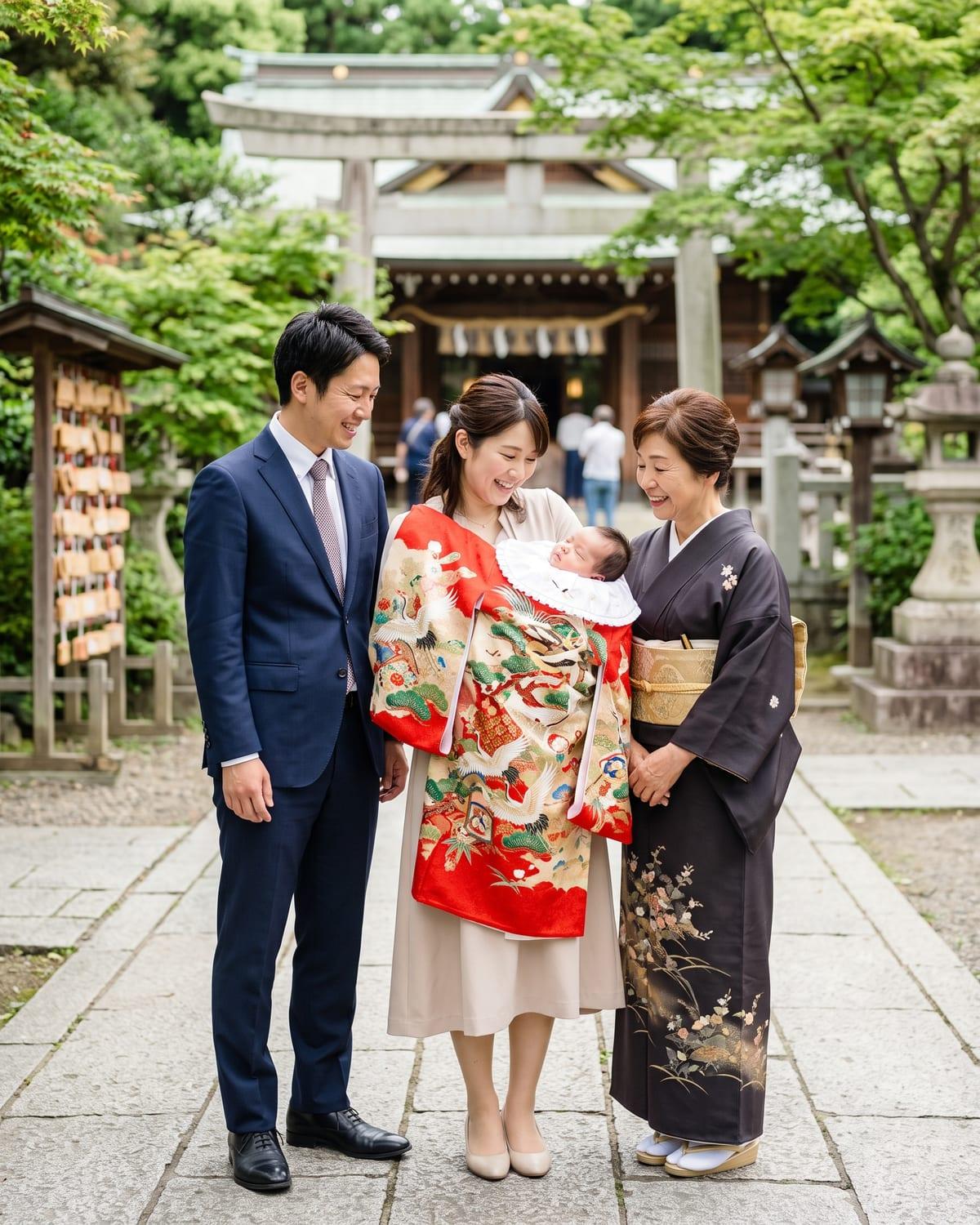
Taking family photos on the shrine grounds is a normal part of Omiyamairi, a baby's first visit to a Shinto shrine about a month after birth. Many shrines are fine with families snapping away on their phones as long as other visitors aren't inconvenienced. The times to hold back are during the blessing ceremony, inside the shrine buildings, and whenever your shot blocks the approach path or the space under a torii gate. Rules differ from shrine to shrine, though, so the most reliable step is to check what your shrine says before you go.
Every shrine sets its own rules
There is no national rulebook for photography at shrines; each one decides for itself. Take Kawagoe Hachimangu in Saitama Prefecture as an example. Its official website spells things out clearly: families may take photos freely with their own smartphones and tablets, as long as they don't bother other worshippers. Photography during the blessing is, in principle, not allowed for anyone other than the shrine's official studio photographer. And commercial photographers who aren't accompanying a family receiving a blessing are not permitted on the grounds.
Not every shrine is that specific. Look on the shrine's website for pages about hatsumiyamairi (another name for the first shrine visit), the kito blessing, or an FAQ, and see whether photography is mentioned. If it isn't, ask when you call to book. Three questions cover it: Can the family take photos on the grounds? What about during the blessing? Can we bring an outside photographer? Some shrines also mark off areas where photography or entry is discouraged, so read any signs and notices once you're there.
Put the camera away during the blessing
The kito is the part of the visit where a Shinto priest recites prayers inside the shrine hall for the baby's health and growth. It usually takes around 20 to 30 minutes. During that time, the basic rule is no photos, even with the shutter sound off. Other families are often blessed in the same session, and it's an important moment for them too.
Some shrines do let families take a commemorative photo inside the hall before or after the ceremony, and sometimes a priest will offer. If that happens, just follow their lead. Put the other way around: unless someone invites you to, keep the camera out of sight inside the hall, and you'll never have to second-guess yourself.
Switch your phone to silent and put it in your bag before you step up into the hall. If it's in your hand, a sweet expression on the baby's face will tempt you. If you really want the ceremony recorded, find out whether the shrine officially offers photography. Some have an affiliated photo studio that will accompany families into the blessing. If that's available, book it; if not, let it go.
Don't stop in the middle of the path or under the torii
The center of a shrine's approach path is called seichu, and many shrines regard it as the path reserved for the deity. The polite way to walk is to keep to the left or right. The same applies to photos. Lining the family up in the middle of the path with the main hall squarely behind them is best avoided, both as a matter of etiquette and because it blocks people walking through. Step to the edge of the path and include the hall at a slight angle; as a backdrop it looks almost the same.
The space directly beneath a torii gate is where foot traffic funnels into a single point. Some visitors bow before passing through, so lingering there quickly creates a backup. If you want the torii in the shot, walk through it first, have the family stand off to one side, and keep the gate in the background. The same goes for the temizuya (the purification fountain) and the offering box in front of the hall: if someone wants to use them, your photo can wait. For where to stand and which way to face, see Where to take Omiyamairi photos on the shrine grounds.
Keep other families out of your shots, and don't make them wait
On weekends and on taian days (dates considered especially lucky in the traditional Japanese calendar), you'll see several families with babies in ceremonial kimono. Popular spots can have a line. Rather than taking dozens of photos in one place, take a few and move on. If another family is waiting behind you, a quick "Go ahead" or "Would you like me to take one of you?" makes it pleasant for everyone.
If other visitors' faces are clearly visible in a photo, blur them or skip that shot if you plan to post it on social media. Anyone can walk onto shrine grounds, but the people in the background didn't expect to end up online.
It's also best to leave the flash off. A sudden flash can startle the baby, and in front of a dim shrine hall it catches the eye of everyone nearby. If the light feels too low, have the family turn toward the brighter side; that looks more natural anyway.
When you stop to look back over your photos, step to the side first rather than standing in the middle of the path or on the steps in front of the hall. It's easy to block the way while everyone crowds around the phone to see how the baby came out.
Ask ahead about tripods and hired photographers
Some shrines don't allow tripods at all, or only in certain areas. Even where they're permitted, a tripod set up on the approach path blocks the way, so use it in a corner of the grounds when it's quiet and keep it brief. Selfie sticks can hit people if you swing them around fully extended, so keep them short in crowded areas and put them away as soon as you're done. For getting the whole family in the frame, Self-timer tips for whole-family photos may help.
Hiring a photographer to come along adds another layer of checking. Even at shrines where families can shoot freely, professional photography may be banned or require advance permission. Before you book, ask the photographer whether they've worked at that shrine, and ask the shrine whether outside photographers are allowed and whether you need to apply. That way you won't arrive to find you can't shoot on the grounds. We cover the booking process in How to book an on-location Omiyamairi photographer.
When in doubt, ask at the shrine office
Even if you can't find any rules, ask at the shamusho (the shrine office) when you check in: "Is it all right to take photos on the grounds?" They'll tell you where you can shoot and where they'd rather you didn't. Beyond that, three habits will see you through at almost any shrine: put the camera away during the blessing, don't stop in the middle of the path or under the torii, and keep other families' faces out of your photos.
To see where other families took their photos, browse the Omiyamairi posts.
References