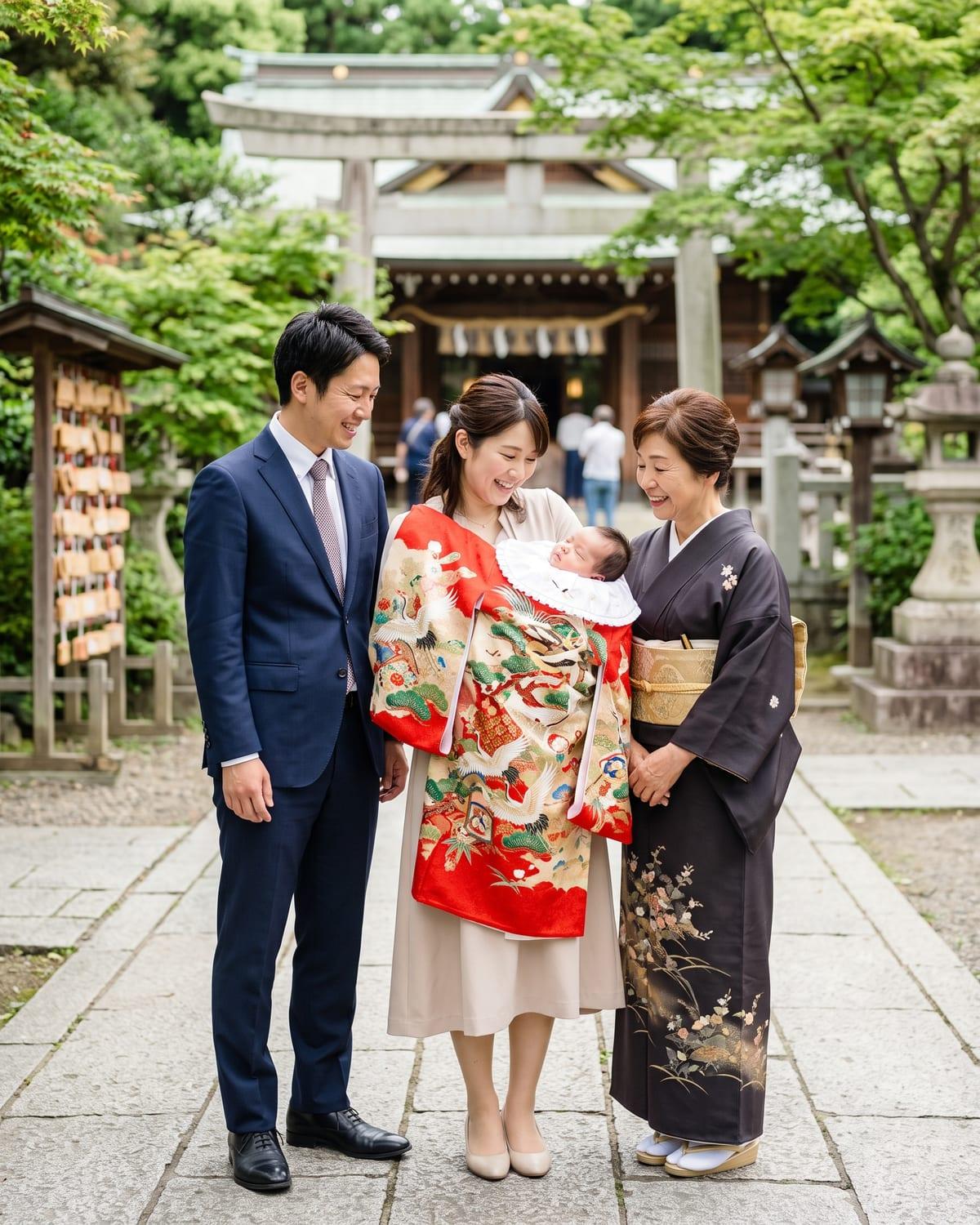
Omiyamairi Without an Iwaigi: How Casual You Can Go Without Being Disrespectful
pokesta Editorial Team · Updated October 12, 2026
You can do Omiyamairi, a baby's first visit to a Shinto shrine at around one month old, without an iwaigi, the decorated ceremonial kimono (also called ubugi or noshime) that is traditionally draped over the baby. Dress has become much more flexible, and plenty of families skip both the white silk under-kimono and the iwaigi and go in a baby dress. Once you've decided to go without one, the people to talk to first aren't at the shrine; they're your relatives. The iwaigi has traditionally been provided by someone in the family, and if you decide without a word, someone may end up quietly disappointed.
An iwaigi isn't something you have to wear
The traditional Omiyamairi outfit is a baby dressed in shiro-habutae, a white silk kimono, held in someone's arms with an iwaigi draped over both. But this isn't a rule you must follow to visit the shrine. Shiro-habutae and the nagajuban under-robe can be left out at the family's discretion, depending on local custom and how much the outfit weighs on the baby. Draping an iwaigi also makes both the baby and the person holding them warmer, which is especially hard on them in summer.
Families have all kinds of reasons for going without. The visit falls in hot weather, they'd rather put the rental or purchase cost toward photos or a meal, or the mother is carrying the baby and wants to travel light. Any of these is reason enough.
A purchased iwaigi can sometimes be remade into a kimono for a three-year-old's Shichi-Go-San (a celebration for children aged three, five and seven), and a rental saves you the upkeep. If you still decide against one, agree on a one-line reason as a family so it's easy to explain when grandparents ask. Adding what you'll do instead, like "It's midsummer, so we want to keep the baby cool" or "We're planning kimono photos at a studio later," makes it less likely anyone thinks you're cutting corners.
Talk first to whoever would provide it
Traditionally, the iwaigi has generally been provided by the mother's family, though in some regions the father's side provides it. Grandparents may have been thinking about it since the day the baby was born, so it's kindest to say "We're thinking of going without an iwaigi" as early as you can. If they've already got one ready, you can meet halfway by draping it only for the blessing and the photos. And if a grandparent says they'd like to give something for the occasion, asking for a cape or baby dress instead lets you accept the gesture and keep the outfit consistent.
The other thing to check is local custom. In some areas, people tie charms or small items to the cords of the iwaigi or cape. In parts of the Kansai region, the custom of ohimo-sen, tying gift money to the cords, is still alive. In families with traditions like these, not having an iwaigi or a cape with cords can cause a problem, so ask your relatives: "Do we usually tie anything to the cords?"
Shrines rarely specify what to wear, but if you're unsure, ask when you book and you'll know for certain.
What to wear instead
The most popular alternative is a white baby dress. It's regarded as Western formal wear on a par with the Japanese outfit, so a dress on its own keeps the occasion suitably formal. How to choose one and how it looks in photos are covered in Is a baby dress enough for Omiyamairi?
Layer a white cape over the dress and the baby in someone's arms looks softly wrapped, much as with an iwaigi. A cape is lighter than an iwaigi, so it's easier on whoever is holding the baby, and if you choose one with cords, it also works for families who hang charms from them. If you'd like to keep a little Japanese flavor, some families choose a coverall with a traditional Japanese pattern.
Let the adults' clothes set the overall tone
Without an iwaigi, the adults' clothes decide how formal the family photos look. To match a baby in a dress, a dress or suit for mom and a suit for dad is a good guide. Plain, subdued colors such as black, navy, gray and beige help the baby in white stand out in the photos.
If you want to go more casual, the usual line is to avoid everyday clothes as such, primary colors and loud patterns, sweatshirts and jeans, and anything revealing. Keep one element of smartness somewhere: if dad skips the jacket, a freshly ironed collared shirt in white or a pale color; if mom wears nursing clothes, a plain style that falls below the knee. That stops the whole family from looking sloppy. Smart outfits without a jacket, and coordinating with both sets of grandparents, are covered in What to wear for Omiyamairi. If grandparents are coming, tell them early what the baby, mom and dad will wear, so no one stands out on the day.
In photos, show the shrine instead of the iwaigi
An iwaigi alone makes a picture look like an Omiyamairi photo. Without it, bring in the shrine instead. Include the torii gate or the main hall in the background, place the charm or talisman you received next to the baby, or shoot in front of the temizuya (the purification fountain) or the rack of ema votive plaques. Any one of these makes it clearly different from an ordinary day out. If the baby is wearing a cape, hang the charm you received after the blessing from its cords, and the photo instantly reads as Omiyamairi day. As long as the adults are dressed in coordinated, subdued colors, the photos look properly put together even without an iwaigi.
If you'd still like at least one photo of the baby in an iwaigi, you can rent one at a photo studio and shoot there. Some families avoid a midsummer visit by doing the iwaigi photos at a studio first. With pokesta, you can also create a family photo of the baby in an iwaigi against a shrine backdrop using AI, from each family member's phone photos (your first photo is free, then $1 per photo). Try it on the Create an Omiyamairi photo page.
Before you decide, just check who might be providing one
Doing Omiyamairi without an iwaigi is fine etiquette-wise. Before you decide, there are only two things to check: whether a grandparent is planning to provide one, and whether there's a custom of tying something to the cords. Once that's settled, choose whatever is easier for the baby and the mother.
All About, "Omiyamairi outfits for baby girls: choosing kimono or a ceremony dress, and what to check when renting" (in Japanese) https://allabout.co.jp/gm/gc/482622/
HugKum (Shogakukan), "When and where to go for Omiyamairi: clothing, costs and common concerns" (in Japanese) https://hugkum.sho.jp/132143