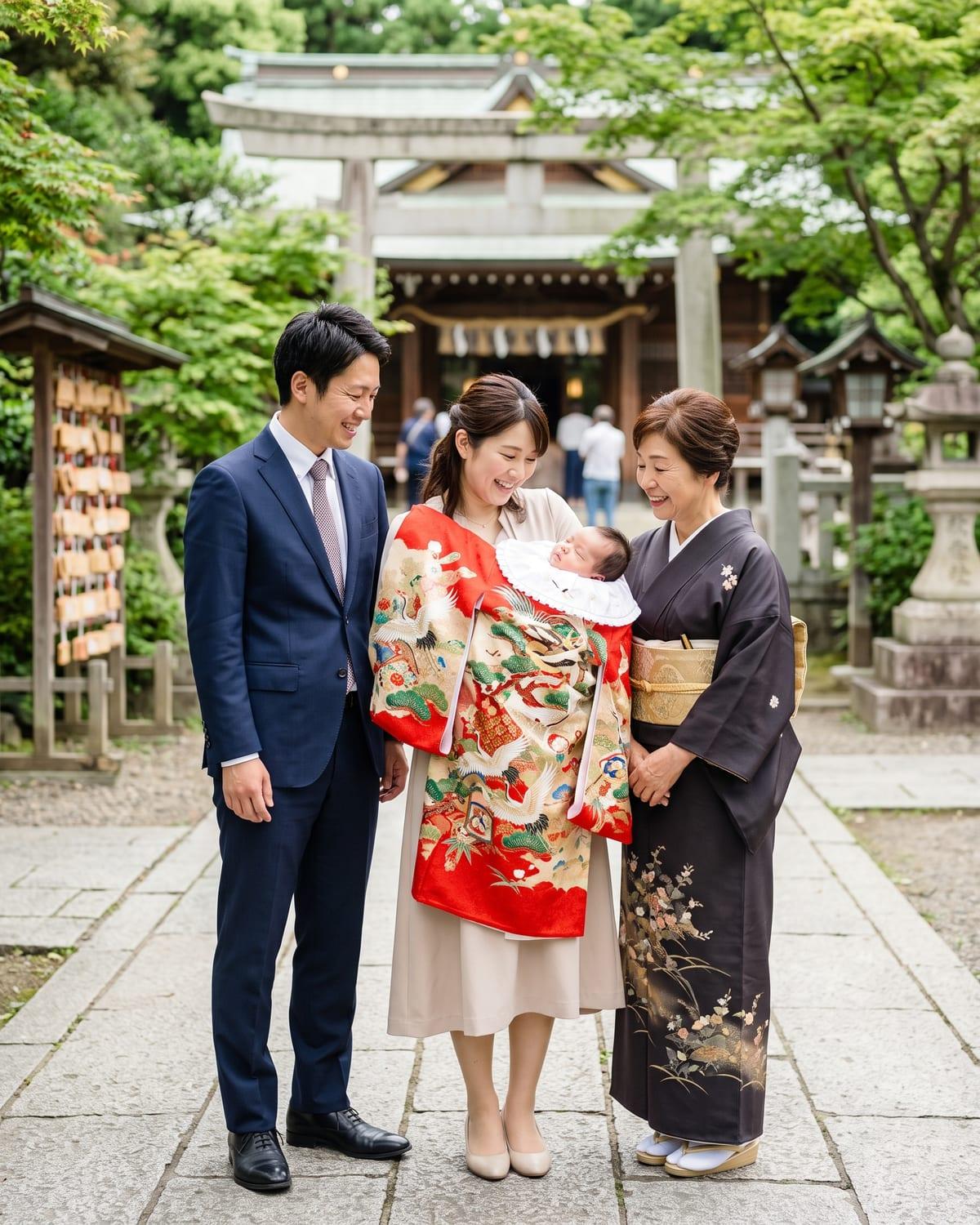
Some families do Omiyamairi (a newborn's first visit to a Shinto shrine, about a month after birth) with just mom, dad and the baby, whether because the grandparents live far away or by choice. It's easy to move around and you can go at the baby's pace, but photos are a problem. Whoever holds the camera is left out, so you end up with "mom and baby" and "dad and baby" and no picture of all three together. The fix is to decide in advance how you'll get the three-person photo, not to figure it out on the morning of.
With two adults, the shortage is hands, not cameras
Before talking about photos, sort out who does what on the day. With only two adults, you're splitting holding the baby, carrying bags and taking pictures between two people.
A mother one month after giving birth is still recovering. The postpartum period is generally said to last six to eight weeks, and carrying a baby around for a long time is hard on the body at this stage. If dad does most of the holding and mom keeps an eye on feeds and diaper changes, she'll be able to sit down and rest along the way.
Pack everything into one shoulder bag that leaves both hands free: diapers, a change of clothes, a nursing cover, gauze cloths and the hatsuhoryo (the offering paid for a blessing). Even with a phone tripod added, aim for a bag light enough to carry in one hand. If you're using an iwaigi (the celebratory kimono draped over the baby), its cords go over the shoulders of whoever holds the baby, so a clean neckline suits dad if he's the one.
First, ask another visitor
There are three ways to get a photo of all three of you: have someone take it, use a self-timer, or hire a photographer. Instead of committing to just one, plan two steps, like "ask someone first, use the self-timer if that fails," so you can switch depending on how the day goes.
The easiest and most reliable option is asking another visitor. At busy times for Omiyamairi, shrines are full of other families with babies. They'll probably want a photo too, so offering "Would you like to take turns taking each other's pictures?" usually gets a yes.
When you ask someone, set up the shot yourself before handing over the phone. Decide where you'll stand and check on the screen how much of the torii gate or shrine hall is in the frame. Then say "Just keep it like this and press here," and the person won't have to guess.
If you want both vertical and horizontal shots, or a burst of several, say so at the start. Asking for "one more" after they're done eats into their time and is hard to ask. Offering to take their picture in return is the natural thank-you.
Pick someone who isn't holding a baby. Families waiting to check in for a blessing or just out of one are busy, so a family relaxing on the grounds is easier to ask.
With a self-timer, stay at the edge and be quick
If there's no one to ask, use a tripod and the self-timer. Even a small phone tripod gets close to chest height when set on a bench or a stone step. Set the timer to 10 seconds, and leave the spot nearest the camera free for whoever pressed the button to return to.
Some shrines have specific rules on bringing tripods and where you can take photos. Check the shrine's website or ask ahead to be safe. When you set up the tripod, choose a place that doesn't block people's path. The center of the approach path is said to be the path of the gods, and one custom is to walk to the side of it, so keep your shooting to the edges of the path or the corners of the grounds, and keep it short.
Try out the tripod at home before you go. Clip the phone into the holder and practice getting back into position within the 10-second timer, and you'll spend much less time fumbling on the shrine grounds. A Bluetooth shutter remote lets you shoot whenever you want without waiting for a timer, so you're less likely to miss the moment the baby opens their eyes.
The basic arrangement is the person holding the baby in the middle and the other parent close beside them. Besides a shot with both of you looking at the camera, take one with both of you looking down at the baby's face, and you'll have two photos with different moods. It's also worth switching who holds the baby, so you get one with dad holding and one with mom holding.
With a self-timer, setting the focus on the holder's face before you shoot cuts down on failed shots. How to choose height and distance is explained in detail in Taking a whole-family photo with a tripod and self-timer.
If hiring a photographer, check the shrine's rules first
If you want the three-person photos done properly, you can hire a photographer to come with you. With someone else behind the camera, mom and dad can focus on the baby, and the three of you come out looking natural.
Some shrines, though, allow ordinary visitors to take photos but ban professional photographers or require advance permission. Some, like Kawagoe Hachimangu, allow a photographer to accompany families during the blessing only if they use the shrine's own photo studio. The same shrine says families are free to take their own photos on smartphones and tablets, as long as they don't bother other visitors. Rules are often aimed at professional photographers, so check separately for shooting yourselves and for hiring someone. Check with the shrine about whether photography is allowed, and on what terms, before booking a photographer, so you don't end up paying for nothing. Studios, on-location photographers and doing it yourself are compared in Omiyamairi photos: studio, on-location or DIY?.
Photos you missed can be made up later
On the day, the baby's mood may run the show, and you might come home with no photo of the three of you. Even then, it isn't lost for good.
One option is a studio on another day. A studio that lends out iwaigi can take your three-person photo separately from the shrine visit. Another is shooting at home. Hold the baby in the iwaigi, find a spot with window light, and use the self-timer for a calm family photo with a different feel from the shrine.
You can also combine individual photos. On pokesta, you can create an Omiyamairi family photo with AI from pictures of each family member, choosing an iwaigi look and a shrine backdrop (one free try after signing up, then $1 per photo).
Decide when, not who
The trick to getting photos at a family-of-three Omiyamairi is deciding in advance when you'll take the three-person photo, rather than who'll take it. Decide that it happens once the blessing is over and the baby has settled, and finding someone to ask or setting up the tripod can all happen in that window. You can also create an Omiyamairi photo or browse other families' posts.
References