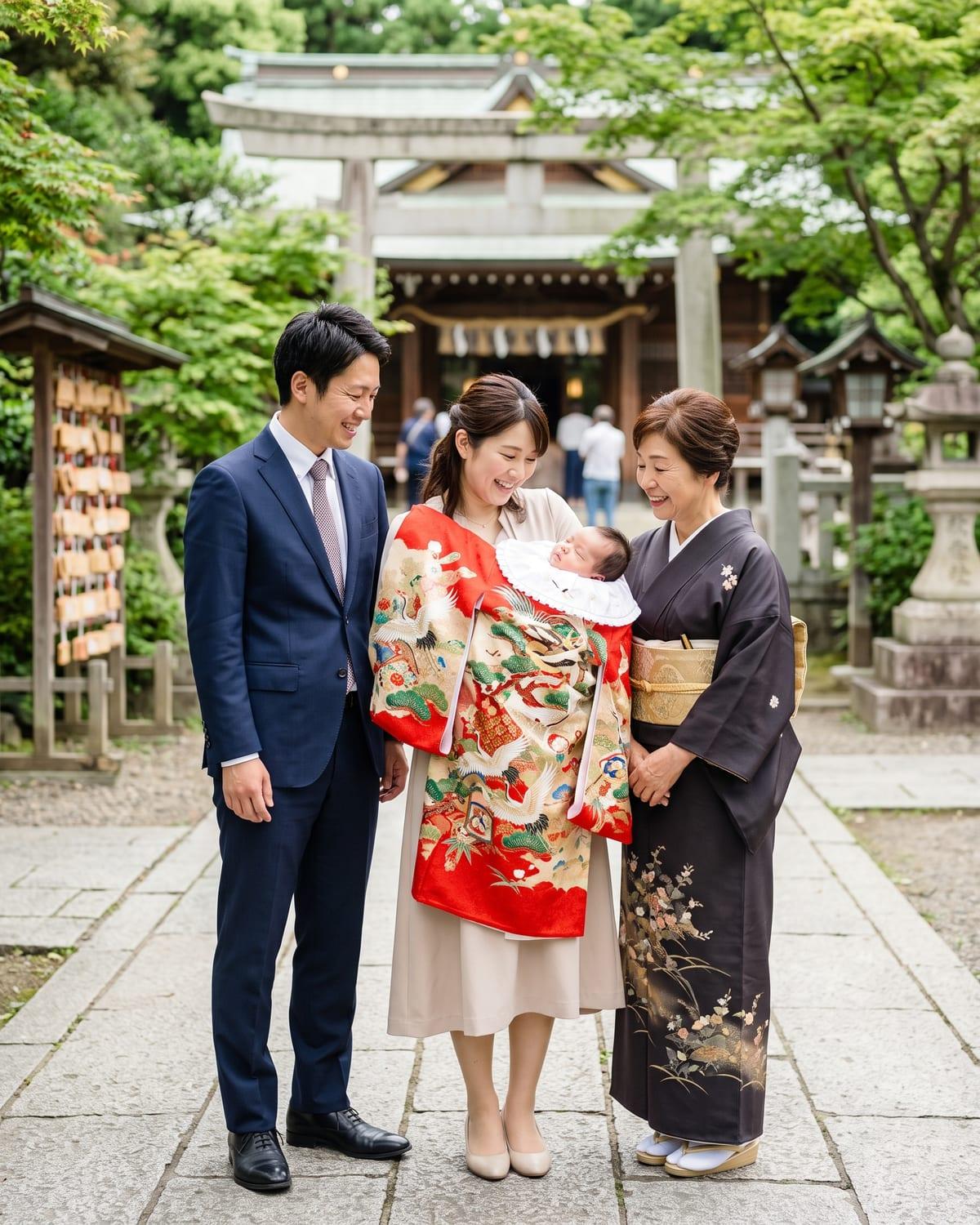
On the day of Omiyamairi (a newborn's first visit to a Shinto shrine, usually about a month after birth), mom is roughly four weeks postpartum. She'll be nursing, carrying the baby and standing in the photos. If the family has agreed to keep things casual, three questions come before looks: can she nurse easily in it, will it hold up to carrying the baby and the iwaigi cords, and is it comfortable around the middle? Get those right, then tidy up the color and length, and she won't look out of place in the pictures.
Let the way you'll feed decide the shape
Between travel, the blessing and photos, Omiyamairi takes a few hours. It's safest to assume at least one feed along the way, and the way you feed decides the cut of the outfit.
The easiest options are a button-front shirt dress, or a nursing dress with a zip or slits at the chest. You don't have to undress your whole upper body in the nursing room, and it takes far less time to straighten up afterward. Separates work too: with a top and a skirt or trousers, you can lift the top from the hem, so you don't need special nursing access.
The two to avoid are dresses that zip up the back and tight pull-over knit dresses. Both mean taking everything off at every feed. If you bottle-feed, the clothes matter less, but you'll be carrying hot water and bottles, so think about a roomy bag that sits comfortably on your shoulder.
Neckline for the iwaigi cords, waist for a postpartum body
If mom holds the baby with the iwaigi (the celebratory kimono draped over the baby and tied on by the person holding them), its cords run from the back of her neck over her shoulders. Big blouse collars or ruffles get flattened under the cords and end up looking crumpled in the photos. A clean crew neck or V-neck, or a shirt with a small collar, is the better choice.
Pick a fabric that isn't too thin and doesn't crease easily. Fluid, lightweight fabrics tend to keep the marks of the carrier straps and cords. A dress in slightly thicker ponte, crisp cotton or jersey keeps its shape even after you've picked up and handed over the baby many times.
The shoulder and chest are exactly where spit-up and milk stains land. Drape a gauze cloth over your shoulder while you move around and take it off just before the photos, and you can hold the baby without worrying about your clothes.
A month after birth, the belly often hasn't settled back yet, and how you feel can change from day to day. Belted waists and slim trousers become uncomfortable every time you sit or nurse. Go for shapes that don't constrict: a dress without a waist seam, a skirt with an elastic waist, or relaxed wide-leg trousers.
If you'd rather not show your figure, a long cardigan or a collarless jacket over the top creates a vertical line that looks streamlined. It also helps with temperature, since you'll be moving between an air-conditioned car or waiting room and the outdoors. Even in summer, it's worth having one layer to throw on.
Knee length to mid-calf is the safe choice. Shorter hems become a nuisance every time you sit in the nursing room, pick a bag up off the ground or crouch to talk to an older child.
One notch quieter than the baby's outfit
The baby stands out in photos when mom's clothes are a step more subdued than the baby's. With an iwaigi, choose a calm solid such as beige, greige, dusty blue or navy. If the baby is going in just a white baby dress, avoid white yourself, or the baby melts into your clothes. A beige a little deeper than ecru, or a pale gray, keeps the baby's outline clear.
All black tends to look heavy in photos. If a formal black dress is all you have, a light cardigan or wrap softens it. If you want a pattern, keep it to a fine one that reads as solid from a distance so it doesn't fight the iwaigi's motifs. Bringing the whole family's colors together is covered in coordinating family colors.
Change the fabric and the layer with the season
In summer, the priority is not showing sweat. Thin gray or pale blue fabrics show underarm and back sweat clearly in photos. Choose a linen blend, or colors like navy and beige that hide it, and sleeves to the elbow keep skin coverage modest. All About also recommends calm colors in summer and clothes that don't expose too much of the shoulders or chest. Holding a baby against you gets hot, so keep your own clothes light and breathable.
In winter, if you hold the baby with a heavy coat on, the photo ends up showing only a coat and a baby. Plan to take the coat off for photos, and keep warm with a thin knit and tights underneath. A front-opening coat is easy to slip off, and if it's in the same color family as your outfit, the photo still works on the occasions you don't have time to remove it.
Spring and autumn bring big temperature swings. A chilly morning can turn warm once you've walked around the grounds. A dress with a cardigan or a light jacket is the easiest combination to adjust.
Shoes and bags for gravel and stone steps
Shrine approaches are often gravel or stone steps, and carrying a baby makes it hard to see your feet. Go for low, chunky heels, ideally pumps with a strap, or smart flats. Clean leather sneakers also look fine with a dress. Some shrines ask you to take off your shoes to enter the hall of worship, so shoes that slip on and off easily help.
For a bag, one large tote that fits a nursing cover, gauze cloths and diaper supplies is enough. One that stands up on its own is handy, since you can set it at your feet during photos. A separate small shoulder bag tends to slide off just as you lift the baby.
When in doubt: front-opening, below the knee, plus a layer
How you feed decides the shape, holding the baby decides the neckline and fabric, and the baby's outfit decides the color. If you can't decide, a front-opening dress below the knee with one layer on top will see you through the nursing room, the stone steps and the photos.
However comfortable the clothes, a hard day is still a hard day. If that's how it goes, change the plan rather than the outfit: mom focuses on feeding and diapers while others take turns holding the baby, and photos are cut down to the group shot so you can leave early. If you don't get a photo with everyone, you can take one another day, or use pokesta to create an Omiyamairi picture of the whole family from each person's photos ($1 per photo, with the first one free).
References