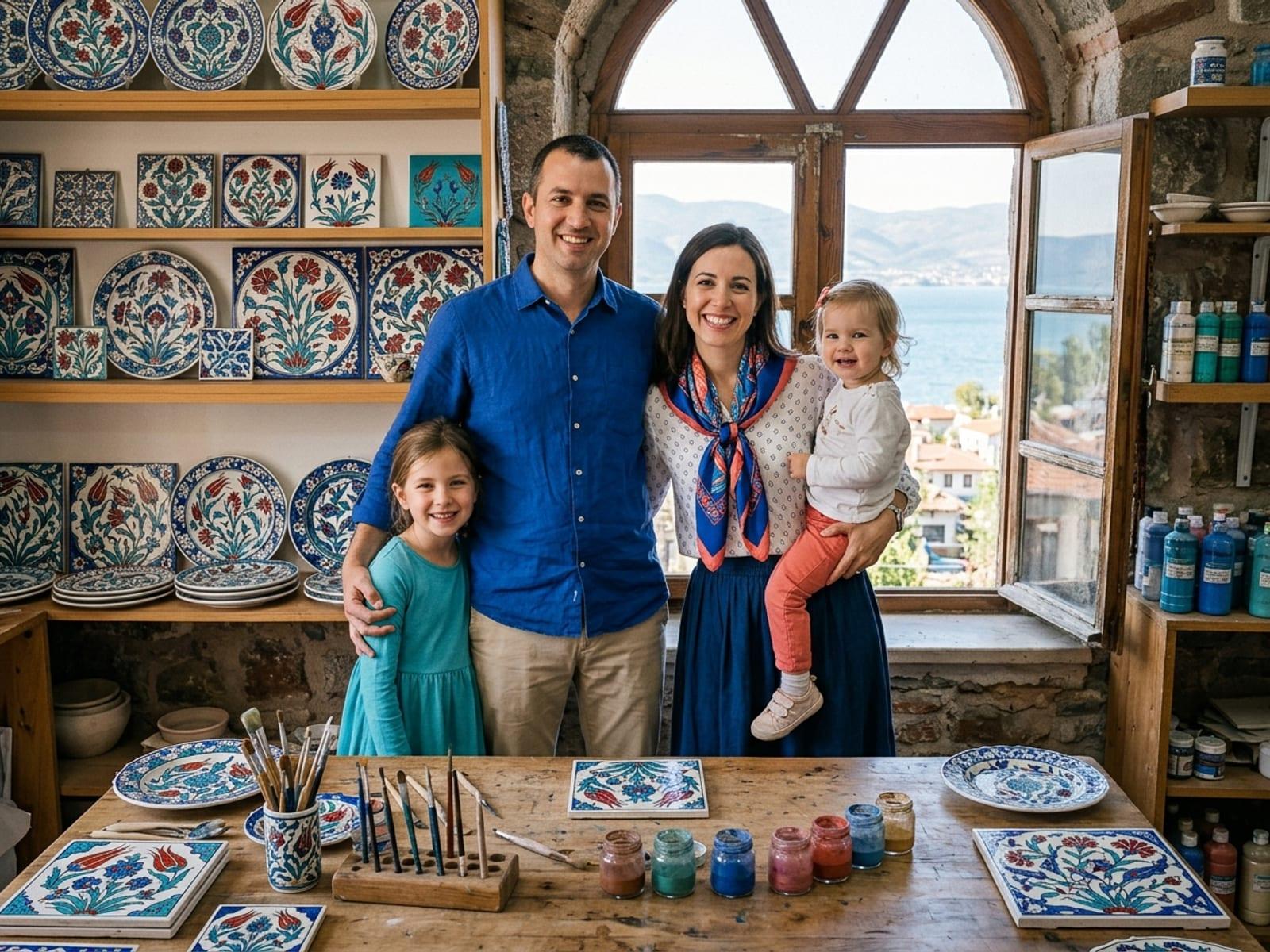
Step inside one of Istanbul's great mosques and the tiles are what catch your eye: walls covered in deep blue and turquoise on a white ground, with flashes of bright red. Tulips, carnations and long, saw-edged leaves fill every inch. Many of these tiles were made in Iznik, a lakeside town southeast of Istanbul. Iznik is a quiet little place today, but it still has tile workshops and shops, and you can walk its walls and ruins, which go back to Roman times and earlier. See the tiles in a mosque first, then visit the town, and a single painted tile becomes far more interesting.
Made for the court, from the late 15th century
Iznik pottery was produced from the end of the 15th century to the end of the 17th. Potters admired Chinese porcelain but couldn't make it themselves, so they developed a body of ground quartz and glass mixed with a little clay, known as fritware. They painted designs onto this white body, covered them with a clear glaze and fired them.
At first the only color was cobalt blue. Turquoise was added around 1520, followed by purple, green, grey and black. Then, around 1560, came the vivid red that sits slightly raised on the surface and has become the signature of Iznik tiles. A bright emerald green first appeared on the mausoleum of Suleiman the Magnificent, completed around 1567.
The patterns fall into a few types. The saz style pairs long, serrated leaves with rosettes. Another style depicts four flowers: tulips, carnations, roses and hyacinths. If you've been to Istanbul's tulip festival, it's fun to compare the real flowers with the way they're drawn on the tiles.
By the end of the 16th century, quality was falling. Orders from the court had dropped, prices stayed fixed while costs rose, and the potters faced competition from imported Chinese porcelain. By the mid-17th century only a few kilns were left, and the last dated pieces are from 1678. The kilns themselves stayed buried under the town until later excavations brought them to light.
See the real thing in Istanbul's mosques
Iznik tiles decorated the imperial mosques and tombs designed by the architect Mimar Sinan: the Süleymaniye Mosque, completed in 1557; the Rüstem Pasha Mosque, from around 1563; the tombs of Suleiman and his wife Hürrem; and Topkapı Palace. The Sultan Ahmed Mosque, often called the Blue Mosque and completed in 1616, is considered the last major building in Istanbul decorated with Iznik tiles. After the Süleymaniye Mosque, you can walk to the Vefa district just to the west and rest at a boza shop open since 1876.
The Rüstem Pasha Mosque is the best place to look closely. Its inner walls are almost entirely tiled, so you can study the patterns at eye level. Give children a challenge, such as "How many tulips can you find?" or "Where is the red?", and they'll happily scan the walls even in a quiet mosque. To go inside, cover shoulders and knees, women cover their hair with a scarf, and everyone takes off their shoes. Visitors can't enter during prayers, so check the times before you go.
A lakeside town and its workshops today
Iznik sits at the eastern end of Lake Iznik. It grew from the ancient city of Nicaea, founded in 316 BC. The Ottoman ruler Orhan took the town in 1331, and for a short time it was the Ottoman capital. About 5 kilometers of walls ring the town, and you enter through gates such as the Lefke Gate or the Yenişehir Gate. In the center you'll find the 6th-century Hagia Sophia, now a mosque; the Green Mosque (Yeşil Cami), built for the first Ottoman grand vizier; and the Nilüfer Hatun Imaret, built in 1388 as a soup kitchen and now a museum.
The town is also important in Christian history. In the 4th century it hosted the First Council of Nicaea, the first ecumenical council of the church. On November 28, 2025, marking 1,700 years since the council, Pope Leo XIV came to Iznik and prayed with Ecumenical Patriarch Bartholomew I of Constantinople near the ruins of the Basilica of Saint Neophytos, believed to be where the council met.
The tile tradition is still alive here. The İznik Foundation (İznik Vakfı) has a workshop on the lakeshore road, where it makes tiles and tableware that combine traditional patterns with new designs. There are other tile and pottery shops and workshops in town too, so ask each one directly whether you can watch the work or try painting. Ceramics are fragile: have the shop wrap your purchases carefully and carry them in your hand luggage.
With children, start at the museum's kiln model
Before the workshops, stop at the Nilüfer Hatun Imaret. It reopened in July 2020 as the Museum of Turkish and Islamic Arts, and the south side of the building is given over to Iznik tiles and how they were made. There is a full-size, three-dimensional reconstruction of a kiln found in the excavations, which lets children see the kind of fire the painted pieces went into. The museum is closed on Mondays, and opening hours can change by season or year, so check before you go.
Shops and workshops often display fragile pieces at a child's reach. Hold younger children's hands as you go in and agree beforehand on "look first, and ask before you touch." That way the adults can browse in peace too.
Inside a mosque there are moments when it's better to keep the camera away. A family photo against a tiled wall can be made with pokesta's AI photos instead ($1 per photo, first one free).
Getting there, and pairing it with Bursa
Iznik is about 90 kilometers southeast of Istanbul in a straight line, but the road has to go around the Gulf of İzmit, making it about 200 kilometers by car. For international flights, the gateways are Sabiha Gökçen Airport (SAW) on the Asian side or Istanbul Airport (IST). Bursa is about 80 kilometers away by road, so you can base yourself there and visit Iznik as a day trip. Entry requirements for Turkey depend on your nationality, so check your own government's official information.
If you stay in Bursa, don't miss its famous İskender kebab. Tiles aren't seasonal, so Iznik fits into a spring flower trip just as well as a quiet winter one.
Look up at the real tiles in an Istanbul mosque first, then watch a brush at work in an Iznik workshop. In that order, children stop seeing the tiles as a pretty wall and start seeing them as pictures someone painted by hand.
References