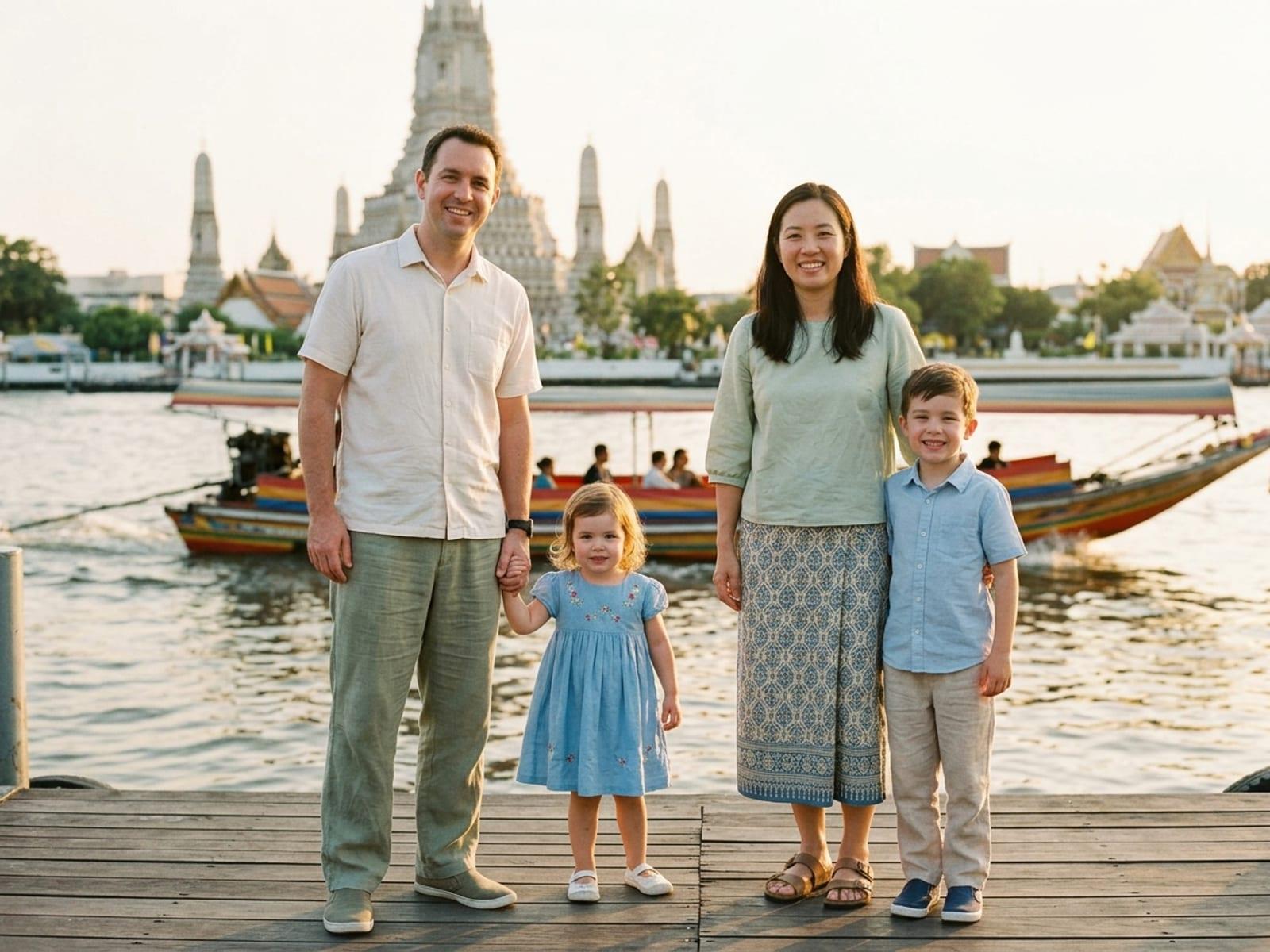
Bangkok's roads are often gridlocked, and an hour stuck in a taxi with children can use up a whole day's energy. That's where the boats on the Chao Phraya, the river running north to south through the city, come in. The Grand Palace, Wat Pho and Wat Arun, three of Bangkok's best-known sights, all sit beside the river. Travel between them by boat and you get a river breeze and city views along the way. Start when the Grand Palace opens at 8:30 a.m., ideally between November and February when it's cooler, and children can manage all three in a day.
Riding the river "bus"
Since 1971, the Chao Phraya Express Boat has run scheduled services on the river, stopping at piers along the banks in turn, much like a bus on water. Routes are identified by the color of the flag the boat flies: orange, yellow, green-yellow and red. Each flag stops at a different set of piers, and some work like express services that call only at the main ones. Before boarding, ask the pier staff whether the boat stops where you want to go. In October 2026 the official website listed a flat fare of 19 baht on the orange-flag boat and showed every flag service as running Monday to Friday, so at the weekend, ask at the pier what's running that day. Fares and timetables do change.
A convenient starting point is Sathorn Pier, next to Saphan Taksin station on the BTS Silom Line. Take the BTS to the station, then head upriver by boat. Tha Chang (N9) is the pier for the Grand Palace and Tha Tien (N8) for Wat Pho, and both are north of Sathorn.
The service links more than 30 piers along roughly 21 km of river. An air-conditioned boat, the Riva Express, has also been running since 2020, which is worth considering on a hot day with small children.
The view from the water is part of the trip. Tall hotels, old warehouses and temple roofs line the banks, and cargo barges and little ferries cross back and forth.
The Grand Palace and the Emerald Buddha, first thing
Start the day at the Grand Palace. According to its official website, when we checked in October 2026 it was open daily from 8:30 to 16:30, with tickets sold until 15:30, and admission was 500 baht. It gets crowded and hot as the day goes on, so aim to arrive at opening time.
Within the palace grounds is Wat Phra Kaew, the Temple of the Emerald Buddha, home to the most revered Buddha image in Thailand; your ticket includes the temple. The Emerald Buddha's robes are changed for each of the three seasons, hot, rainy and cool, so it looks different depending on when you visit. Gleaming golden chedis, buildings decorated with colored glass and long murals telling stories give children plenty to look at.
The palace and temple matter deeply to the monarchy and to Buddhists. Clothing must cover shoulders and knees, so bring long trousers or longer skirts and tops with sleeves for everyone, children included.
At Wat Pho, look all the way to the soles of the feet
Just south of the Grand Palace is Wat Pho. It's within walking distance, but on a sunny day pick the shady side of the street.
The highlight is the huge reclining Buddha that fills its hall: 46 m long and 15 m high, its golden body stretching from one end to the other. Don't miss the soles of the feet. Each is 3 m high and 4.5 m long and inlaid with mother-of-pearl in 108 panels showing auspicious symbols. Along the corridor stand 108 bronze bowls, and people drop a coin into each one. Change some money into small coins and let your children fill the bowls; most enjoy the job.
Wat Pho is also called Thailand's first "public university." Its murals and stone inscriptions record knowledge of religion, medicine, literature and more, and in 2008 these inscriptions were recognized by UNESCO's Memory of the World Programme. The temple grounds also house a school of traditional Thai massage and medicine, said to be the first school of Thai medicine approved by the Ministry of Education. Around the hall of the reclining Buddha are many more Buddha images and chedis, and the Buddha images in the cloisters, restored in the reign of Rama I, are covered in gold leaf.
Across by ferry to Wat Arun
After Wat Pho, take the cross-river ferry from Tha Tien pier, and Wat Arun is right in front of you on the other side.
Wat Arun, the Temple of Dawn, stands on the west bank in Thonburi. Its name comes from Aruna, the god of dawn who drives the chariot of the sun god in Indian mythology. In the late 18th century, after Ayutthaya, the old capital upriver, fell in 1767, King Taksin made Thonburi his capital and named this temple Wat Chaeng, and the story goes that he passed in front of the temple at dawn and vowed to restore it. It keeps the memory of another capital, from before the time of Rattanakosin Island across the river, where the Grand Palace and Wat Pho stand. The great central tower is covered in fragments of colorful porcelain, and up close you can see fine patterns arranged in the shapes of flowers. Some of the porcelain is said to have arrived as ballast on ships from China. See how many flower patterns your children can find on the tower's surface.
Late afternoon, when the tower catches the setting sun and is reflected in the river, is another lovely time to see Wat Arun. In the evening it's also worth viewing from the opposite bank.
Taking boats with children
At the piers, boats rock with the water level and the waves, so footing can be unsteady when getting on and off. There can be a gap between boat and pier, so always hold children's hands, and lift small ones on and off. Boats are often crowded and passengers board and leave quickly, so agree as a family beforehand where you'll get on and where you'll get off.
Strollers aren't suited to the boats or the temples, so use a baby carrier for small children. There's little shade, so bring hats, sunscreen and extra water. In some temple buildings you take your shoes off, so shoes that slip on and off easily are handy.
The easiest season for walking is roughly November to February, when it's relatively cool and dry. The main international gateway is Suvarnabhumi Airport (BKK), and the Airport Rail Link train runs from the airport into the city.
To see what a family photo on a riverside pier, with a temple across the water behind you, might look like, you can try pokesta's AI-generated photos ($1 per photo, with your first one free). The old town around the palace is home to a long-established pad thai shop, and heading back downriver in the evening you can stop at Yaowarat's street food stalls. Entry requirements for Thailand depend on your nationality, so check your own government's official information before you travel.
References