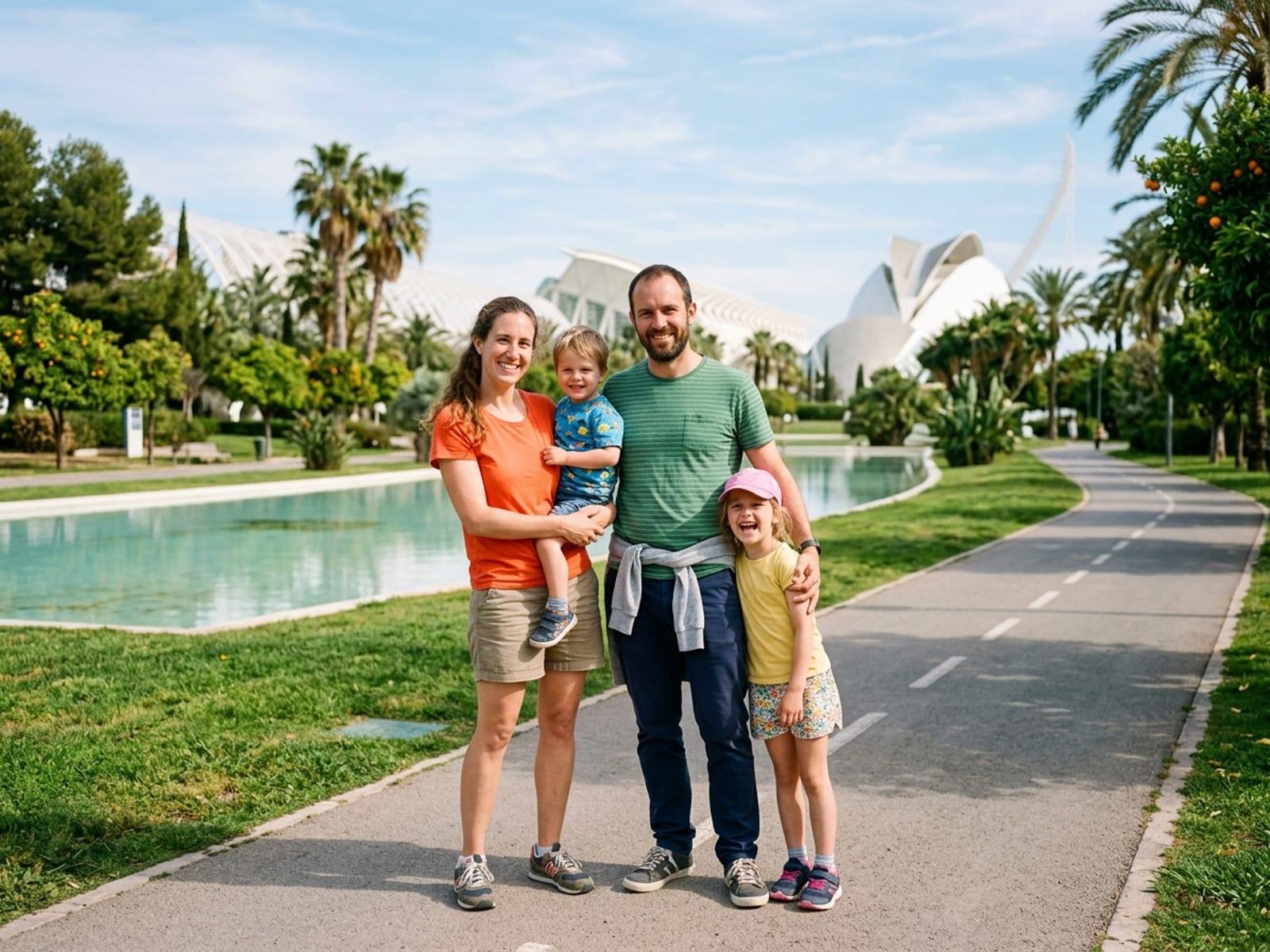
The Turia Gardens in Valencia, Spain's third-largest city, are a long, narrow park of roughly 9 km laid out in the old riverbed after the river was diverted following the 1957 flood, and you can walk them all year. Partway along is Gulliver Park, a 70-meter giant children can climb and slide down, and at the seaward end are the white buildings of the City of Arts and Sciences and the Oceanogràfic aquarium. With kids, don't try to walk all 9 km: cycle or pick a stretch, and go in spring or autumn, in the cool of the morning or evening, rather than in the summer heat.
A green ribbon runs through the middle of the city, ducking under one bridge after another: rows of palms and orange trees, lawns, runners and cyclists. Following the old river as a single route is the simplest way to see it all.
A riverbed without a river, born of a flood
The Turia River used to flow along the north side of Valencia's old city. On October 14, 1957, heavy rain made it burst its banks, and around 100 people died. In response, a plan to move the river itself south of the city, the Plan Sur (South Plan), was drawn up in 1958, and the new channel was finished in 1972.
At one point there was a plan to run a highway through the empty riverbed. Residents pushed back with the slogan "The Turia riverbed is ours, and we want it green," and it was decided to make it a park. The gardens opened in 1986. Today they run about 8.5 km (the tourist office says 9 km), with an average width of about 160 meters. Bridges old and new, stone ones that once spanned the river and others added since, now cross over the park one after another. There are old stone bridges like the Serranos Bridge, and new ones like the 9 d'Octubre Bridge, designed by Santiago Calatrava and built in 1989, and the Assut de l'Or Bridge of 2008, so each time you pass underneath, you meet a shape from a different era. Once you go down the embankment, the traffic noise fades and it's hard to believe you're in the middle of a city.
Gulliver, 70 meters long and made for climbing
The children's favorite is Gulliver Park, toward the southeast end of the gardens. It's a playground that opened in 1990, based on a scene from Jonathan Swift's Gulliver's Travels: Gulliver lying tied down after landing in the land of the tiny Lilliputians, turned into a giant figure 70 meters long. His body is made of ramps, stairs and slides, so kids can climb over his arms and hair and slide down the folds of his clothes. The idea is that visitors get to feel like the Lilliputians.
Entry is free. Opening hours vary with the season: from November to February it's open 10 a.m. to 5:30 p.m., and in summer hours usually extend to around 9:30 p.m. Times can change from year to year, so check before you go. It reopened in November 2022 after a renovation.
The giant was created by architect Rafael Rivera and Manolo Martín, a craftsman who builds figures for the Fallas, Valencia's festival of fire. They were commissioned in 1986, working from a design by the cartoonist Sento Llobell. In a city famous for the giant figures of its festival, it makes sense that a festival figure-maker had a hand in this playground giant. It was paid for by the regional government's department of industry, commerce and tourism, with the city providing the land.
Some of the slides are big and steep, so an adult should stay close to small children and let them play only where they can climb under their own steam. Summer midday sun is fierce, so morning or late afternoon is the better time to go.
The City of Arts and Sciences and one of Europe's largest aquariums
Carry on down the riverbed from Gulliver Park toward the sea, and you'll see the City of Arts and Sciences, its bright white curves reflected in the water. It's a group of buildings designed mainly by the architect Santiago Calatrava. The first to open, in April 1998, was the Hemisfèric, a planetarium and giant-screen cinema. It was followed by the science museum (2000), the Umbracle, a walkway planted with local plants and set with sculptures (2001), the Oceanogràfic aquarium (2003) and the opera house (2005).
The Oceanogràfic was designed by architects including Félix Candela, and you'll recognize it by its thin, curving concrete roof in the form of a hyperbolic paraboloid. It's described as the largest aquarium in the European Union, with separate buildings recreating the Mediterranean, wetlands, the tropics, the Antarctic and Arctic, the Red Sea and other waters. Several hundred species live there, including dolphins, belugas, sea lions, penguins, sharks and rays. It takes at least half a day, so if you also want to see other buildings, it's realistic to pick just one or two to suit your children's energy.
The science museum is indoors, which makes it a good rainy-day option. Inside the Hemisfèric are a big-screen cinema and planetarium, where you can sit and watch films about the stars and nature; it doubles as a rest stop for little ones worn out from walking. The Umbracle, with its Valencian plants and sculptures, makes a pleasant path between buildings. In 2009 a covered plaza, the Àgora, was added and is used for concerts and sports events. Check prices and opening hours for each building on the official website.
By bike, or on foot one stretch at a time
Walking all 9 km is far too much for children. The gardens are bike-friendly, so either ride, or walk just the stretch you want and come back by bus or metro. Near the northwest end of the gardens is Bioparc, a zoo that opened in 2008, so you could also plan a day that starts there and works east to Gulliver Park and the City of Arts and Sciences. Cramming the zoo and the aquarium into one day is too long for kids, though; splitting them over two days, or choosing one, lets you enjoy each properly.
Parts of the park are shaded and parts aren't, so hats and water are a must, especially in summer. With small children, take a break on the grass or under a tree after each stretch and decide on the spot whether to keep going. That relaxed approach works best. You get into the riverbed by going down the embankment from street level, so if you have a stroller, look on the map for an entrance that's easy to get down.
For a family photo with the palms and white buildings behind you, there's also pokesta's AI photos ($1 per photo).
Spring and autumn are the easy seasons
The gardens are good for walking all year. Summers are very hot, so spring and autumn are more comfortable with kids. Valencia Airport (VLC) serves the city. For getting around the city, there's the Valencia Tourist Card, which gives unlimited public transport for 24, 48 or 72 hours.
To try Valencia's most famous dish, have paella by the Albufera lagoon at lunch, and if you're visiting in March, you can plan around the Fallas too. Ferries from Valencia also cross to Mallorca, so you could add breakfast of the island's spiral pastry, the ensaïmada. Entry requirements for Spain depend on your nationality, so check your own government's official information before you travel.
References