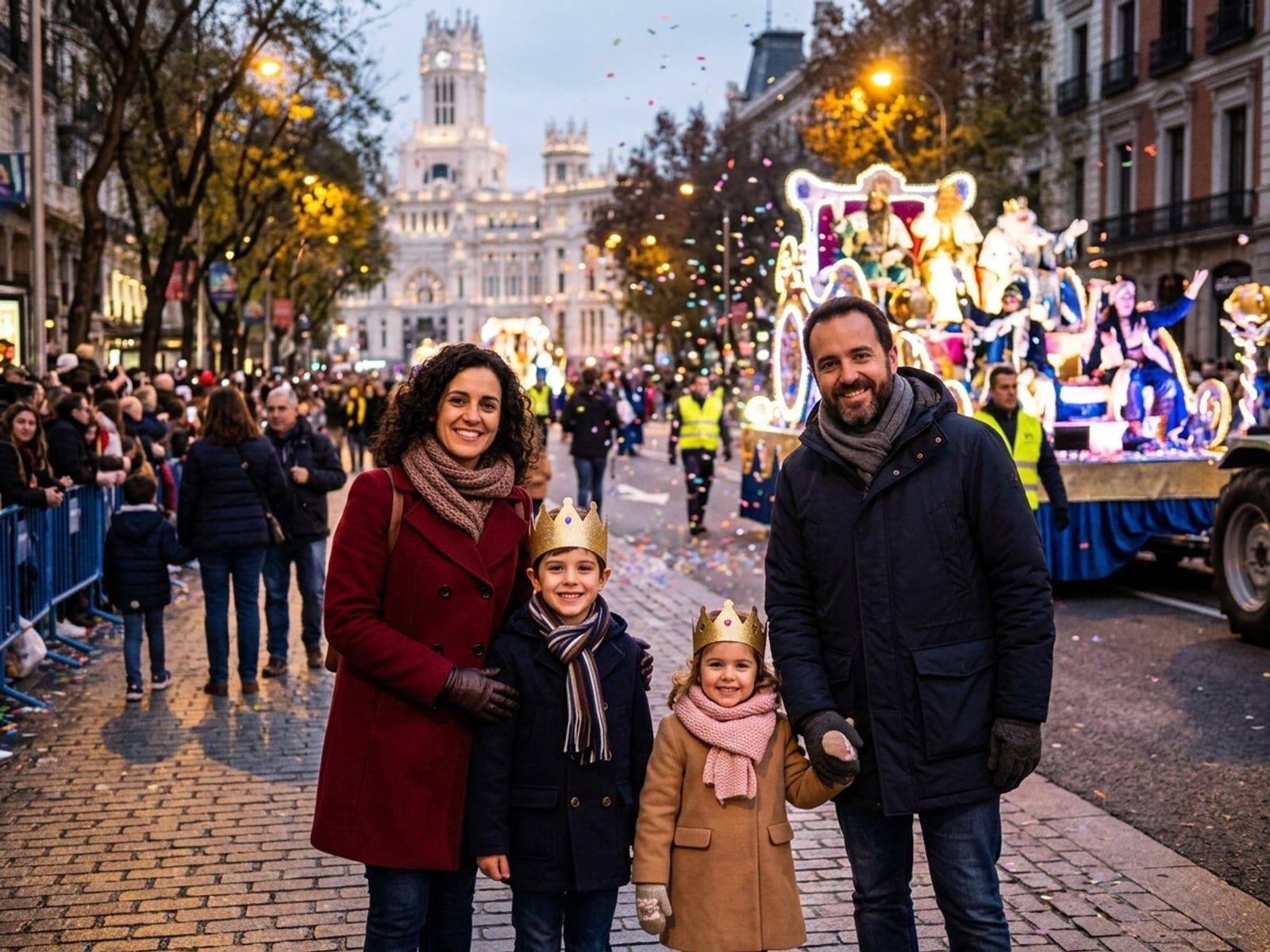
Madrid's Three Kings Parade, the Cabalgata de Reyes, is a procession of floats that rolls down Paseo de la Castellana to Plaza de Cibeles on the evening of January 5, the night before the Three Kings (Reyes Magos) bring children their presents, and candy is thrown to the kids along the route. For Spanish children this, not December 24, is the biggest night of the winter holidays. With small kids, the easiest plan is to watch from the northern end of the route near the start, where the floats pass earlier, wrapped up in gloves and hats against the cold.
The night the Kings arrive
The Bible tells of wise men from the East who followed a star to visit the newborn Jesus and offer him gifts. The Catholic Church remembers that visit on January 6, the feast of the Epiphany. In Spain, the ones who traditionally bring children their presents are the three Kings, Melchior, Gaspar and Balthazar. Children write them letters ahead of time listing what they'd like.
On the eve, January 5, towns all over Spain hold a cabalgata. The oldest one on record is said to be in Alcoy, a town in the province of Alicante, where the parade has run since 1885. Madrid had its own custom in the early 19th century: on the night of the 5th, people carried ladders to the city walls to announce the Kings' arrival, a tradition known as the "ladder festival" that is said to have later blended into the parade. Since 1964, the national broadcaster RTVE has shown Madrid's cabalgata on television every year, and watching it on TV has become a winter ritual of its own.
In 2026, a 6 p.m. start and a speech at Plaza de Cibeles
Madrid's 2026 cabalgata set off at 6 p.m. on January 5. The route ran south from Plaza de San Juan de la Cruz along Paseo de la Castellana and Paseo de Recoletos to Plaza de Cibeles. The Kings' floats reached the Cibeles Palace at around 9 p.m., where the Kings spoke to the children of Madrid, and a fireworks show set to music closed the evening.
Candy is thrown from the floats, around 1,200 kilos of it in total. Besides the Kings' floats, more than 250 royal pages walk in the procession. In 2026, the end of the parade also brought circus, magic and dance performances.
The route and start time can change from year to year. Check the City of Madrid's official announcements for that year's route and road closures.
With kids, watch near the start and dress for the cold
The cabalgata is one of the most crowded nights of the year in Madrid, and the area around Cibeles at the finish is especially packed. With small children, one option is to watch from the northern part of the route, near the start. The floats pass earlier there, so you can see everything and head back before the kids get sleepy. If you want to stay for the Kings' speech and the fireworks, pick your spot well ahead of time and plan on staying put.
Once the sun goes down, the streets get cold fast. Gloves, hats and a scarf to cover the neck are essentials, and since you'll be standing for a long time, choose shoes that keep feet warm. It's almost all standing room along the route, and once the crowd fills in, a stroller can't move forward or back. A baby carrier makes life much easier for little ones. Children chasing candy sometimes dart toward the road, so put the kids at the barrier with an adult right behind them, and split the jobs between whoever takes the photos and whoever keeps watch. A small bag for the candy they catch keeps pockets from getting sticky.
Restrooms and places to eat are hard to find once the parade begins, so take care of both beforehand. Afterward, rather than heading straight for the metro, wait a little until the crowd thins out. It's a much easier trip home with children.
If you have a baby or are worried about the evening cold, you don't have to go out at all. Madrid's cabalgata is broadcast every year on the evening of January 5 on La 1, the national broadcaster's main channel. Watching the Kings arrive on TV in your hotel room, and saving your energy for the next morning's presents and roscón, is a perfectly good way to spend the night.
The next morning, slice the roscón de reyes
On the morning of January 6, children find their presents set out next to their shoes. It's a public holiday, and families sit down together to eat the roscón de reyes. This ring-shaped sweet bread is flavored with orange blossom water and topped with brightly colored candied fruit meant to look like the jewels on a crown. Some versions are filled with whipped cream, custard, cabello de ángel (a sweet pumpkin preserve whose name means "angel hair") or chocolate truffle.
Hidden inside are a small figurine and a dried fava bean. Whoever finds the figurine is king or queen of the day, and whoever gets the bean pays for the roscón: that's the old Spanish way to play. This crowned cake is said to have come from France with Philip V, the first Bourbon king of Spain. A Spanish newspaper from 1848 already describes a large cake called the "torta de reyes." The version made with orange blossom water and candied fruit, as it's known today, is thought to have appeared around 1901.
There's no dress code, but deep red, navy or camel coats look good both under the lights of the floats at night and at the breakfast table the next morning. A gold paper crown on the kids suits the day well. You can see what your family would look like watching the parade on a wintry Madrid boulevard with pokesta's AI-generated photos ($1 per photo, and your first one is free). For ideas on taking photos at home, see our piece on Three Kings Day family photos.
Book early, and take the metro on parade day
The cabalgata is held every year on January 5, and January 6 is a national holiday. Madrid is busy with visitors from New Year through the 6th, so book accommodation early. To warm up before the parade, the old town, a walk west of Plaza de Cibeles, has cafés serving churros con chocolate, fried dough dipped in thick hot chocolate, and historic restaurants such as Botín and Lhardy that serve the winter stew cocido.
Adolfo Suárez Madrid-Barajas Airport (MAD) is about 12 km northeast of the city. Metro Line 8 takes around 12 minutes from Terminals 1 to 3, and just under 20 minutes from Terminal 4, to Nuevos Ministerios station. Using the airport stations adds a €3 airport supplement to the regular fare. Terminal 4 also has Cercanías commuter rail on line C-1, and an express bus links the airport with Atocha station and Plaza de Cibeles, near the end of the parade route. If you have big bags, it saves you a transfer. On parade day, the main avenues are closed to traffic, so the metro is the easiest way to get around the city.
Entry requirements for Spain vary by nationality, so check your own government's official guidance before you travel.
References