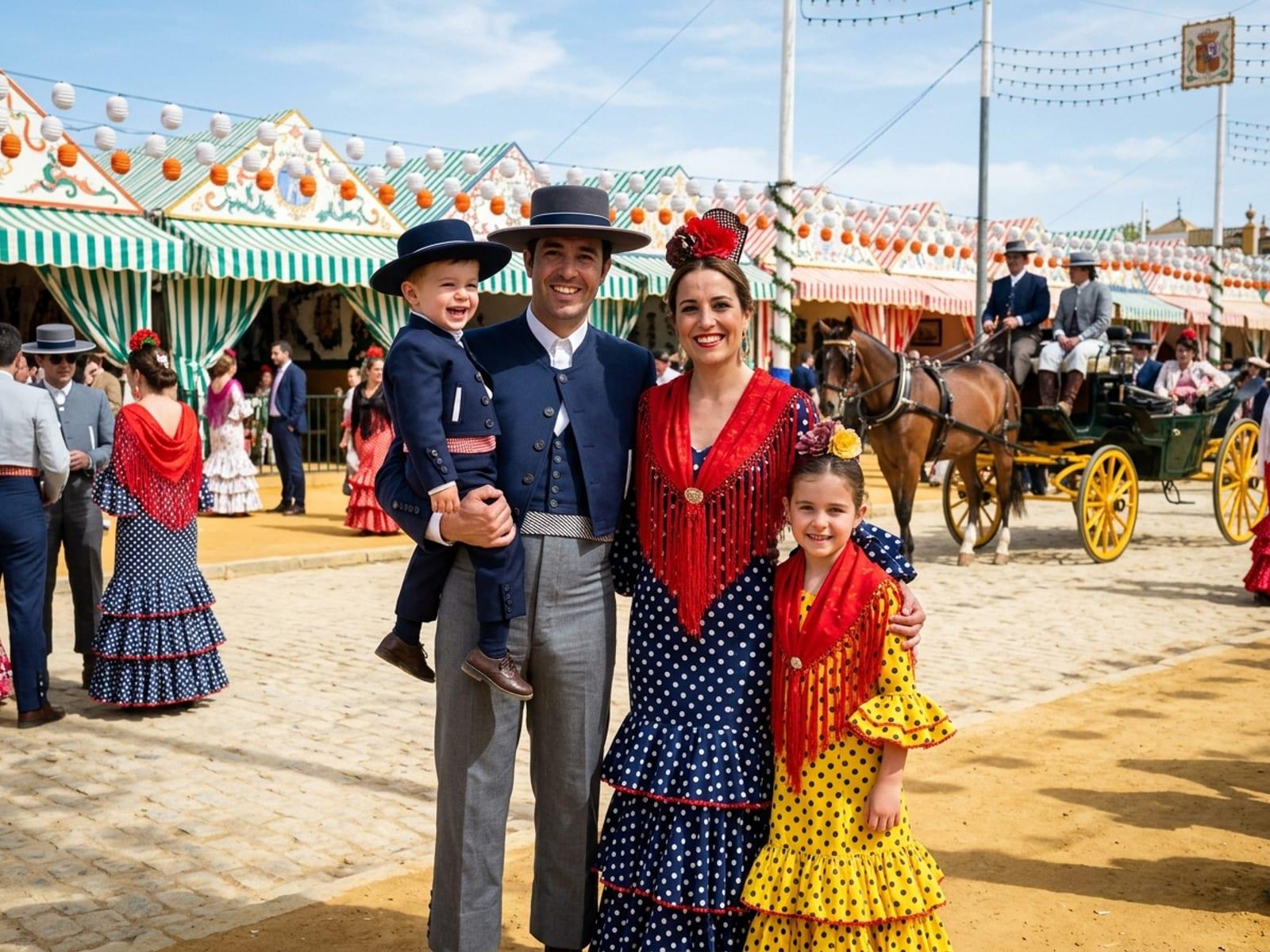
The Feria de Abril, or April Fair, is Seville's spring festival, held about two weeks after Easter, which means it sometimes slips into May. In 2026 it ran from April 21 to 26, and the city's tourism office lists 2027 as Tuesday 13 to Sunday 18 April. Most of the marquees on the fairground, the casetas, are private and invitation-only, but there are public ones anyone can enter, and the streets fill with women in ruffled flamenca dresses and horse-drawn carriages. Families usually do best between midday and early evening, when the carriages are out.
A livestock fair that became Seville's own party
The Feria grew out of a proposal made in 1846 by two city councillors, José María de Ybarra and Narciso Bonaplata, for an agricultural and livestock fair. The first one opened on 18 April 1847 on the Prado de San Sebastián, with 19 casetas. As people gathered to do business, it gradually turned into a festival of eating, drinking and dancing. Today hardly any trading is left; it's a week Sevillians spend with family and friends.
The fairground, called the Real, is a large site in the Los Remedios district in the southwest of the city, close to the Guadalquivir River, where the fair moved in 1973. Its streets are lined with more than 1,000 casetas (tents), each one home to a family, a group of friends, a company or an association.
The fairground streets are named after famous bullfighters. The ground is covered with albero, the yellow earth long used in Seville's gardens and bullrings, and after a day of walking, white shoes and dress hems take on a faint yellow tinge. Put the kids in shoes you don't mind getting dirty.
Easter sets the dates, and since 2025 it runs Monday night to Sunday
The Feria has no fixed dates. It's usually held about two weeks after Holy Week (Semana Santa), the week leading up to Easter, so it moves with Easter between late March and late April. In some years, such as 2025, the "April Fair" actually takes place in May.
The shape of the week has changed recently. From 2017 the fair started on a Saturday night and ended the following Saturday, but from 2025 it went back to the earlier format: six days, from the Monday night of the lighting to the Sunday. For 2027, that means lighting on Monday night, 12 April, and the close on Sunday the 18th.
The festival opens at midnight with the alumbrado, when the main gate (portada) and the countless light bulbs strung across the fairground are switched on all at once. The night of the lighting is called the pescaíto, and tradition calls for a dinner of fried fish. Small fried fish are a familiar taste all along the Andalusian coast, alongside Málaga's espetos, sardines grilled on skewers on the beach. Large portadas have been built since 1949, with a new design each year, often a city landmark; lit by thousands of bulbs, the gate is also the usual meeting point. On the final Sunday night, fireworks over the banks of the Guadalquivir bring the Feria to a close. Times can shift from year to year, so check with the City of Seville's tourism office.
Casetas are mostly invitation-only
Most casetas are private. They belong to families or members, and you need a member's invitation to get in. Someone usually stands at the door, and strangers may be politely turned away. In 2026, only 16 of the more than 1,000 casetas were public.
One of them is run by Seville's tourism office for visitors. According to the office, it's at 225–229 Pascual Márquez Street, with indoor and terrace seating, and terrace tables must be booked in advance at the tourist offices, by phone or by email. These details can change each year. At the other public casetas, you can go in if there's a free seat, so get there early at lunchtime. Inside, you'll be served manzanilla, a type of sherry, mixed with soda, along with cured ham and fried snacks, and circles form to dance sevillanas, Seville's folk dance, performed in four parts by couples facing each other. It plays non-stop from one caseta to the next.
Guided tours of the fairground in five languages leave from the portada kiosk at 1, 2:30, 4 and 5:30 p.m., according to the tourism office.
Flamenca dresses, and choosing one for a child
The dress women wear at the Feria is the traje de flamenca: a figure-hugging cut with tiers of ruffles, worn with a fringed shawl and a big flower in the hair. The dress is said to have taken hold after the 1929 Ibero-American Exposition, and traditional as it is, its styles change every year.
No one is required to wear one, but at the fair a great many women and girls do. Flamenca dress shops in Seville sell girls' dresses in a wide range of sizes, and some families buy one there for the day itself. The traditional outfit for men is the riding costume, with a short jacket, high-waisted trousers and a flat, wide-brimmed hat, though most men at the fair wear a jacket and tie. For visiting men and boys, a collared shirt and a jacket are plenty.
You can also see what the whole family would look like in these outfits before the trip, with pokesta's AI-generated photos ($1 per photo).
With kids, go between midday and early evening, when the carriages are out
The Feria is a festival of long nights, and the casetas stay lively well past midnight; since 2005 the lights have gone off at 3 a.m. on a normal night. For families, midday through early evening works best. Horse-drawn carriages may circulate only from noon to 8 p.m., on a set route through the eastern blocks of the Real, and there are no horses or carriages at night. This paseo of riders and carriages in their finery is a real treat for horse-mad kids. The carriages pass very close, so keep a firm hold of little ones' hands.
Next to the fairground is the Calle del Infierno ("Hell Street"), a funfair with more than 100 rides, described as the largest temporary amusement park in Spain. In 2026 it had quiet hours on Tuesdays, Thursdays and Fridays from 4 to 7 p.m., when music and ride sound effects were turned down or off for people sensitive to noise, a good window if your child finds loud noise hard.
The spring sun can be strong, so bring hats and water and rest in a shady caseta or your hotel in the hottest hours. Accessible toilets are set up around the fairground.
Seville by air or high-speed train, the fairground by bus or metro
Seville Airport (SVQ) is about 10 km east of the city center. An airport bus runs to the Plaza de Armas bus station in the center and takes about 40 minutes. If you're starting from Madrid, the high-speed AVE train runs from Madrid's Atocha station to Seville's Santa Justa station in about two and a half hours.
The metro stations closest to the fairground are Plaza de Cuba, Parque de los Príncipes and Blas Infante. In 2024, city buses run by TUSSAM served the fair on lines 5, 6, 41, C1 and C2, plus special shuttles from the Prado in the center, and the tourism office recommends the special Feria buses, which are wheelchair accessible. Routes and hours vary from year to year. The metro and buses get crowded at night, so decide early when to head back.
Hotels fill up early during the Feria and prices rise; counting two weeks on from Easter gives a rough idea of future dates, so book as soon as they're set. In years when the Feria falls in May, it's easy to pair it with Córdoba's Patio Festival, when residents open their flower-filled courtyards in the first half of the month. Entry rules for Spain vary by nationality, so look up your own government's official guidance before you travel.
References
- Visita Sevilla (Seville tourism office), "The April Fair" https://visitasevilla.es/en/the-april-fair/
- Visita Sevilla, "Feria de Sevilla 6 - 11 de mayo 2025" http://www.visitasevilla.es/wp-content/uploads/2025/04/Feria-2025_ESP.pptx.pdf
- Visita Sevilla, "Feria de Sevilla 21-26 abril 2026" https://visitasevilla.es/wp-content/uploads/2026/03/Guia-Feria-Sevilla.pdf
- Visita Sevilla, "Feria de Abril 2026 (English guide)" https://visitasevilla.es/en/wp-content/uploads/sites/2/2026/03/ENG_Feria-2026_compressed-1.pdf
- Wikipedia (Spanish), "Feria de Abril de Sevilla" https://es.wikipedia.org/wiki/Feria_de_Abril_de_Sevilla
- El Independiente, "Cómo llegar y salir en transporte público de la Feria de Abril de Sevilla" (April 2024) https://www.elindependiente.com/tendencias/2024/04/13/como-llegar-y-salir-en-transporte-publico-de-la-feria-de-abril-de-sevilla/
- Wikipedia, "Sevillanas" https://en.wikipedia.org/wiki/Sevillanas
- Andalucia.com, "Seville Feria - Feria de Abril" https://www.andalucia.com/festival/seville-feria.htm
- Wikipedia, "Seville Fair" https://en.wikipedia.org/wiki/Seville_Fair
- Renfe, "Train AVE Madrid to Sevilla" https://ocio.renfe.com/en/renfe/tren-ave-madrid-sevilla
- Wikipedia, "Seville Airport" https://en.wikipedia.org/wiki/Seville_Airport