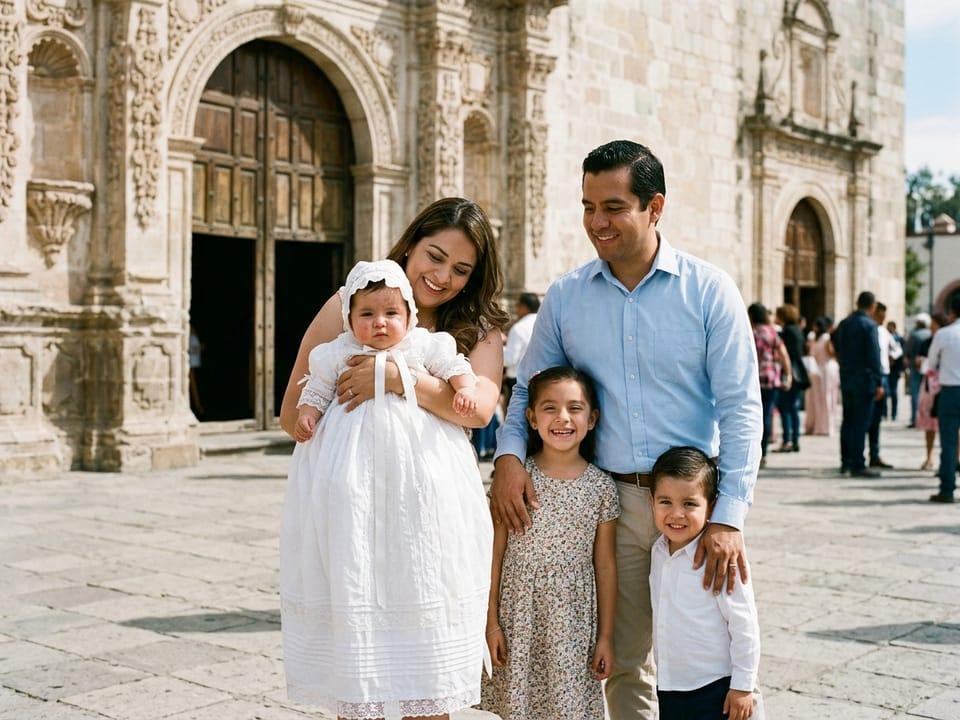
A baptism outfit for a baby has one real requirement: it should be white. The length, the lace, the matching bonnet and shoes are family custom and taste, which is good news for the budget. Before you buy anything, find out what the outfit is called where you're shopping, whether a padrino is planning to pay for it, and whether there's already one folded away in the family. Then fit it to the baby on the day, and dress the adults so the white stands out.
The rite asks for white, not for a particular gown
In the Catholic rite, after the water and the anointing, the child is clothed in a white garment. The Catechism of the Catholic Church explains that it symbolizes that the baptized person has "put on Christ" and risen with him. That meaning has nothing to do with price: a plain white cotton romper carries it as fully as a hand-embroidered silk gown.
Parishes differ in the details, so ask when you register whether the baby should arrive in white and whether the parish places a white cloth on the child during the rite. The Catechism also describes water poured three times over the head and an anointing with chrism, so a damp neckline with a trace of oil is normal. An outfit that opens easily at the neck and back is kinder to the baby, and to the fabric, than one with a high, tight collar.
Ropón in Mexico, faldón in Spain
The same white outfit goes by different names. In Mexico the classic is the ropón de bautizo, a long white gown, with a bonnet and soft shoes if you want them. In Spain you'll hear faldón. Spanish Wikipedia defines it as a skirt for babies that covers them from the waist to the feet, and notes that for a baptism the classic choice is a longer, richer one than the everyday kind, traditionally borrowed from a relative or inherited from earlier generations. If you're shopping in Peru or for a Spanish-speaking parish in the US, search under both words; US stores also list the same thing as a "christening gown" or "baptism outfit."
The difference matters when you borrow. A faldón hangs from the waist, so its length is forgiving and only the top worn with it has to fit. A one-piece ropón has to fit at the chest, shoulders and sleeves. If an heirloom faldón comes with a top that's too small, a new white body or blouse underneath may be all you need.
Climate matters as much as vocabulary. A July baptism in an Andean town, a winter one in northern Spain and an August one in Texas call for different fabrics: lined satin and tulle are warm, cotton and linen breathe. In a cold church, plan a white cardigan or knitted shawl that comes off for the photos. Our guide to DIY baptism photos at home covers keeping the baby comfortable and settling them safely to sleep afterwards.
Ask who's buying before anyone buys
In Mexico the outfit may not be the parents' purchase at all. TV Azteca Jalisco, describing what padrinos traditionally give, mentions buying the ropón for the godchild, alongside throwing the bolo of coins to the children at the party. The same article notes that Church law doesn't oblige godparents to give anything, and that a saint's medal is a common gift. Other families, in Mexico and elsewhere, simply buy it themselves.
Since customs vary, the cheapest step is a conversation. If a padrino or madrina wants to buy it, share the baby's measurements, the date and the style you have in mind, so it doesn't arrive two sizes small or clash with the family bonnet. If there's already a family gown, say so early. The padrinos can give the medal, the candle or the shoes instead, and nobody pays twice.
Borrow first, then secondhand, then simple new
A baby wears a baptism outfit for a few hours, which is why borrowing works so well. Ask grandparents, aunts and friends whose children were baptized recently, agree who pays for cleaning and when it goes back, and photograph its condition when you collect it. For older heirlooms, our guide to christening gowns on a budget explains how to check and store one without damaging it.
Secondhand comes next. Most white outfits are worn once, so a used ropón or faldón can be in excellent condition. Check it in daylight for yellowed folds, missing buttons and loose lace, and ask for the garment's actual measurements rather than the age on the label.
New, the price climbs with the fabric, with hand embroidery or lace, and with the number of matching pieces. A simple cotton ropón without bonnet and shoes costs far less than a full set, and a white romper less again. Prices in pesos, euros, soles or dollars vary by region, season and shop, so compare complete sets item by item. Spending more makes sense when the family wants a gown to hand down, or when an heirloom is too fragile or stained to wear; then a seamstress or textile conservator is a better use of money than another gown.
Fit the baby on the day, not the label
Babies grow quickly, so buy or borrow close to the date, measure the baby's chest and length a week or two before, and compare with the garment's own measurements. Leave room for a thin white body underneath, and check the sleeves don't swallow the hands. Tiny buttons down the back are lovely and slow on a wriggling baby; snaps are faster. If the shoes pinch or fall off, white socks are fine.
A crawling or walking child catches a floor-length ropón under knees and feet. A shorter white dress, a romper, or a white shirt and trousers makes for a happier morning, and the long gown can come out for one held photo. The traje de bautizo for boys covers the same range: a small white suit with a vest and bow tie, a collared romper, a guayabera-style romper, or the family gown, which suits a boy as well as a girl. The cheapest good option is usually a well-fitting white romper he can wear again.
Leave the white to the baby
What the adults wear decides whether the baby stands out. A Spanish etiquette expert interviewed by El Debate in 2026 advised formal or semi-formal dress for a baptism: light or mid-tone suits for men, day dresses or smart sets in soft or neutral colors for women, no shine or sequins. Pure white, she said, is usually reserved for the baby, and sometimes the mother.
That suits the camera. Beside a white gown, navy, grey, soft blue, sage or dusty pink keep the lace visible, while a white shirt right next to the baby swallows it. Parents and padrinos needn't match, but two or three agreed colors make group photos calmer. Give the plainest clothes to whoever will hold the baby most. If your family's custom is for everyone to wear white, pick a darker background, such as a church door or a hedge. Our guide to baptism photos with the padrinos covers where everyone stands.
If a padrino can't travel, pokesta can create a family photo of everyone in baptism clothes with AI from each person's own phone photos, at $1 per photo with the first one free. Other families' outfits are on the baptism posts page.
References