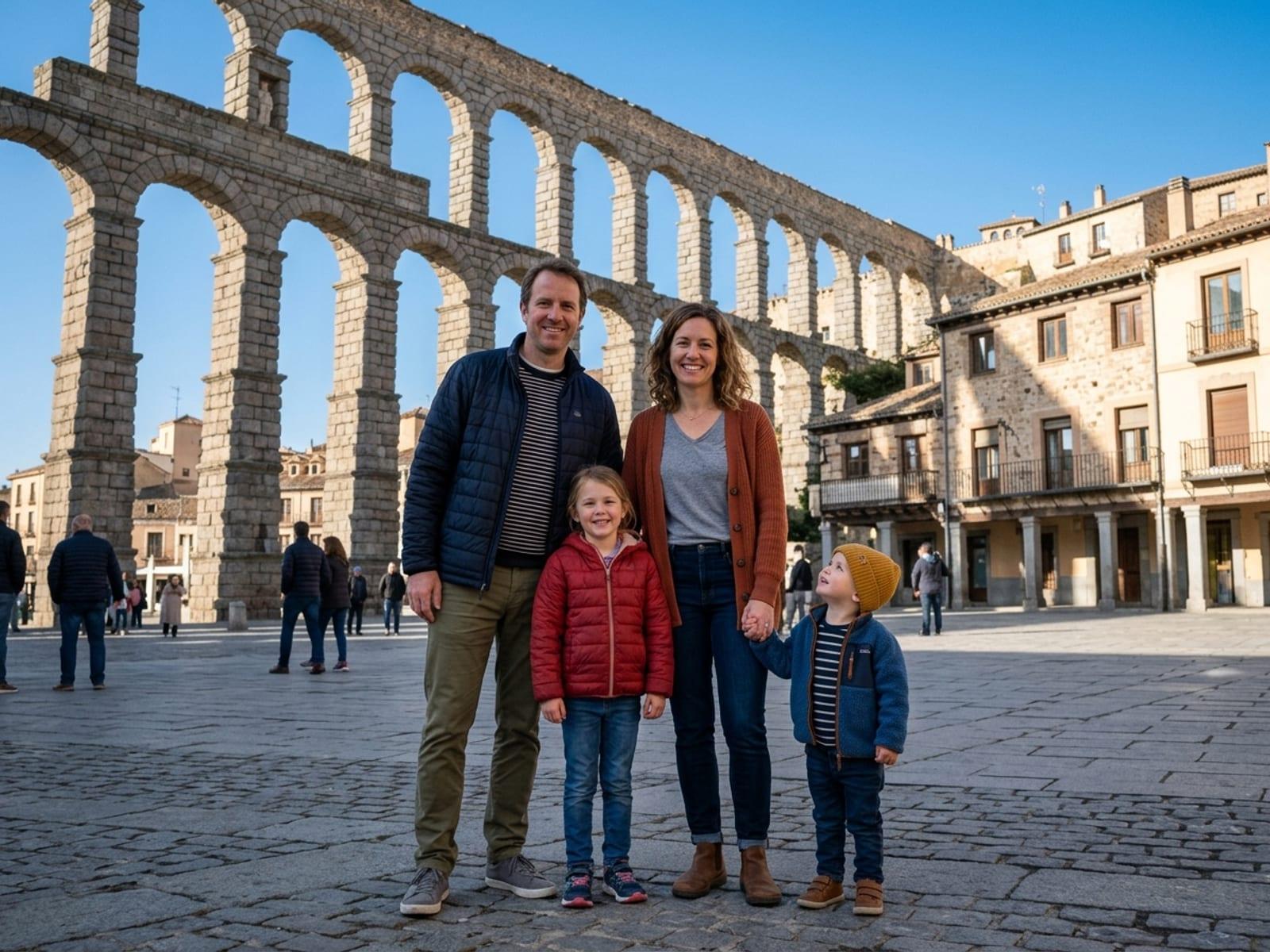
Segovia, a town on the high plateau northwest of Madrid, is known for its roughly 1,900-year-old Roman aqueduct and the Alcázar castle on the cliff at the western tip of its old town, all added to UNESCO's World Heritage list in 1985. The high-speed train from Madrid's Chamartín station takes about 30 minutes, so it's an easy day trip, and the old town is small enough to walk from the aqueduct in the east, past the cathedral, to the Alcázar in the west. With children, see the aqueduct in the morning and the Alcázar after lunch, and decide before you set off whether you'll climb the tower's 152-step spiral staircase.
Stand in the square and two tiers of gray stone arches stride across the sky above you, more than 28 meters high at the tallest point.
167 arches, no mortar
The aqueduct was built to carry water from a spring in the mountains, about 17 km from town, along a channel of about 15 km. The part everyone notices is the raised section that crosses the valley just before the town, with 167 arches. At its highest it measures about 28.5 meters, including the foundations. It's built of granite blocks stacked without mortar or any other binder, held up only by the weight of the stones and the shape of the arches.
Nobody knows exactly when it was built. One view puts it around the end of the 1st century, while a study in 2016 suggested a date a little after 112 AD. The raised section changes direction sharply at the Plaza del Azoguejo, which is the best place to look up at the aqueduct from close quarters.
The source is the Fuenfría spring in the mountains, and the aqueduct actually carried water into the town until 1973. On the side nearest the old town, 44 sets of arches stand in two tiers, one above the other. Part of it was damaged in the Middle Ages, and in the late 15th century, under the Catholic Monarchs, 36 arches were rebuilt under the direction of the prior of a nearby monastery. Roughly in the middle of the double arches is a small niche in the wall that is said to have once held a statue of Hercules. Today it holds a figure of Our Lady of Mount Carmel, which was replaced with a resin copy in 2019; the original is kept in the museum in the town's old mint.
The town also has a legend about the aqueduct. A girl, tired of carrying water up the hill every day, asked the devil to spare her the chore and struck a deal with him. But the rooster crowed before the devil finished the job, and the bargain came to nothing. Tell your children the story before you look up, and the arches may look a little different.
Let the kids see for themselves, up close, that there is nothing at all between the stones. Standing at the foot of an arch shows you how big it is, and comparing it with an adult's height helps a child grasp what 28 meters really means.
West along the old town's ridge to the cathedral
From the aqueduct, cobbled streets climb gently into the old town toward its center. The town sits on a long, narrow ridge between two rivers, and old stone houses and churches line the streets on either side.
In the middle of town stands the cathedral. Its first stone was laid on June 8, 1525, and work continued in several stages until 1685. It's a late Gothic building with a tower nearly 90 meters tall, a landmark you can see from anywhere in town. If the children are flagging after the climb from the aqueduct, take a break around the cathedral before heading on to the castle.
The clifftop Alcázar and its 152-step tower
At the western tip of the old town, on a rock where the Eresma and Clamores rivers meet, stands the Alcázar. The castle is on record by 1120, and it served the kings of Castile as a fortress and palace. In 1474, Isabella I took refuge here before being proclaimed Queen of Castile. In 1764 it became the Royal Artillery School, and after a fire on March 6, 1862 destroyed its ceilings and more, it was restored. Today it houses an arms display and the Spanish army's oldest historical archive. One of the palace rooms is called the Hall of the Galley because its wooden ceiling looks like the upturned hull of a ship. Looking up with your children to find the shape of the boat is a fun way to see it.
The visit takes you through the palace and its displays and lasts about 40 to 45 minutes. The Tower of Juan II, built in the first half of the 15th century, needs a separate ticket, and its spiral staircase has 152 steps. It isn't accessible to people with reduced mobility, and children can't go up on their own. Visits to the tower are limited to 25 minutes, and tickets that include it can sell out, so buy early if you want to climb. Carrying a small child up and down a steep spiral staircase is hard going, so decide based on your children's age and stamina. Visitors under 16 must be accompanied by an adult.
Opening hours are 10 a.m. to 6 p.m. from November 1 to March 31, and 10 a.m. to 7:30 p.m. from April 1 to October 31 (according to the official website as of October 2026). Ticket sales close 30 minutes before closing time, and it's closed on December 25. Prices and special opening days can change, so check the official website before you go.
The order to walk it, and what to wear with kids
The route that works best is east to west: the aqueduct in the morning, the uphill walk to the cathedral, then the Alcázar after lunch. Lunch in Spain is late, around 2 p.m., so either grab an early snack near the cathedral or shift your Alcázar visit around lunchtime, so hungry children don't grind to a halt. To get back, retrace your steps or take a bus or taxi to the station. With cobbles and slopes all the way, a baby carrier is often easier than a stroller.
Segovia sits high up and can feel colder than Madrid. Even in spring and autumn, mornings and evenings are chilly, so bring a jacket that's easy to take on and off. In summer the sun is strong, and in the squares with little shade, hats and water are a must.
pokesta's AI photos ($1 per photo) can also make a picture of your family looking up at the double stone arches.
Getting there from Madrid
International flights land at Adolfo Suárez Madrid-Barajas (MAD). From Madrid, high-speed trains run from Chamartín station to Segovia-Guiomar in around 30 minutes. That station is some way from the town center, so take a bus or taxi to the area near the aqueduct. Long-distance buses from Madrid are another option. Check train and bus times and fares on each operator's official website.
If you're staying in Madrid, balance the day out of town with a city day at historic restaurants like Botín and Lhardy or a breakfast of churros con chocolate, and the kids won't wear out. Entry requirements for Spain depend on your nationality, so check your own government's official information before you travel.
References