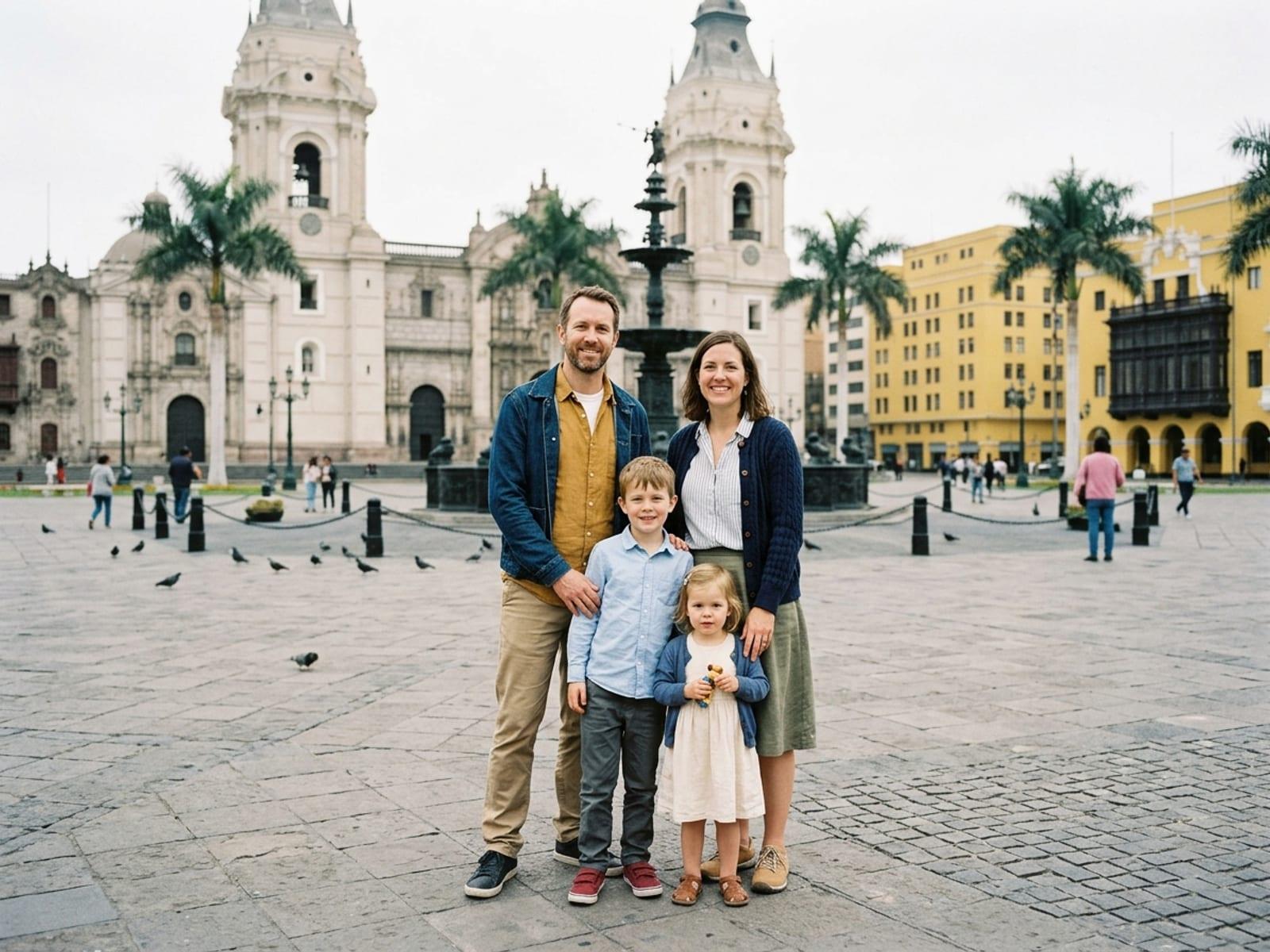
The Historic Centre of Lima is the old town of Peru's capital, founded by the Spanish in 1535, and its cathedral and palaces around the Plaza de Armas, its carved wooden balconies and the catacombs of the San Francisco Monastery are listed by UNESCO. With children, a half day works well: the square and the monastery in the morning, lunch in Chinatown and a rest at your lodging, then, after dark, the Parque de la Reserva, where 13 fountains move to light and music. The catacombs are dim and lined with bones, so tell young children what to expect before you go in.
The "City of Kings," founded in 1535
Lima began on January 18, 1535, when the Spanish conquistador Francisco Pizarro chose the site for the Ciudad de los Reyes, the City of Kings. Close to the Pacific, on the banks of the Rímac River flowing down from the Andes, it flourished as the center of Spanish colonial rule. The Rímac runs along the northern edge of the old town and is crossed by a stone bridge, the Puente de Piedra. The far bank lay outside the old city walls, and mansions such as the Quinta de Presa still stand there. The University of San Marcos was founded in 1551 and began teaching in 1553, and the Inquisition was established in the city in 1570.
UNESCO first listed the Monastery of San Francisco in 1988, then extended the site to the whole historic center in 1991. The listed area covers about 278 hectares and contains more than 600 historic buildings. The city has been hit by major earthquakes many times and rebuilt after each one. At San Francisco alone, the central dome collapsed in the 1940 earthquake and was restored in 1969, and the sacristy ceiling that fell in the 1966 earthquake was restored in the 1990s.
Start at the Plaza de Armas
The center of the old town is the Plaza Mayor, also called the Plaza de Armas. Peru's independence was proclaimed here in 1821, and a bronze fountain installed in 1651 stands in the middle. Around the square are the Government Palace, the Municipal Palace, the cathedral and the Archbishop's Palace. Large carved wooden balconies project from the front of the Archbishop's Palace, one of the defining views of old Lima.
These wooden balconies (balcones) aren't only on the Archbishop's Palace; they survive on buildings all over the old town. Some are enclosed boxes projecting from the wall, others are open with just a railing. Make a game of spotting them with the kids and the old streets hold their attention far longer.
In 2010 the guard ceremony of the Hussars of Junín, the cavalry regiment then serving as the presidential escort, was declared part of Peru's national cultural heritage. Whether a changing of the guard takes place at the Government Palace, at what time and where you can watch from may change for security reasons, so check on the day.
The catacombs of San Francisco
The Monastery of San Francisco stands at the corner of Jirón Áncash and Jirón Lampa, a short walk from the Plaza de Armas. The present church was rebuilt after the great earthquake of 1655 and consecrated in 1672.
The highlight is the catacombs beneath the monastery. They served as a cemetery during the colonial era until 1810, and it is estimated to have held up to about 25,000 people. You can still see bones arranged by type. The monastery has much more to see as well: a library of about 20,000 volumes, including books from the 15th to 18th centuries and more than 6,000 parchment documents; 130 choir stalls carved in cedar; a room hung with eleven large paintings of the Passion of Christ attributed to the workshop of Rubens; and the friars' refectory, with paintings of the apostles and a large Last Supper. At independence in 1821, the friars are said to have signed the declaration of independence in the monastery's chapter house.
The catacombs are narrow and dim, and full of bones. For small or easily frightened children this can be too much, so tell them what to expect beforehand and don't push if they don't want to go in. The monastery is still a place of worship, so keep quiet inside the church.
In the evening, fountains with light and music
A short drive south of the old town, in the Santa Beatriz district, is the Parque de la Reserva. Created in 1929, it reopened after restoration in October 2000, and on July 26, 2007, the Circuito Mágico del Agua (Magic Water Circuit) opened there. Its 13 fountains are computer-controlled and move in time with lights and music. Guinness World Records has recognized it as the largest fountain complex in a public park in the world.
The tallest, the Fuente Mágica (Magic Fountain), shoots water more than 80 m high. There's the Tunnel of Surprises, a water tunnel 35 m long that you walk through, and a fountain for children, and at the 120 m Fountain of Fantasy, a show of projected images and lasers runs at set times.
The fountains light up after dark, so the easy rhythm with children is to walk the old town by day, rest at your lodging, then head out in the early evening. If you plan to play in the water tunnel or the children's fountain, bring a change of clothes and a towel. A butterfly house (mariposario) opened in the park on November 10, 2024, and payment there is said to be in cash only, in Peruvian soles. Opening days, hours and admission fees can change, so check the latest information before you go.
Walking the old town with kids
The old town is busy with people and heavy traffic. Hold your children's hands and carry valuables in front of you. Don't walk along with your phone in hand, and stay aware of your surroundings when taking photos. Avoid wandering the old town at night with children; use taxis or ride-hailing apps to get around.
Here's one way to spend a half day. In the morning, look at the balconies and the fountain on the Plaza de Armas, then walk to San Francisco. Have lunch in Chinatown, go back to your lodging in the afternoon for a nap or a rest, and after dark head to the fountain park, watch the light show and get back early. Don't try to cram everything in; taking the sights one at a time while the kids are still in a good mood is the way to enjoy the old town. On a Sunday, start the day the Lima way with a breakfast of pan con chicharrón and tamales before you set out.
For lunch, the chifas of Chinatown, inside the old town, are an easy choice. To see what your family might look like lined up in front of the cobbled square and wooden balconies, you can try pokesta's AI photos ($1 per photo, and your first one is free).
When to go and getting there
You can visit the Historic Centre of Lima at any time of year. In October, the Señor de los Milagros procession, with people dressed in purple carrying a sacred image through the old town, makes the streets even livelier. The international gateway is Jorge Chávez International Airport (LIM), and from there you'll take a taxi or similar to the old town. Opening hours and visitor rules at the sites can change, so check official information before you go. Entry requirements for Peru depend on your nationality, so look at your own government's official guidance before you travel.
References