Black and white wool, knitted into an eight-petaled motif that looks like a snowflake. That motif is called the selburose, the Selbu rose, and it spread from selbuvotter, the mittens of Selbu, a small village in central Norway. It's said to be the most widely worn knitting pattern in Norway, and because it looks like a snowflake or a star, it has become known around the world as a symbol of the Nordic countries, of winter and of Christmas. Visit the village where it comes from and you'll find a history of women's working lives behind the pattern. Selbu is about 70 km east of Trondheim, and the local museum shop sells mittens and local yarn; with children, taking yarn home to knit something small together lasts longer than buying a pair they'll soon outgrow.
1857: a girl knits a pair of mittens
Selbu mittens go back to 1857, when a village girl, Marit Guldsetbrua Emstad, knitted the first mittens with a pattern worked in two strands of yarn. Born in 1841, Marit is said to have taken three pairs of patterned mittens to church, and Visit Norway puts her age at the time at around 15 or 16.
Marit didn't invent the eight-petaled rose itself, though. It appears in 16th- to 18th-century knitting pattern books from Italy, France, Switzerland and Germany, and in Norway it was already used before 1857 on sweaters from the west of the country based on Danish patterns. What Marit did was work it into two-color mittens and set off a fashion that swept the village. Selbu's municipal coat of arms, adopted in 1991, shows three Selbu roses.
Marit's mittens quickly caught on in the village. From 1897, Selbu mittens were sold at Husfliden, a handicraft shop in Trondheim, and after 1910 the trend spread nationwide through Norway's handicraft associations. By the 1930s, Selbu alone is said to have produced around 100,000 pairs a year. In the decades when Norway was working its way to independence from its union with Sweden, people were looking for things that felt distinctly Norwegian, and this homegrown pattern is thought to have benefited from that mood.
At the peak, in the 1930s and 1940s, around 3,000 knitters are said to have relied on mittens as their main income. Knitting gave the women of Selbu a way to earn their own money and some independence. During the Second World War, members of the Norwegian resistance wore Selbu mittens with the royal coat of arms knitted into the pattern.
Mittens as wedding gifts
Selbu mittens were also closely tied to marriage. A bride knitted mittens for her wedding guests, and girls are said to have started knitting mittens from an early age for a future husband and for guests. A single pair took time, patience and skill, and mittens were part of a bride's trousseau. According to Visit Norway, at weddings in the past every male guest received a pair, and the mittens were displayed in the bridal loft (brudeloftet) during the celebrations, which lasted three to five days.
In 2014, Selbu mittens entered Guinness World Records as the world's largest hand-knitted mittens. Each one measures 237 cm long and 97.5 cm wide, well over the height of an adult, and 68 women knitted them from 5.5 kg of yarn.
How to recognize genuine Selbu mittens
Selbu mittens follow some long-kept rules of form. Visit Norway lists these features:
- The back of the hand and the palm have different patterns
- A column-like pattern called the "stolpe" runs up each side where the back meets the palm
- A gusset called the "kile" sits at the base of the thumb
- They are traditionally black and white (colors are much freer today)
- Men's mittens usually have a pattern on the cuff too, while women's often have striped cuffs
The local handicraft center Selbu Husflidscentral still names two yarns for genuine Selbu mittens: yarn from Selbu's own spinning mill and yarn from the Norwegian maker Rauma.
You'll see plenty of "Norwegian pattern" mittens on your travels. With the features above in mind, it becomes easier to tell whether a pair keeps to the traditional form.
Seeing and buying them in Selbu
Selbu lies about 70 km east of Trondheim. It had about 4,200 residents in 2024 and takes its name from Selbusjøen, a lake of about 60 square kilometers. The place to visit is the local museum, Selbu Bygdemuseum, in the old vicarage next to Selbu Church, where a display shows old Selbu mittens. The museum also lies on the Romboleden pilgrim route.
On the same site is Selbu Husflidscentral, a handicraft center devoted to preserving local craft, especially Selbu's two-color knitting. The museum shop stocks Selbu mittens in various colors and patterns, as well as yarn from Selbu and elsewhere in Norway. Whether knitting classes or guided visits are available, and when they're open, varies through the year, so the safest thing is to phone ahead.
Making it fun for children
A pair of hand-knitted Selbu mittens takes a long time to make. Children's hands grow fast, so instead of buying a child-sized pair, you might choose one adult pair for the family to wear in photos, or buy yarn and a pattern and try knitting something small at home. Two-color knitting is a bit tricky for beginners, so have an adult start with a small piece like a hat or a coaster and let the children pick the yarn colors. That way the trip carries on once you're home.
The Selbu rose isn't only for mittens. It also appears on the traditional Norwegian lusekofte sweater, and on the Marius sweater. If choosing mittens feels too hard, a hat or sweater with the pattern is a good alternative.
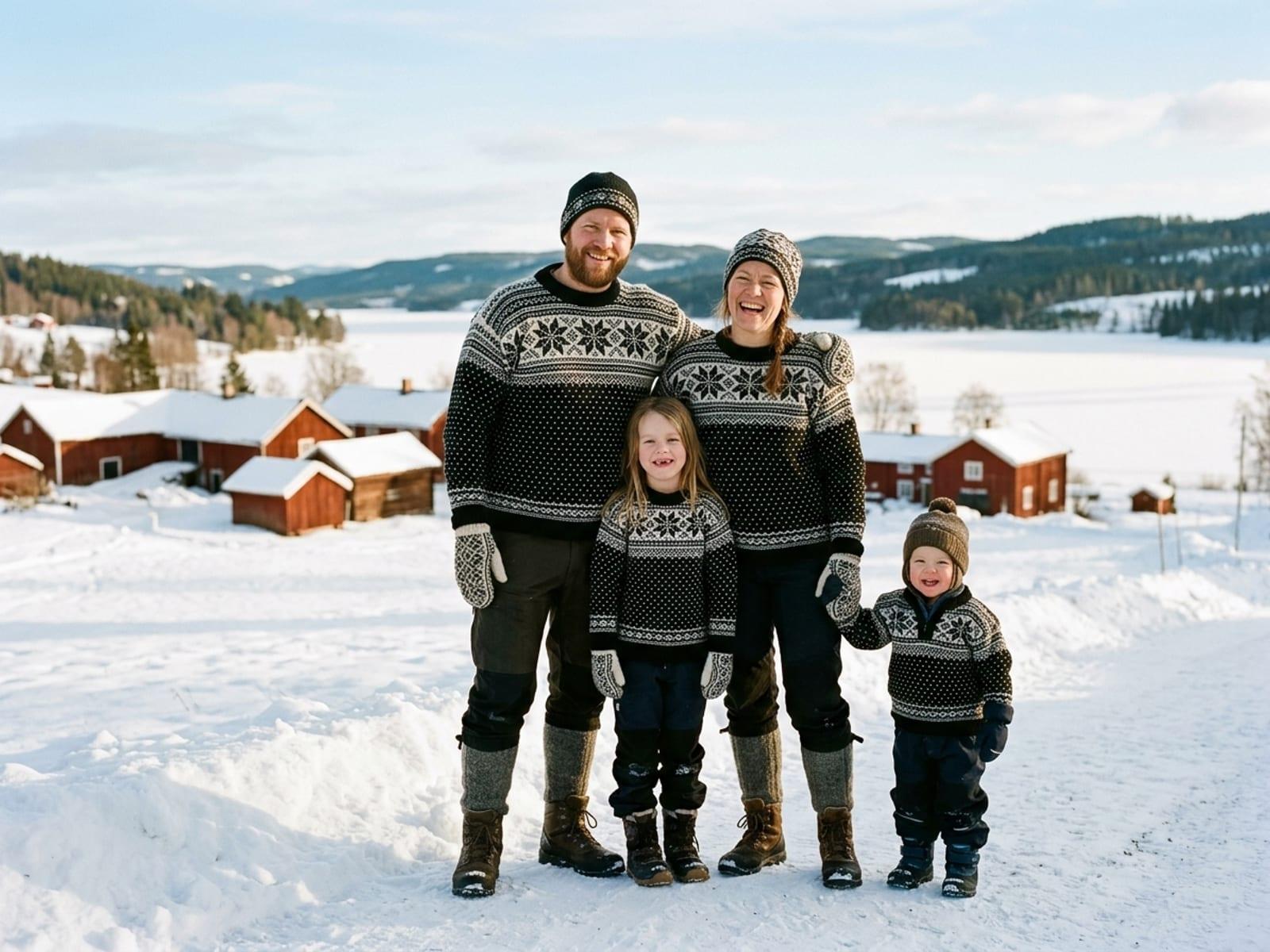
For photos, matching family knits or mittens in the Selbu pattern stand out against a snowy village or a frozen lake. To see how a family photo in matching Selbu patterns might look, you can try pokesta's AI photos ($1 per photo, and your first one is free).
When to go and how to get there
The nearest airport is Trondheim Airport Værnes (TRD). Driving is the easiest way to reach Selbu. Winter, when you might sit in the snowy stands at the Holmenkollen ski jump in March, is when the mittens really come into their own, but you can visit the village outside the snow season too. Check opening days for the museum and shop in advance. If you're traveling in central Norway in summer, you can pair a visit with the July festival at Stiklestad and its open-air play about St. Olav.
References