From a mountain station 866 meters above sea level down to the edge of a fjord takes about an hour. Norway's Flåm Railway, Flåmsbana, is a 20.2 km mountain line that winds its way down a steep valley. Sheer rock walls, waterfalls and farms on the valley floor slide past the windows one after another, and at one stop you can step out right in front of a huge waterfall. It slots easily into a rail journey between Oslo and Bergen, and it gives children the experience of watching the scenery change just by sitting on a train.
Down the valley through 20 tunnels
The Flåm Railway is a branch line. It leaves the Bergen Line, which links Oslo and Bergen, at Myrdal station and runs to the village of Flåm at the head of the Aurlandsfjord, an arm of the Sognefjord. According to the English-language Wikipedia, it is 20.2 km long and descends from 866 meters at the top of the valley to almost sea level. The steepest gradient is 5.5 percent, meaning a drop of 55 meters for every 1,000 meters traveled. Norwegian Wikipedia says about 80 percent of the line is at this steep gradient.
There are 20 tunnels with a combined length of 5.7 km, more than a quarter of the route, and 18 of them were dug by hand. The idea of running a railway down to the fjord was first put forward in 1871. Parliament approved construction in 1909, work began in the 1920s, and steam trains started running in 1940. The line was electrified in 1944.
Where the line doubles back inside the mountain is an 888.6-meter tunnel near Vatnahalsen, which loops around at several levels to ease the gradient. The longest is the Nåli tunnel, at 1,341.5 meters. The river in the valley crosses the line three times, but instead of building bridges, the engineers routed the river through tunnels under the tracks. Know these tricks before you board, and every tunnel becomes a chance to guess with the kids where in the mountain you are right now.
Today it's a tourist line, carrying close to a million passengers in 2016 and 940,000 in 2019. The Norwegian rail company Vy operates the trains, while a company owned by local municipalities and others runs the passenger business.
Stepping off at Kjosfossen, the waterfall stop
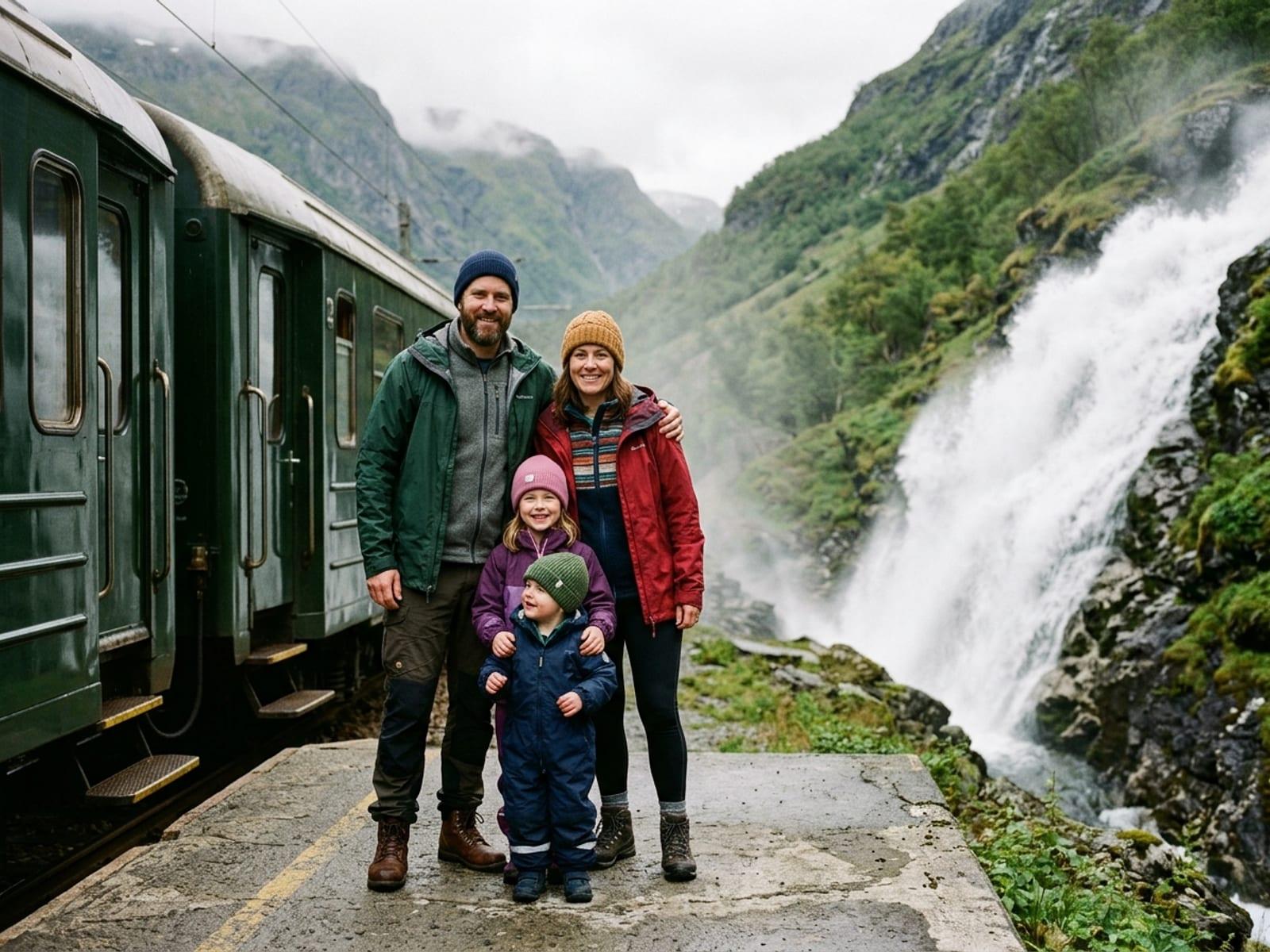
The highlight of the journey is Kjosfossen station. It sits at 670 meters, opened in 1951, and has a huge waterfall pouring down right beside it. The station exists for the waterfall, and you can watch it up close from the platform. Spray carries on the wind, so keep your camera or phone from getting wet.
The platform fills up with people looking at the falls. Keep hold of small children's hands, and listen out for the signal to get back on the train. The stop is short, so plan to take your photos and head straight back aboard.
Down or up, and which side to sit on
You can ride the Flåm Railway in either direction: down from Myrdal to Flåm, or up from Flåm to Myrdal. One good plan is to come to Myrdal on a Bergen Line train, ride down to Flåm, and carry on to the next town by fjord boat or bus. That way the scenery runs on from mountain to fjord, and you never retrace your steps.
The view differs on each side of the train, and which side has the best of it changes as the valley turns. As a family, you can split up across the aisle by the windows on both sides and point things out to each other. The summer season is busy, so buy tickets early and secure your seats. Fares, the number of departures and how seat reservations work vary by season, so check the operator's official website.
The old station building in Flåm houses the Flåm Railway Museum, which according to Norwegian Wikipedia is free to enter. It tells the story of the line, so it's a good place to look around with the kids while you wait for your train.
Cold at the top, dark in the tunnels
The ride takes about an hour, so even small children reach the bottom before they get bored. Still, there's more than 860 meters of difference in altitude between Myrdal station in the mountains and Flåm on the fjord. Waiting to change trains at the mountain station can feel chilly even in summer, so bring layers. The carriages go dark on the stretches with one tunnel after another, so if your child doesn't like the dark, tell them in advance that there will be lots of tunnels.
Flåm is a small village of about 300 people. The valley still has Flåm Church, built in 1670, and it's the birthplace of the poet Per Sivle. Yet according to the English-language Wikipedia, it receives close to 450,000 visitors a year and around 160 cruise ships call there. Trains get crowded when cruise passengers arrive, so consider an early morning or evening departure. In October 2014 heavy rain damage shut the line for about four weeks, and mountain railways can be affected by the weather. If bad weather is forecast, check service information the day before.
From Flåm you can take a boat to the Nærøyfjord, a World Heritage Site. The Nærøyfjord is one of the fjords inscribed by UNESCO in 2005 as the West Norwegian Fjords. It's about 17 km long and only about 250 meters wide at its narrowest. Boats between Flåm and Gudvangen pass through the Aurlandsfjord and the Nærøyfjord.
If the stop is too short to get everyone lined up in front of the falls, pokesta's AI photos ($1 per photo, with your first one free) can put the whole family on the platform afterward.
When to go and how to get there
The number of Flåm Railway departures varies a lot by season and peaks in the summer tourist season. Summer, with its deep green valleys and long days, is the most popular time. Travel between mid-May and mid-June and your trip can also overlap with apple blossom season in the Hardanger orchards, elsewhere in western Norway. Once your dates are set, check the timetable on the operator's official website.
The gateway airports are Bergen Airport (BGO) and Oslo Airport (OSL). From either city, take a Bergen Line train to Myrdal and change to the Flåm Railway. If you're staying in Bergen, ride the funicular up Mount Fløyen the day before: seeing the harbor and fjords from above helps children picture the route ahead. By car, the E16 highway between Oslo and Bergen runs through Flåm.
Ride the train down the valley from the mountain station, then change to a boat on the fjord. If you want to take in Norway's landscapes in a single day, that's the clearest route there is. Entry requirements for Norway depend on your nationality, so check your own government's official information before you travel.
References