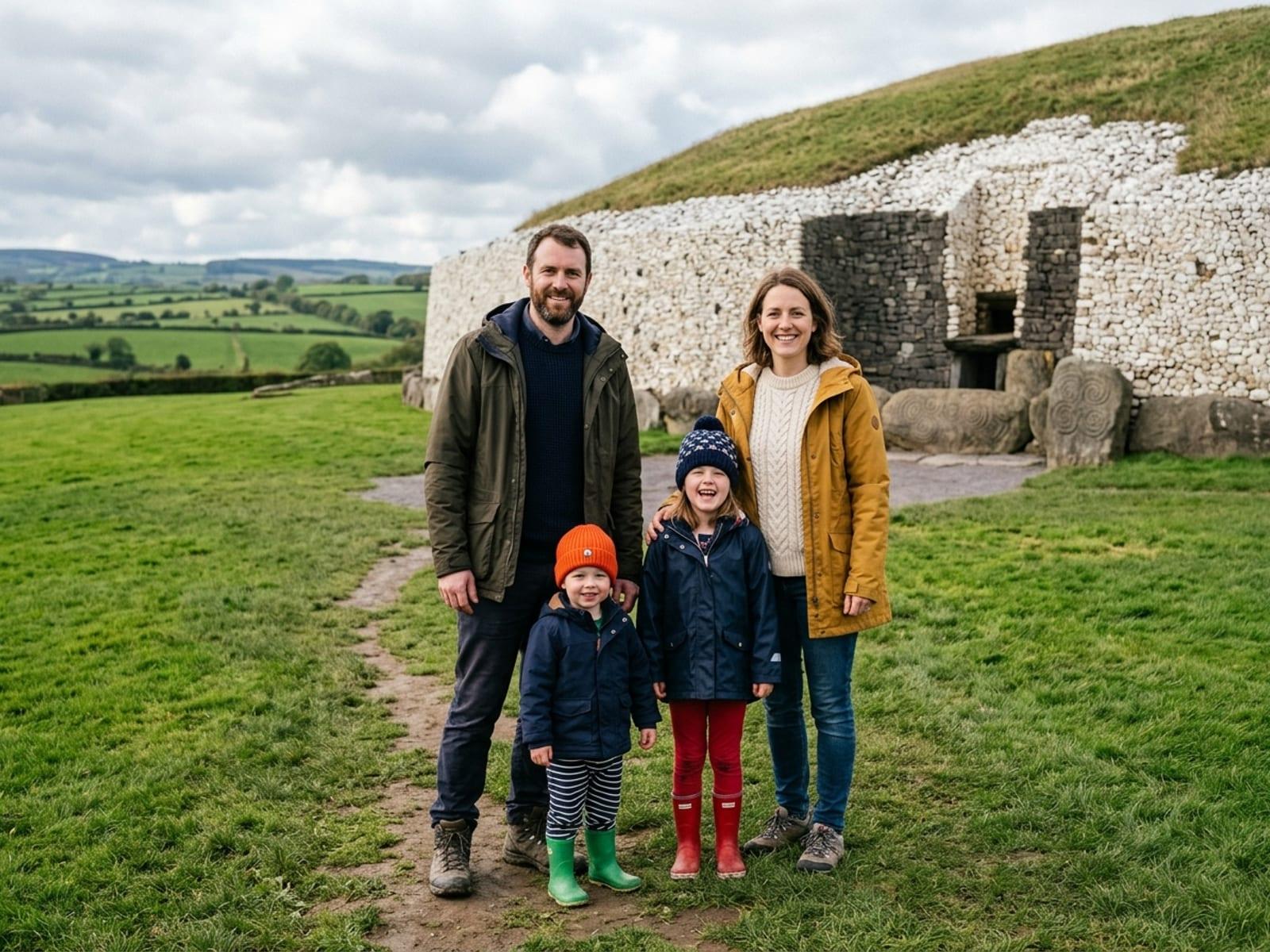
About 40 km north of Dublin, on a ridge above a great bend in the River Boyne, lies a huge round mound covered in grass. This is Newgrange, a stone tomb built around 3100 BC. It is older than the Great Pyramid of Giza and older than Stonehenge in its present form, and on the morning of the winter solstice the rising sun shines through a small opening above the entrance all the way into the chamber at the back. The surrounding area, Brú na Bóinne, became a UNESCO World Heritage Site in 1993. The only way inside is on a booked tour from the visitor centre at Donore, and every child and baby needs a ticket of their own.
The "palace of the Boyne," with at least 90 monuments
In Irish, Brú na Bóinne means "palace" or "mansion of the Boyne." In English it's sometimes called the Bend of the Boyne, but that isn't what the name means. Within the bend of the Boyne in County Meath are at least 90 monuments, including passage tombs (tombs reached by a passage), mounds, standing stones and enclosures. At their heart are three large passage tombs: Newgrange, Knowth and Dowth.
The mound at Newgrange is 85 metres across and about 12 metres high. From the entrance a 19-metre passage leads inside to a chamber roofed with corbelled stones. The great stone in front of the entrance is carved with a triple spiral, among the most famous examples of megalithic art anywhere. The white quartz wall across the front of the mound was reconstructed by Michael O'Kelly, who led excavations from 1962 to 1975, and how he rebuilt it is still debated.
Newgrange and Dowth are thought to have been aligned with the winter solstice sun, and Knowth with the sun at the spring and autumn equinoxes. There are about 40 passage tombs in the area, built between roughly 3300 and 2900 BC. In September 2023 the state bought the land around Dowth, with plans for it to form the core of a future national park.
On solstice mornings, light reaches the chamber for 17 minutes
Above the entrance to Newgrange is a small opening called the roof box. For about five days around the winter solstice, if the sky is clear, light from the rising sun passes through it, along the passage and onto the floor of the inner chamber, lighting the dark room for about 17 minutes. It shows that people more than 5,000 years ago knew precisely when the shortest day of the year fell.
On the mornings of 19 to 23 December, around the solstice, the visitor centre opens early and normal tours don't run. For a family trip, it's more reliable to avoid those dates and go inside on a regular tour.
The only way in is a tour from the visitor centre
Every visit starts at the Brú na Bóinne Visitor Centre in Donore, County Meath. If you drive straight to the monuments you can't get in. You check in at the centre, look around the exhibition, then take a shuttle bus to the monuments and go round with a guide.
Tours vary by season. According to the official site, from 1 March to 1 November the main tour goes into the chamber at Newgrange, and there are also tours of either Newgrange or Knowth (one each per day). From 2 November to the end of February, only the Newgrange tour runs. At Knowth you don't go inside the tomb.
Booking is essential. Tickets go on sale on the official booking site at midnight Irish time: 30 days ahead for dates from 1 April to 1 November, and 7 days ahead for dates from 2 November to 1 March. Numbers are very limited, so check as soon as your dates are set. Cancellations are released as they come in, so even if it's sold out, it's worth looking again around 8.30 to 9.30 am and 3 to 4 pm. Tickets from resale sites other than the official one are not valid, and there are warnings about fake sites made to look like the official one.
When we checked in October 2026, the visitor centre was open 9 am to 4.15 pm in January, February, October, November and December; 9.30 am to 4.45 pm in March and April; and 9 am to 5.45 pm from May to September. It's closed 24 to 27 December and on 1 January. Prices and hours can change, so check the latest on the official site.
Babies need tickets, and the passage is dark and tight
Every child, babies included, needs their own ticket, and under-18s can't visit without an adult. The passage and chamber at Newgrange are low and narrow, and the official site says they aren't suitable for anyone uncomfortable in tight spaces or with limited mobility. Some children find the dark, narrow passage frightening, so tell them beforehand: "It's dark and tight in there, but only for a short time." That helps them go in calmly.
Before you leave, try drawing the triple spiral from the entrance stone on paper together. When children stand in front of the real stone and can spot the pattern themselves, the marks left by hands 5,000 years ago feel much closer. Seeing the exhibition at the centre before the tour (an audio guide is available) gives everyone a sense of when and how the tombs were built, which makes the guide's talk at the site easier to follow.
The monuments are outdoors, with no shelter from rain or wind. Bring waterproof jackets and shoes that can handle mud. The centre has a cafe, a picnic area and toilets with baby-changing facilities. Access at the monuments is limited, and the official site asks wheelchair users and anyone needing assistance to contact the centre before booking. It doesn't mention strollers, so if that's a concern, ask in the same way. Photography isn't allowed inside the passage and chamber at Newgrange.
Since you can't take pictures inside, one option is to make a family photo in front of the mound beforehand with pokesta's AI photos ($1 per photo, your first one free).
An easy day trip from Dublin
The centre is on the south side of the Boyne, about 8 km west of the port town of Drogheda. The gateway is Dublin Airport (DUB), and at about 40 km north of Dublin it makes a comfortable day trip by car. If you're staying in Dublin, a slower next day at Phoenix Park and Dublin Zoo, with no tour slot to catch, lets the children run it off. For public transport, the official site gives directions by bus, by bike and on foot.
The Boyne Valley is in County Meath, the same county as Trim and Athboy, known for festivals rooted in Samhain, the ancient forerunner of Halloween. If you visit in autumn, you can trace both ancient tombs and ancient festivals in one trip. Entry requirements for Ireland depend on your nationality, so check your own government's official information before you travel.
References