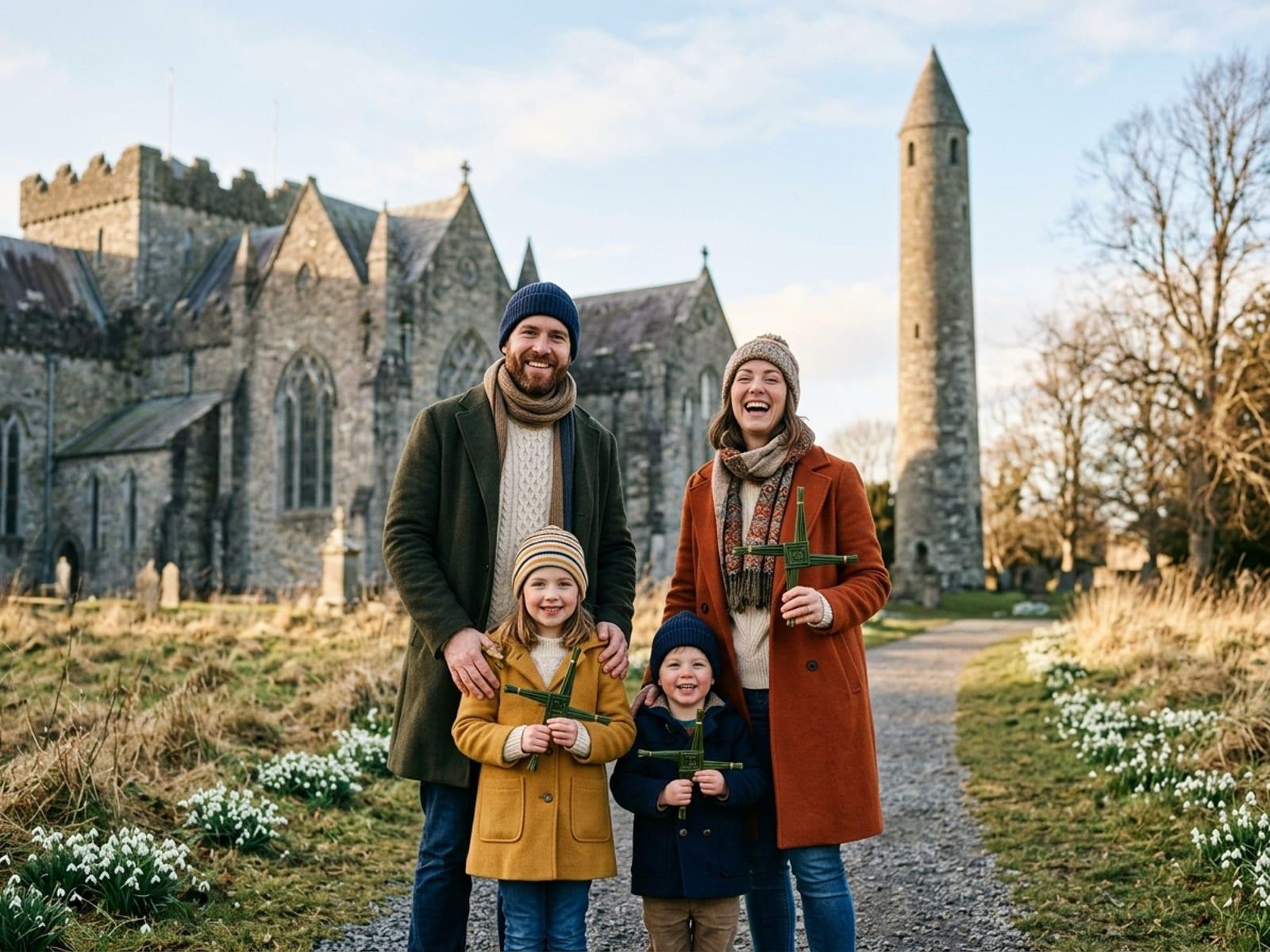
1 February is the feast of St Brigid, one of Ireland's patron saints. In the old calendar it marks Imbolc, the start of spring, and since 2023 it has also been a public holiday. Nowhere celebrates it more than Kildare, the town where Brigid is said to have founded her monastery. You can weave a cross from rushes, see the flame that burns in the town square and walk around a cathedral with a round tower beside it. Fast trains from Dublin take under 30 minutes, and with children it works best to dress warmly and build the day around the children's craft and music events and the cathedral grounds.
A saint and the first stirrings of spring
Brigid was a holy woman who lived around the 5th century, and in Ireland she has long been honoured alongside St Patrick. Tradition says she founded a large monastery in Kildare. A life of the saint written by Cogitosus in the late 7th century already records a feast being kept in Kildare on 1 February.
The date was also Imbolc, one of the four Gaelic seasonal festivals. It was tied to the time of year when ewes begin lambing and come into milk. A Christian saint's feast and an older spring festival have overlapped on this day ever since. Samhain, the festival of the four that opens winter, lives on in the fire ceremony of County Meath's Púca Festival.
From 2023 the day became a public holiday, officially "Imbolc/St Brigid's Day". The rule is a little unusual: the holiday falls on the first Monday in February, except in years when 1 February is a Friday, when that Friday is the day off. In 2027, 1 February is a Monday, so the feast day itself is the holiday.
Rush crosses and the flame in the square
The best-known custom of the day is the St Brigid's cross, woven from rushes. Four arms reach out from a small woven square in the centre, a little like a pinwheel. Once made, the cross was hung over the door, above a window or in the cow byre to protect the household from fire and illness. In some parts of the country, girls also carried a "Brídeóg", a doll made of rushes or cloth, from house to house.
You can weave a cross at home from rushes, straw or even twisted paper. Make one each as a family before you set off, and you'll have something to hold in your photos in Kildare and a souvenir to take home.
The other symbol is fire. Brigid's nuns are said to have kept a perpetual flame burning in a fire house in the cathedral grounds. That flame went out around the time of the Reformation. It was symbolically relit in 1993, and since 2006 it has burned permanently inside a sculpture in the town's Market Square, lit from the flame kept at Solas Bhríde, the sisters' centre on the edge of town.
In 2026, Kildare County Council ran "Brigid 2026 – Spirit of Kildare" at venues across the county from 29 January to 2 February. On 1 February, Kildare town hosted "Carrying Her Flame", an outdoor procession representing the turn from winter to spring, and the programme included music and craft events for small children. The festival's name and dates change from year to year, so check the organisers' announcements for the year you plan to go.
Cathedral, round tower and holy well
St Brigid's Cathedral in the centre of town is a stone church built in 1223 by Ralph de Bristol, Bishop of Kildare, and largely rebuilt in the late 19th century. It's said to stand on the site of Brigid's first church.
Next to it stands a 12th-century round tower, 33 metres tall and the second highest in Ireland. In summer you can climb to the top, though it's a hard climb for small children. Visits to the cathedral are said to require booking ahead, so get in touch early once your dates are set. During the winter festival, simply looking up at the tower from outside makes for a fine photo.
In Tully, south of the town centre, you'll find Solas Bhríde, the sisters' centre, and the old St Brigid's Well. A pilgrim walk to the well has traditionally taken place on the eve of the feast. The well is still a place of prayer, so keep your voice down when taking photos and avoid catching people at prayer in the frame. The tourist office and heritage centre in Market Square is a handy place to start, and a good way to learn how the town and the saint are connected before you set out. It's closed on Sundays, so drop in between Monday and Saturday.
What to wear in Kildare in February
February in Ireland is still winter. Rain and wind are common, so bring a wool coat, a waterproof outer layer, hats and gloves. Outdoor processions and the walk to the well can run from late afternoon into the evening, and it gets cold fast once the sun goes down.
There's no traditional dress for the day. A cream Aran sweater or a tweed coat, the kind of wintry Irish fabrics you'd expect, looks right against the stone of the cathedral and the still-bare trees. Hand your child the cross they wove that day and you have a photo that could only have been taken on St Brigid's Day.
Give pilgrimages and prayers some room
Some festival events, including ones for children, need to be booked in advance, and popular ones fill up quickly, so look over the programme as soon as it appears. Pilgrim walks and prayer gatherings are religious occasions. If your children are at the age where they run everywhere, it's calmer for everyone if you watch from a little way off.
On the edge of town are the Irish National Stud and its Japanese Gardens, where you can go and see the horses between festival events. It's a cold time of year, so build at least one indoor stop into the day to keep small children happy. For lunch, look out for boxty, the potato pancake that is traditionally eaten on this day too.
An easy day trip from Dublin
Kildare is about 50 km west of Dublin and has a station on the main Dublin–Cork railway line. The fastest trains get there in under 30 minutes, and the drive takes about an hour. The nearest international airport is Dublin Airport (DUB). Public transport timetables can change on festival days, so check before you set off. Entry requirements for Ireland depend on your nationality, so check your own government's official information.
Ireland's spring celebrations carry on into March with St Patrick's Day. If you'd like to see how a family photo in front of the cathedral, rush crosses in hand, might turn out, you can try it first with pokesta's AI photos ($1 per photo, and your first one is free).
References
- Wikipedia, "Saint Brigid's Day" https://en.wikipedia.org/wiki/Saint_Brigid%27s_Day
- Kildare County Council, "Ireland's Flagship Brigid Festival Returns to Kildare" https://kildarecoco.ie/News/Irelands,Flagship,Brigid,Festival,Returns,to,Kildare,.html
- Kildare Heritage, "St. Brigid's Sacred Sites & Stories" https://www.kildareheritage.com/places-in-kildare/st-brigids-sacred-sites
- Discover Ireland, "St Brigid's Cathedral & Round Tower" https://www.discoverireland.ie/kildare/st-brigid-s-cathedral-round-tower
- Wikipedia, "Kildare" https://en.wikipedia.org/wiki/Kildare