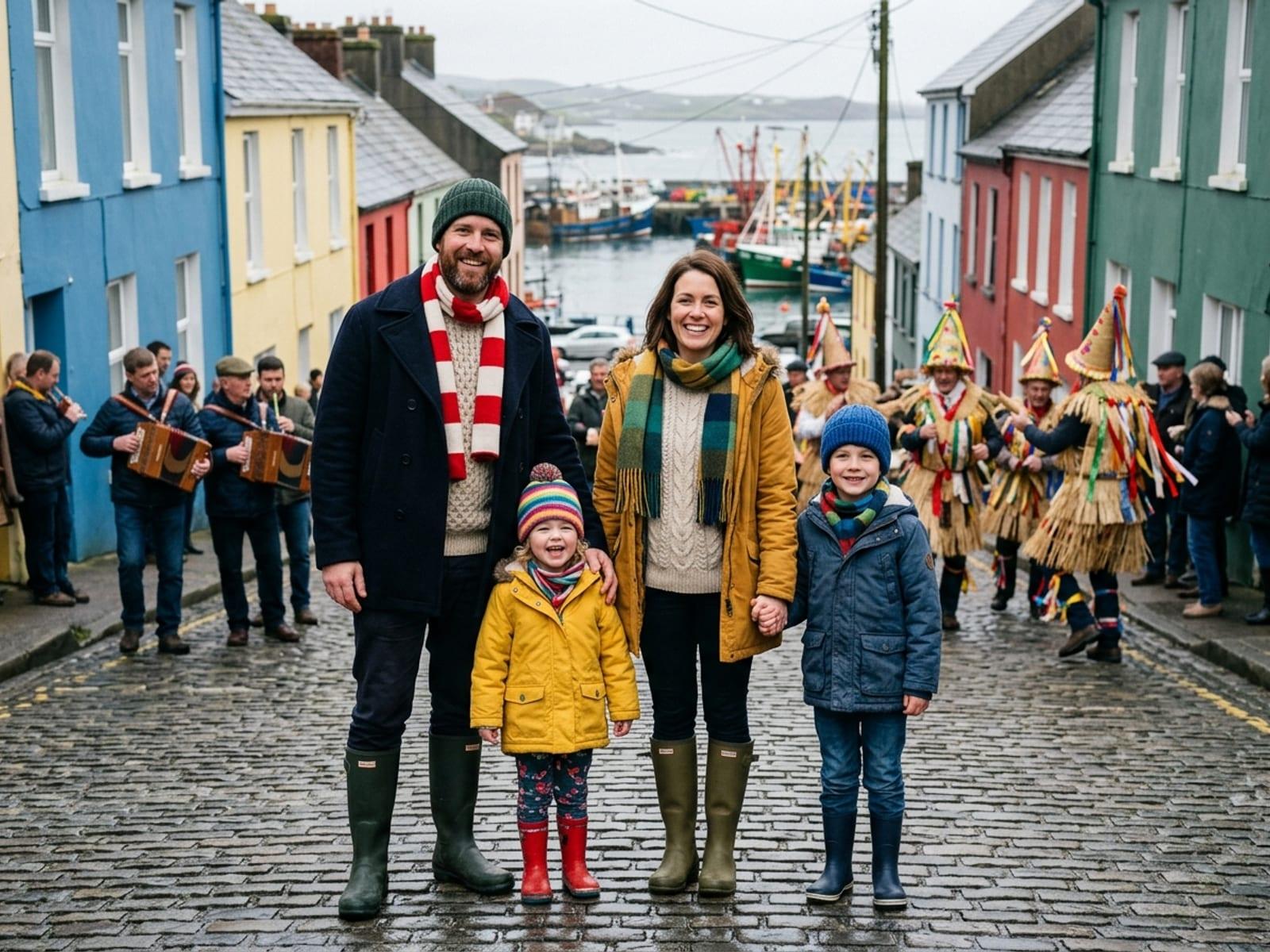
Wren's Day in Dingle falls on 26 December, St Stephen's Day, a public holiday in Ireland. In this harbour town in County Kerry, the Wren Boys take over the streets. Hidden behind straw suits and masks, four rival groups, each with its own band, colours and hobby horses, go around town from midday until midnight, playing in the pubs and collecting for local charities. According to a 2025 report, the young people head out first, starting their round at about 11 a.m. Wren Day, Lá an Dreoilín in Irish, was once kept all over the country and now survives in only a handful of places, but in Dingle the whole town still turns out for it. Watching costs nothing: you just stand at the side of the street, and with small children the early afternoon until dusk is the best window. In 2026, 26 December is a Saturday. Buses are cut back or stop altogether around Christmas, so plan to arrive and stay in Dingle the night before.
A winter custom built around a tiny bird
The wren is a very small bird, and in old Irish lore it was called the king of birds. On St Stephen's Day, men and boys used to catch one and carry it from house to house, either on a branch decorated with holly, ivy and ribbons or in a box on the end of a pole.
They were known as the Wren Boys. Wearing straw masks or brightly coloured clothes, they played drums, whistles and the melodeon, a kind of small accordion, and sang as they went, collecting money and food from each house. The money paid for a "Wren dance" that the whole village attended. Over the 20th century the custom died out in most places, but from the end of the century it was taken up again in many of them.
There are several stories explaining why a little bird should get such treatment. One says that when St Stephen was trying to escape from captivity, a wren sang and woke the guards. Another says that when Irish soldiers were lying in wait for an enemy, a wren made a noise and gave them away. The song the Wren Boys sang at each door went along the same lines: the wren, the king of all birds, was caught on St Stephen's Day, so please give us money to bury him. It asked for any small change at all and had a slightly tongue-in-cheek air.
Needless to say, nobody catches a real bird today. A model bird is used instead, and the money collected along the way goes to local charities and the like. Only a small share still goes to the wren's "funeral" or ball night as it once did; a 2025 report noted that the year before, €10,000 of the money raised went to the bus that takes people with cancer to hospital in Cork. No one knows for sure how the custom started, and some see links to pre-Christian festivals around the winter solstice. In Dingle, the Wren has been documented as far back as the 1860s.
Dingle's four Wrens
Dingle has a group called a "Wren" (locals say "Wran") for each of its four districts. The John Street group (Sráid Eoin) wears blue and white, Goat Street red and white, the Quay green and white, and the Bridge Street group, known as the "Green and Gold", green and gold. Which colours each group uses is fixed by long tradition, and for townspeople it's a matter of local pride.
Each Wren has its own band, and together with the straw costumes and a hobby horse, a model horse worn by one of the performers, they go around town from midday until midnight. The straw costumes are prepared weeks in advance. There's a long-standing rivalry between the groups, and some say that's what has kept the tradition so strong. A 2015 news report by the national broadcaster RTÉ showed the Green and Gold band marching through town playing "Take Her Away Down to the Quay".
A piece on TheJournal.ie, published on 26 December 2025, gives a good picture of how the day runs. It quotes Aoife Granville, who lectures in folklore at University College Cork and goes out with the John Street (Sráid Eoin) Wren. The young people go out first, around 11 a.m. In the old days the groups went from house to house, with a few rounds of music and dancing in each one; now the masked musicians go from pub to pub, playing and collecting as they go. Granville and her father have been visiting schools to teach children how to make the straw hats. The John Street Wren's motto, she says, is "We never died a winter yet."
There are no rules for spectators. Stand at the side of the street and wait for the different-coloured groups to come by one after another. Every group collects donations as it goes, so have some coins ready and let your child drop them in the box. It brings them a little closer to the parade. When someone in a straw costume comes right up close, small children can get a fright and burst into tears. At first, hold them in your arms and let them watch from a few steps back.
A winter day in a harbour town
Dingle is the only town on the Dingle Peninsula, with about 1,700 people. It's in the Gaeltacht, an area where Irish is spoken, and its official Irish name is Daingean Uí Chúis, though people usually just say An Daingean. It has been a fishing port since around 1830, and still has a large fishing harbour.
From 1983 to 2020 the town was also known for Fungie, a dolphin who lived in the bay and played with people. There's an aquarium in town with tropical fish and sea creatures from local waters, a good place to spend a rainy winter day with children. The parade goes on until midnight, but with small kids the bright hours from early afternoon to early evening are the best time to watch. It's only a few days after the winter solstice, so it starts getting dark soon after 4 pm.
St Stephen's Day is also a day for enjoying the Christmas leftovers. Spiced beef, sold by the butchers at Cork's English Market, is one of the dishes often eaten on this day. If you see it at your guesthouse or in a restaurant, have a taste with the kids.
What to wear on the Atlantic coast in winter
Late December in Dingle brings plenty of rain and strong wind, and it feels colder than the thermometer suggests. Pack a waterproof jacket, a thick jumper, a hat and gloves, and shoes that grip on wet paving. It gets much colder towards evening, so a spare pair of gloves for small children is a good idea.
Spectators don't dress up for Wren Day. You could pick a group to cheer for, though, and have the family wear scarves or hats in its colours. A splash of green and gold, or red and white, stands out well against a grey winter sky and the harbour.
Get to Dingle the day before
Wren Day is on 26 December every year. The nearest international airport is Kerry Airport (KIR) in Farranfore, County Kerry. Dingle is about 50 km south-west of Tralee and about 71 km from Killarney. Trains run as far as Tralee, but from there you'll need a car or a bus. Public transport can be heavily cut back or suspended between Christmas Day and St Stephen's Day, so the safe options are hiring a car or arriving in town and staying the night before. Some guesthouses close over Christmas, so start looking early. If you're in County Kerry in summer instead, Puck Fair in Killorglin, where a goat is crowned king from 10 to 12 August, fills the streets with a parade of its own.
Entry requirements for Ireland depend on your nationality, so check your own government's official information. You'll also find family photos from Christmas in Ireland among the community posts. To get a feel for a family photo on a harbour-town street beside the straw-clad parade, you can try it first with pokesta's AI photos ($1 per photo, your first one free).
References