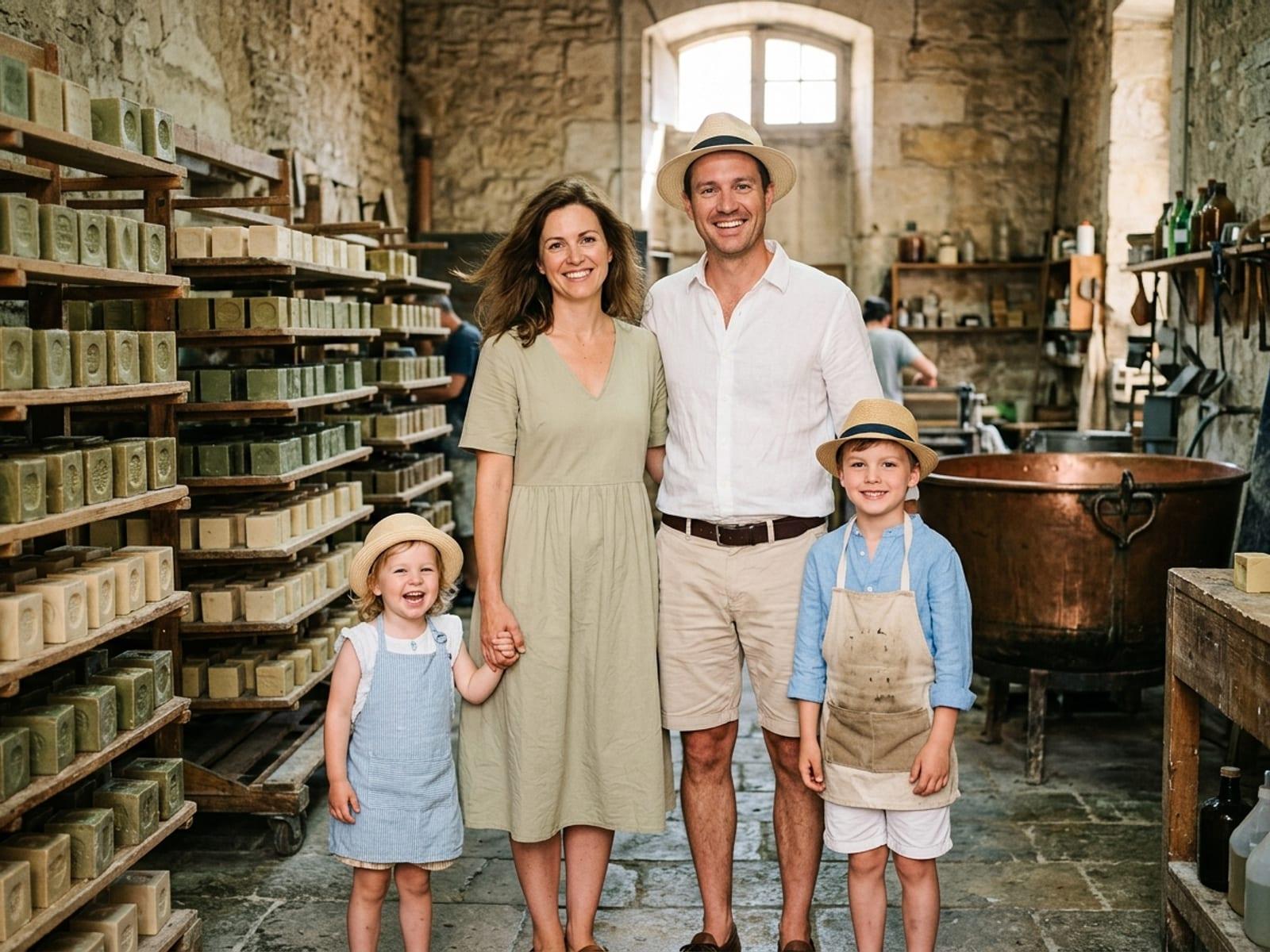
The port city of Marseille in the south of France has been known for its soap for centuries. Oil is cooked in a great cauldron, poured into a mold to set, cut into cubes and stamped. A few workshops in and around Marseille still make soap this old-fashioned way. If you're taking home one specialty from Marseille, soap is the place to start. With children, pair a free workshop tour with a chance to stamp a bar yourself, and a simple souvenir becomes something they saw being made.
A 1688 royal edict: "olive oil only"
The first soap maker in Marseille whose name appears in the records dates from 1370. In 1593 the city's first soap factory opened, and by the mid-17th century seven factories in Marseille were turning out about 20,000 tonnes a year.
The turning point came on October 5, 1688, with a royal edict issued under Louis XIV. To protect the quality of Marseille soap, it allowed only "pure olive oil, without any mixture of fat," and banned animal fats. The number of factories kept growing, to 49 in 1786 and 62 in 1813. Production peaked at 180,000 tonnes a year in 1913, but after the Second World War synthetic detergents took over and most of the factories closed.
Cooked in a cauldron, cut and stamped
In the traditional Marseille process, oil and soda are heated and mixed in a big cauldron and cooked. The soap is then washed with strong brine to remove impurities, left to rest and washed again, poured into a mold to dry, cut into cubes and finally stamped. Classic Marseille soap came as a large cube of around 600 grams stamped with "72%," the share of oil it contained.
The color tells you something too. Soap made with olive oil ranges from brown to green, while white soap is made from oils such as palm or coconut (copra). Neither one is the "real" one; they're simply made from different oils. If a shop has green and white cubes side by side, let the kids smell each, and they'll notice the difference in the oils with their noses.
The name isn't protected, so look at who made it
Surprisingly, "savon de Marseille" is not a protected designation of origin, the kind of legal label that ties a name to a place and a method. A French industry standard sets rules such as a minimum of 63 percent fatty acids, but soap doesn't have to be made in Marseille to use the name, and the biggest producers are said to be China and Turkey.
Makers who stick to the traditional process have formed the Union des Professionnels du Savon de Marseille (UPSM). Its members include Le Sérail, the Savonnerie du Midi and Fer à Cheval in Marseille, and Marius Fabre in nearby Salon-de-Provence. If you're buying from a souvenir shop in a tourist area, check whether one of these makers' names is on the box or the soap. At a workshop, you can buy directly from the people who make it.
The makers vary in size. Annual output is put at about 3,000 tonnes for Fer à Cheval, about 1,000 tonnes for Marius Fabre and about 900 tonnes for the Savonnerie du Midi. Salon-de-Provence is also home to Rampal Latour, founded in 1828, which isn't in the UPSM and makes its soap with its own patented process. Even under the same name, each workshop sees things a little differently.
Workshop tours you can do with kids
In Marseille itself, the Savonnerie du Midi in the 15th arrondissement opens its workshop and soap museum to visitors. According to the Marseille tourist office, individual tours run twice on weekdays, at 11 am and 2 pm, with a 3:30 pm tour added during school holidays. Tours are free but must be booked by email or phone. The workshop is closed on weekends, and tours in English can be requested. Its soap is made only from vegetable oils, with no added fragrance, coloring or preservatives. It also holds the Entreprise du Patrimoine Vivant (Living Heritage Company) label, which the French state awards to firms with outstanding craft skills. There's a treasure hunt for families, and children get a coloring sheet and a bar of soap at the end (while supplies last). There's a lift, and the tour is wheelchair accessible with assistance.
If you're willing to travel a bit further, head northwest of Marseille to Marius Fabre in Salon-de-Provence. Four generations have made soap in the town since 1900, and the workshop has a museum of about 600 square meters. On display are hand-carved boxwood stamps, old tools and soap molds, and the stencils used to mark the wooden shipping crates. Entry is free for individuals. Outside peak season, guided tours run at 10:30 am on Tuesdays and Thursdays and 2:30 pm on Wednesdays and Saturdays, with more during school holidays and summer. It's closed on Sundays and most public holidays, and the tour isn't wheelchair accessible.
Marius Fabre also runs a workshop, "J'estampille mon savon," where you stamp your own bar. Prices, booking and the minimum age for children change with the season, so contact the workshop before you go.
What to wear, and getting it home
You don't need special clothes for a workshop tour. Linen shirts that suit the bright Provençal sun, or a dress in a pale olive-leaf green, will tie your photos together in front of the shelves of soap. You can see what the family might look like standing in a soap workshop with pokesta's AI-generated photos ($1 per photo, with your first one free).
The big cubes are heavy, and a few 600-gram bars will quickly weigh down a suitcase. Smaller bars, one for each person in the family, plus a single big one for home, is an easy amount to carry back. For one more Provençal gift, there's Montélimar nougat, made with honey and almonds in a town on the Rhône. It softens in the heat, so individually wrapped pieces travel best.
Settle on the day of your visit first
You can tour workshops all year, but some open only on weekdays and some change their hours between summer and the rest of the year, so settle on the day first and plan around it. The gateway is Marseille Provence Airport (MRS), which connects to both Marseille and Salon-de-Provence. To reach the Savonnerie du Midi, take bus 30 from the city and get off at "Cité des Arts de la Rue," then walk about 8 minutes. Continue east along the coast to Nice, where the old town serves socca, a chickpea flatbread baked in big copper pans. Entry requirements for France depend on your nationality, so check your own government's official information.
If you're visiting Provence in summer, you can combine this with the lavender fields of Valensole. Souvenir shops there are full of lavender-scented soap; set one next to an unscented bar from the workshop, and the kids can tell them apart by nose.
References