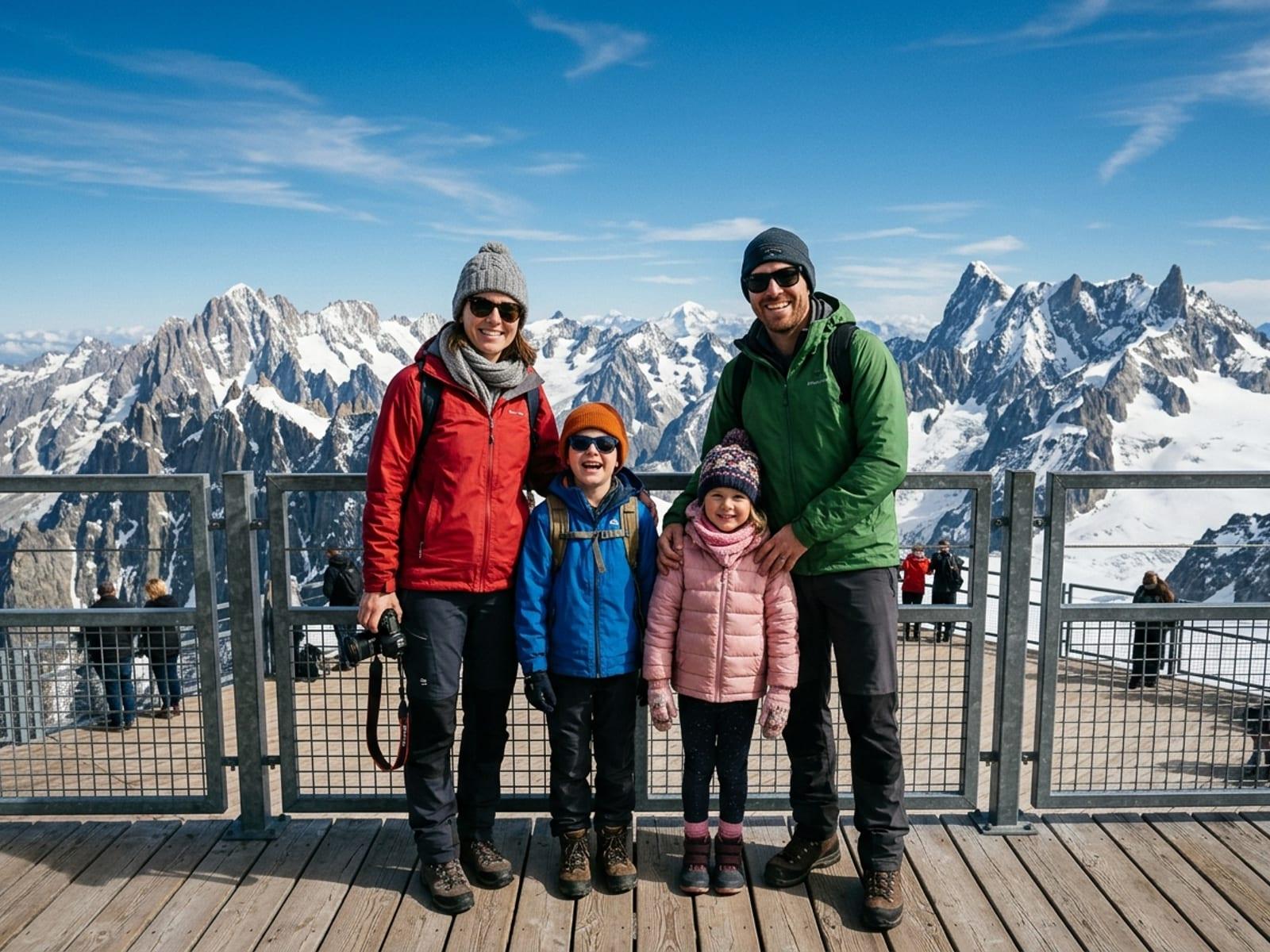
From Chamonix, the town at the foot of Mont Blanc, the highest mountain in Western Europe, cable cars and a mountain railway carry you straight up into a world of snow and ice. The Aiguille du Midi viewpoint, at 3,842 meters, is about 20 minutes away by cable car. Montenvers, overlooking the Mer de Glace ("sea of ice") glacier, is 20 minutes by red rack railway. Children under 3 aren't allowed on the Aiguille du Midi, though, and it isn't recommended for under-5s. That's the fork in the road for families: with small children, go to Montenvers; once they're over 5 and can handle the cold, the Aiguille du Midi.
1924: the town of the first Winter Olympics
Chamonix lies in an Alpine valley in southeastern France, close to the borders with Switzerland and Italy. The town center sits at about 1,035 meters, and in 1924 it hosted the first Winter Olympics. It's still a base for hiking in summer and skiing in winter, drawing visitors all year round. On a clear day, even from the town's streets, you can see the white summit of Mont Blanc and a row of granite spires stabbing at the sky.
Aiguille du Midi: wait until they're over 5
The cable car up the Aiguille du Midi opened in 1955. For about 20 years it was the highest cable car in the world, and the vertical rise from the town at 1,035 meters to 3,842 meters is still said to be the biggest anywhere. You change at the midway station, Plan de l'Aiguille (2,317 meters), and the second section climbs without a single pylon all the way to the station on top of the rock. Inside the summit building there's an elevator, and from the viewing terraces Mont Blanc and its glaciers spread out right in front of you. In 2013 "Step into the Void" was added, a glass room jutting out over more than 1,000 meters of empty air. Above 3,700 meters there's another attraction called "The Pipe." Don't push a child who's scared of the glass floor; the view from the terraces is plenty to convey the sheer size of the mountains.
The operator says children under 3 can't ride and that it isn't recommended for under-5s. Air pressure and temperature change abruptly at this altitude, so with young children it's best not to push your luck. It's also not recommended on bitterly cold days or for people with heart conditions, and older visitors are advised to consult a doctor beforehand.
Allow about two to three hours for the visit, including travel, and up to roughly twice that in busy periods. The cable car requires a reservation, and you're given a boarding number. Going first thing in the morning is recommended, and extra tickets are sometimes released online the day before, so check early once your plans are set. As of October 2026, a return ticket to the summit costs 60.20 to 83 euros (varying by day and season), or 43 euros to the midway station.
Montenvers: a red train from age 1
With small children, start with Montenvers. This rack railway, completed in 1909, climbs about 5 km from Chamonix to Montenvers station at 1,913 meters in around 20 minutes. Watching the little red train crawl up gradients of up to 22% is a treat for kids in itself. According to the operator, children can ride from age 1.
From in front of the station, you look down on the Mer de Glace, a gray and white river of ice filling the valley. At the station there's a mountain hotel with about 20 rooms, a restaurant, and the Glaciorium, an exhibition about glacier research and the changing climate. From there, a small 10-person gondola takes you further down to the Ice Cave at 1,760 meters, carved into the glacier itself. Walking along a passage walled in ice, children really get that a glacier is one great mass of ice. It's 170 steps down from the gondola station to the cave, and the same back up, so decide based on your kids' stamina. The cave and gondola close for a period in autumn: for 2026, the closure is announced from September 28 to October 16. The Ice Cave stays shut until November 1, and the railway doesn't run from November 2 to December 4. If you're visiting in late autumn, be sure to check that your date doesn't fall in a closure. An adult ticket covering the return train, gondola, Ice Cave and Glaciorium costs 49.70 euros (as of October 2026).
Go up in winter clothes, even in summer
On the outdoor terraces of the Aiguille du Midi, the temperature can drop to minus 10°C even in summer. The operator advises bringing warm clothes, sunglasses and sunscreen in every season. For children, pack a hat, gloves and a jacket that covers the neck. The sun gets stronger the higher you go and bounces off the snow, so bring sunglasses for the kids too. Montenvers is also colder than the town, so an extra layer is a good idea. Note that animals aren't allowed on the Aiguille du Midi, except assistance dogs.
In bad weather the summit can be inside the clouds with nothing to see. Check the morning weather and operating status on the operator's "live info" page before you set out. Snow or wind can shut things down, so building a spare day into your itinerary lowers the risk of going home without seeing the view.
You can see how your family might look lined up on a sunny viewing terrace with Mont Blanc behind you with pokesta's AI-generated photos ($1 per photo, and the first one is free).
The nearest airport is across the border in Geneva
The cable car and the railway both run for much of the year, but summer is when the gondola from the Aiguille du Midi across the border to Pointe Helbronner on the Italian side also operates, so it's the season with the widest mountain views. Operating periods vary by year and by facility, so check the official websites.
Chamonix is in the same region as Lyon, Auvergne-Rhône-Alpes. If you stop in Lyon before or after the mountains, you can fit in a meal at one of the city's bouchons, with their red-and-white checked tablecloths and Lyonnaise home cooking. On a trip between mid-June and mid-July, heading south also lets you catch the short purple season of the lavender fields on the Valensole Plateau.
The nearest major international airport is Geneva Airport (GVA), across the border in Switzerland. By rail, take the line from Saint-Gervais through Chamonix to Vallorcine. It's a narrow-gauge mountain line that opened in 1901 and reached Vallorcine in 1908, and from Vallorcine the Mont-Blanc Express continues to Martigny in Switzerland. Entry requirements, including if you enter via Switzerland, depend on your nationality, so confirm them through your own government's official information before you travel.
References