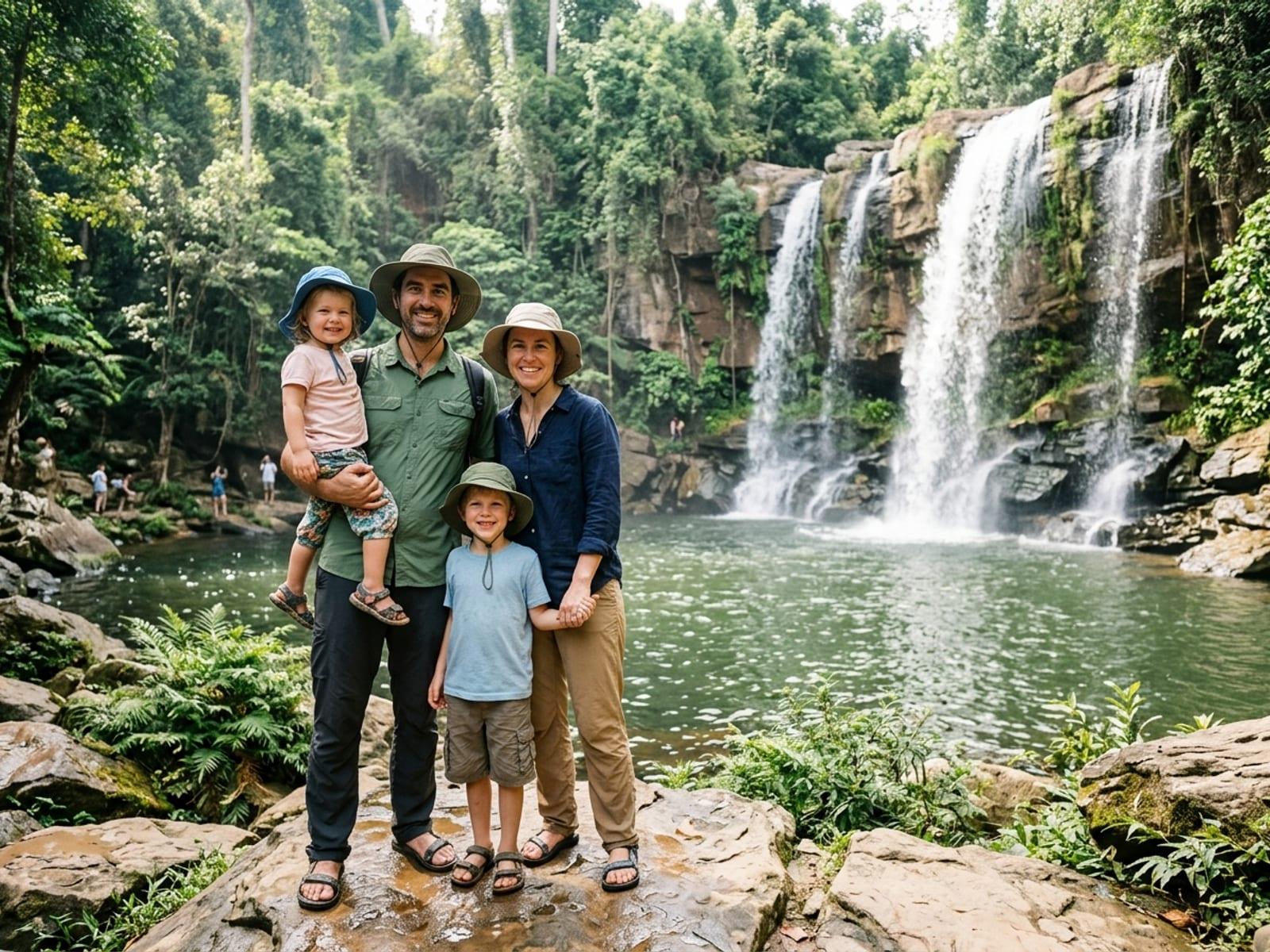
Phnom Kulen is the sacred mountain about 48 km north of Siem Reap where the Khmer empire is said to have begun in 802. Kids can splash around at its two-tiered waterfall in the forest, a temple at the top houses what is said to be the country's largest reclining Buddha, and at Kbal Spean on the western slopes carvings line the bed of a stream. For a family, the easiest plan is a day trip by car between November and January, when the falls are full and the carvings visible, leaving early and stopping at Banteay Srei on the way.
After a few days of touring Angkor, children start to tire of stone temples. A mountain where you can take in both nature and faith in a single day makes a welcome change.
802: the mountain where an empire began
Phnom Kulen is a range of sandstone hills and plateau, about 500 meters above sea level at its highest, with a summit plateau averaging around 400 meters. In the Angkor era it was called Mahendraparvata. In 802, Jayavarman II declared independence from Java on this mountain and had himself proclaimed chakravartin, "king of kings," which is regarded as the beginning of the Khmer empire. The mountain's sandstone was also quarried for building the temples of Angkor. Later, Udayadityavarman II also made it his capital and built many temples here. Tell your children that the stones they touched in the galleries of Angkor Wat may well have come from this very mountain, and the temples and the mountain start to feel like one connected story.
It remains a sacred mountain, visited by Hindu and Buddhist pilgrims. The area became a national park in 1993, covering about 374 square kilometers, and in 2020 it was added to Cambodia's tentative list for World Heritage status.
Two-tiered falls in the forest
The biggest draw for families is the pair of waterfalls on the river that crosses the plateau. The upper fall is 4 to 5 meters high and 20 to 25 meters wide, with water sliding over flat rocks. The lower fall is 15 to 20 meters high and 10 to 15 meters wide. The size of the falls depends on the season and the rain; the end of the rainy season into the start of the dry season strikes the best balance between water volume and easy walking.
If your kids will be in the water, the most important thing is never to take your eyes off them. The plunge pool below the lower fall is deep, and the rocks are wet and slippery. Keep paddling to the shallows around the upper fall, and bring floats or a life jacket for small children for peace of mind. Sports sandals that stay on and grip well are the best footwear. Don't forget a change of clothes, towels and a bag for wet things.
A reclining Buddha, and a thousand lingas in the riverbed
On the plateau stands Preah Ang Thom, a Buddhist temple built in the 16th century, which enshrines a large reclining Buddha said to be the biggest in the country. It's an important place of pilgrimage for Cambodians, so visit in clothes that cover shoulders and knees, and take off shoes and hats before going up into the shrine. It helps to tell children beforehand that this is a place where people come to pray.
The other highlight is Kbal Spean, on the southwestern slopes of the Kulen hills. You drive there from Banteay Srei temple, then walk about 2 km uphill through the forest from the car park, roughly 40 minutes, to reach the first waterfall. From there, carvings continue for about 150 meters along the riverbed and the rocks on the banks. The best known are the small lingas, stone forms representing Shiva, carved in rows into the riverbed, which give the site its other name, the "River of a Thousand Lingas." There are also carvings of Vishnu reclining with Lakshmi, Brahma on a lotus, Shiva and Uma riding a bull, the monkey god Hanuman, and animals such as cattle and frogs.
Kbal Spean was discovered in 1969 by the ethnologist Jean Boulbet, but research was halted by the civil war, and it only became safe to visit in 1989. The carvings are easiest to see when the rainy season has ended and the water has started to drop. To see the carvings under the water, lift your children up so they can peer down from above. The uphill path is a mountain trail with tree roots and stone steps, so strollers are out; carry small children in a baby carrier. Even with kids old enough to walk on their own, plan for the climb up and back down and build in plenty of rest stops.
Red sandstone Banteay Srei, on the way there or back
On the road to Kbal Spean is Banteay Srei, a temple consecrated on 22 April 967. It was built by courtiers who served King Rajendravarman II, and it's considered the only one of Angkor's major temples not built by a king. The name is usually translated as "citadel of women."
It's built from a hard red sandstone well suited to fine carving, and the buildings are small in scale. For children worn out by the steep stairs of the big temples, it's just the right size, with carvings at eye level. Its pediments carry entire scenes from mythology, the first time this was done in Khmer architecture. It lies about 25 km northeast of central Angkor, so it fits neatly into the morning or the return trip on your mountain day.
Entry fees and getting around
Phnom Kulen National Park isn't managed by the APSARA Authority, which runs the Angkor temples, and it charges its own entry fee separate from the Angkor Pass. According to a 2018 notice from a local ecotourism organization, the entry fee for foreign visitors was 20 dollars, available from an office along National Road 6 or through hotels and tour companies. Prices and how to buy tickets can change, so check the latest details with your hotel or tour company. The road climbs the mountain, so leave plenty of time and plan the day with your driver.
There are few places to buy food or drinks on the mountain, so bring plenty of water and snacks. Pick up a num pang, Cambodia's baguette sandwich, in town in the morning and it'll do for lunch on the mountain; eat it early, as fillings spoil quickly in the heat. Setting off early means you can walk to the falls and trails before the heat builds.
Go after the rains, from November to January
The falls are fullest and the Kbal Spean carvings easiest to see from about November to January, after the rains end. The size of the falls depends on rainfall, and by the end of the dry season the flow can dwindle to a trickle. Siem Reap town is about 48 km away and the last stretch climbs a mountain road, so allow extra travel time and breaks for the children. Combining the trip with Banteay Srei along the way makes for an easy day's itinerary. The gateway airport is Siem Reap–Angkor International Airport (SAI); entry rules vary by nationality, so check your own government's official information before you go. For the temples, see Angkor Wat with kids: dress code and pacing, and for life on the lake, Kampong Phluk, the stilt village on Tonle Sap.
To see the family beside a forest waterfall before you go, try pokesta's AI photos ($1 per photo).
References